
When you think about investing, it can seem overwhelming at first. However, understanding the core elements of investment is the first step toward making informed and confident financial decisions. Investment allocates money into assets like stocks, bonds, or real estate to generate long-term returns.
However, you must understand the key elements that shape successful investment strategies to maximize your investments.
In this blog, we'll dive into what investment is and break down the top elements of investment that every investor should know. You’ll learn about the different types of investments, how to assess their cost and tax efficiency, and the steps involved in the investment process.
Whether you’re a beginner or looking to refine your strategy, this guide will cover everything you need to get started and grow your wealth!
What Exactly is Investment?
Investment is the process of using your money to purchase assets or financial products, expecting their value to grow over time and generate returns. It involves taking on some level of risk to achieve financial gains in the future.
Having defined investment, the next step is to look at the key elements of investment driving its effectiveness and growth potential.
Key Elements of Investment

Investing your money wisely can lead to significant wealth growth, but it’s important to understand the key elements that shape your investment decisions.
Each of these elements plays a crucial role in determining your success as an investor. Here’s a clearer explanation to help you understand better.
Risk
Risk is the possibility that your investment will lose value or not perform as expected. Several types of risks can affect your investments:
Market Risk: This is the risk of your investment losing value due to overall market fluctuations. For example, during a market crash.
Credit Risk: This applies to bonds. It’s the risk that the company or government issuing the bond may default on its payment. For example, if a company faces financial issues, it may be unable to pay interest on its bonds.
Inflation Risk: Inflation reduces the purchasing power of your returns. For instance, if you earn a 6% return on your investment but inflation is 7%, your real return is negative. This means that your money’s value isn’t growing as much as the rising cost of goods.
Return
Return is the money you earn from your investment. It’s typically shown as a percentage of your initial investment and can come from two main sources:
Capital Gains: These are profits made when you sell an asset for more than you paid. For example, if you buy a stock for ₹500 and sell it for ₹700, your capital gain is ₹200 per share.
Dividends: These are periodic payments from companies to their shareholders. If you own shares in a company that pays a ₹5 dividend per share every year, you’ll receive that ₹5 for every share you own.
Time Horizon
Your time horizon refers to how long you plan to keep your money invested before accessing it. The time you choose to invest will influence the kind of investment strategies you use:
Short-Term: If you need your money within 1-3 years (like saving for a holiday or a wedding), you’ll want to focus on safe, low-risk investments such as fixed deposits, short-term bonds, or a high-interest savings account.
Long-Term: If you’re investing for 5 years or more (like saving for retirement or your children’s education), you can afford to take on more risk with investments like stocks, equity mutual funds, or real estate.
Diversification
Diversification means spreading your investments across various assets (stocks, bonds, real estate, etc.) or sectors to reduce risk. It ensures that a downturn in one area doesn’t wipe out your entire portfolio.
For instance, instead of investing only in the technology sector, you could diversify by investing in healthcare, finance, and energy. If the tech industry faces a downturn, the other sectors might perform better and balance out the losses.
Liquidity
Liquidity refers to how easily you can convert your investment into cash without affecting its price. Some investments are more liquid than others:
Stocks: Generally very liquid because you can sell them anytime on the stock exchange.
Real Estate: Less liquid. Selling property takes time, and you may have to pay hefty transaction costs.
If you need quick access to cash, you prefer liquid investments like stocks or mutual funds over something less liquid like property.
Compounding
Compounding is the process of earning returns on your initial investment and the returns you’ve already earned. This “snowball” effect helps your money grow faster over time.
For example, if you invest ₹10,000 at an annual interest rate of 5%, after one year, you’ll have ₹10,500. In the second year, the interest will be calculated at ₹10,500, so you’ll earn ₹525, bringing your total to ₹11,025. The more time you give your money to grow, the more powerful compounding becomes.
Costs, Fees, and Taxes
The costs of investing can significantly affect your overall returns. Here are the main types of costs and how taxes play a role in your investment strategy:
Management Fees: If you invest in mutual funds or hire a financial advisor, you may need to pay management fees. For example, if a fund charges a 1% annual fee and you earn a return of 6%, your net return would only be 5%.
Transaction Costs: Buying and selling investments can come with fees, such as brokerage charges, which reduce the money you make from your investments.
Taxes: In India, the profits you make from selling investments (capital gains) are subject to tax. The tax rates for capital gains as of July 23, 2024, are as follows:
Short-Term Capital Gains (STCG): Taxed at 20% for equity investments sold within 12 months.
Long-Term Capital Gains (LTCG): Taxed at 12.5% with a ₹1.25 lakh exemption limit per year. For listed securities, LTCG applies if held for over 12 months; for real estate, the holding period is over 24 months.
Now that you’ve got a solid foundation of investment essentials let’s explore the different types of investments you can consider.
Types of Investments
Investing gives you many options, each with its risks and rewards. Knowing the different types of investments is important so you can make smart choices based on your goals, how much risk you’re willing to take, and how long you plan to invest.
Below is a table that breaks down the most common types of investments you can consider:
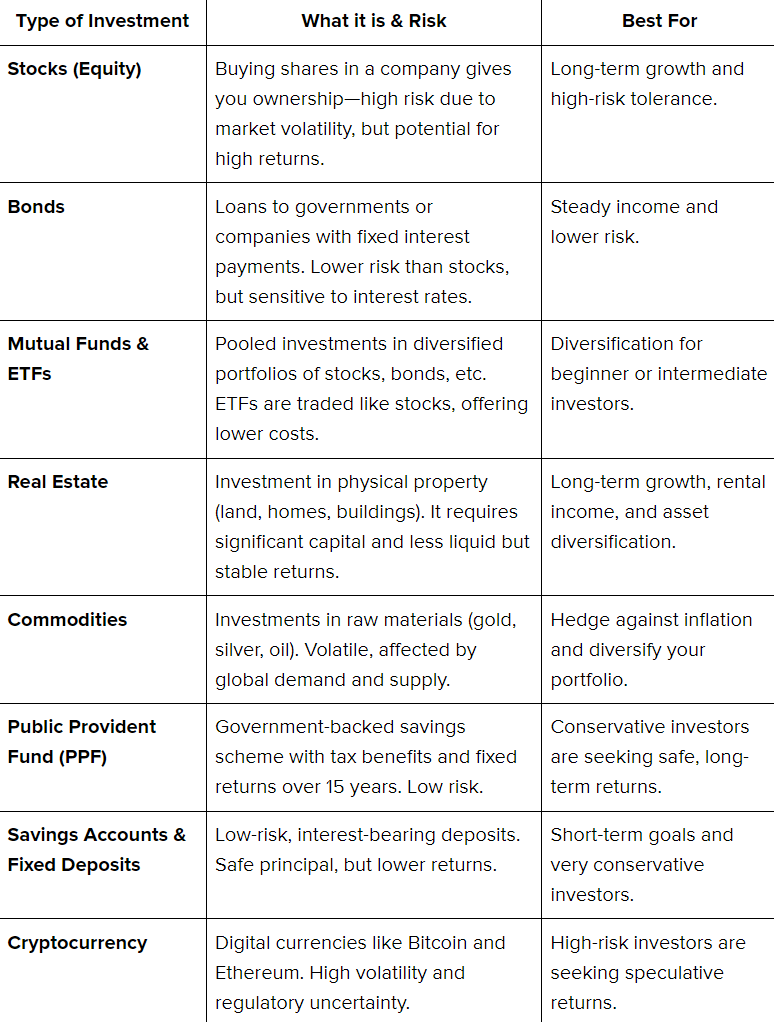
Now that you’re familiar with the different investment options, let’s look at the steps you’ll need to follow to navigate your investment journey successfully.
Steps Involved in the Investment Process
Investing can feel overwhelming, but breaking it down into simple steps can make it easier. Here are clear steps to help you understand the process:
Set Clear Goals: Identify what you're saving for, whether it’s a house, education, or retirement. Your goals will shape your investment strategy and timeline.
Understand Your Risk Tolerance: Know how much risk you’re comfortable with. If you prefer stability, consider safer options like bonds. If you can handle fluctuations, understanding your risk tolerance can help you choose investment options that align with your financial goals. Some assets, like bonds, tend to be more stable, while others, like stocks, may experience more price fluctuations.
Research Your Options: Explore investment avenues like stocks, mutual funds, and real estate. Each has risks and rewards, so pick the ones that align with your goals.
Create a Plan: Decide how much you’ll invest and which assets to focus on. A clear plan keeps you on track and focused on your goals.
Diversify: Don’t put all your money in one place. Spread it across assets like stocks, bonds, and real estate to reduce risk.
Monitor Your Investments: Regularly check how your investments are performing. Adjust your portfolio if necessary to stay aligned with your goals.
Be Flexible: Life changes, and so do markets. Be ready to adjust your strategy as needed, especially as you get closer to your financial goals.
Conclusion
Investing can help you achieve your financial goals, but it’s important to recognize that risks are part of the process. As you’ve learned in this blog, the elements of investment, such as risk, return, diversification, and liquidity, play a critical role in shaping your strategy. Understanding these key factors allows you to make smarter decisions that align with your financial objectives.
Precize offers access to private equity and credit opportunities if you want to explore & diversify beyond conventional options.
Private Equity: Invest in growing private companies and access unlisted or pre-IPO shares.
Private Credit: Explore global trade finance opportunities and diversify with alternative fixed-income assets.
Login to Precize today and reserve your access and explore diverse investment options beyond traditional asset classes, tailored to align with your financial goals