NSE FY26 Results: Regulatory Headwinds Meet Strategic Asset Monetization
NSE FY26 results (audited consolidated accounts for the year ended 31 March 2026) show softer operating revenue, higher expenses driven partly by regulatory provisions, and net profit down about 20% year on year. At the same time, one-off gains from monetizing non-core assets, especially a stake sale in NSDL, partly offset the hit to reported profitability.
NSE FY26 Results vs FY25: Headline Snapshot (Consolidated)
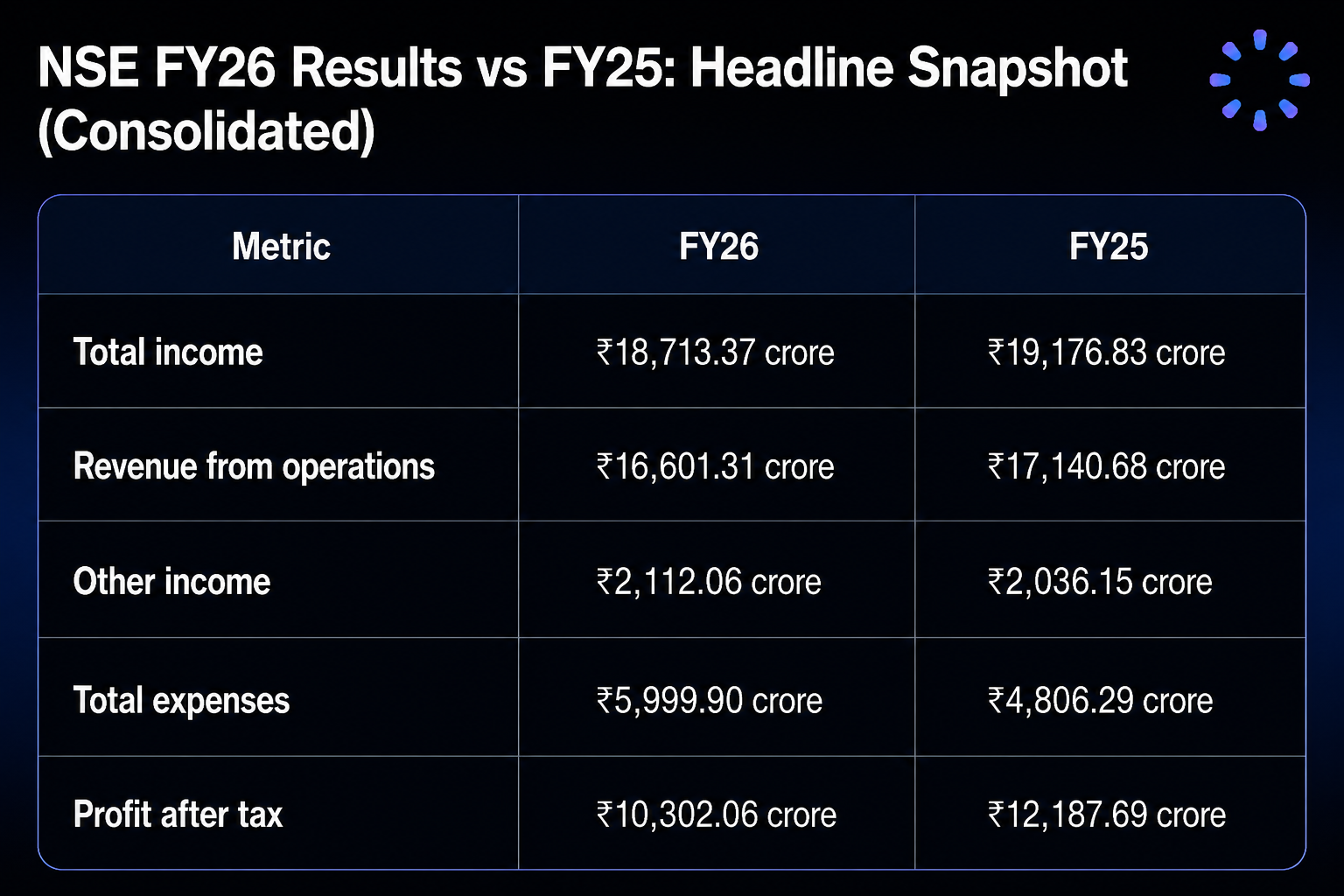
FY26 is a year where lower core revenue met step-ups in costs and provisions, so reported PAT fell even though exceptional gains from asset sales partially cushioned the outcome.
NSE FY26 results: Income and the top-line story
Total income and operations
The NSE Group reported total income of ₹18,713.37 crore for FY26, about 2.4% lower than ₹19,176.83 crore in FY25. The softer trend showed up most clearly in revenue from operations, which moved from ₹17,140.68 crore to ₹16,601.31 crore.
Other income increased to ₹2,112.06 crore from ₹2,036.15 crore (derived from disclosed totals). That lift helped, but it did not fully offset the cooling in operating revenue in the consolidated picture.
Why the top line matters beyond the headline
For a market infrastructure group, top-line softness can reflect cash market and derivatives activity, pricing and incentive structures, competitive dynamics, and regulatory changes that influence how revenue is recognised or rebated. None of that replaces reading management commentary, but it explains why National Stock Exchange profit does not move in a straight line with "how bullish retail feels on Twitter."
If you are comparing NSE FY26 results with global exchange peers, keep the basics in mind: Indian market structure, product mix, and regulatory cycles are not directly comparable without adjusting for those differences.
NSE FY26 results: Profitability, Expenses, and Regulatory Provisions
PAT and the expense line
Profit after tax was ₹10,302.06 crore in FY26 versus ₹12,187.69 crore in FY25. That is roughly a 20% decline, which is large for a company of this scale.
Total expenses rose from ₹4,806.29 crore to ₹5,999.90 crore. In plain terms, FY26 carried a heavier cost and provisioning load, and that showed up directly in National Stock Exchange profit comparisons year on year.
Regulatory provisions and settlements
A major driver was a provision of ₹1,391.21 crore relating to SEBI orders connected to the colocation facility and dark fibre connectivity. This sits on top of ₹100 crore provided earlier.
The exchange also paid ₹40.35 crore to SEBI toward a composite settlement linked to an inspection covering 2021–2022.
These items are exactly the sort of non-recurring or irregular outcomes that can dominate the narrative in a single fiscal year, even when the operating franchise remains strong.
People costs and labour-code-related accounting
Employee benefit expenses were ₹789.98 crore. Separately, an exceptional item of ₹126.44 crore was recognised related to the impact of the new labour codes.
Segment trends inside NSE FY26 results
Trading and clearing
Trading services revenue was ₹15,043.67 crore in FY26 compared with ₹15,559.46 crore in FY25.
Clearing services revenue fell more sharply, to ₹1,762.37 crore from ₹2,525.31 crore. Clearing trends can move with volume, margins, product mix, and risk framework changes, so this line deserves attention when you read the exchange's segment discussion.
Data, indices, and allied services ("others")
The “others” segment, which includes areas such as data feeds and index licensing, improved to ₹644.49 crore. For investors evaluating NSE as a business, this bucket matters because it can represent recurring, non-trading-linked revenue streams that diversify the story beyond pure transaction sensitivity.
Strategic monetization: NSDL and divestments in NSE FY26 results
NSDL stake sale (OFS)
One of the defining corporate actions in FY26 was an Offer for Sale of a 9% stake in National Securities Depository Limited (NSDL). The transaction resulted in a pre-tax exceptional gain of ₹1,200.94 crore.
Think of this as balance-sheet and portfolio hygiene: Monetising a stake in a related market infrastructure entity can release capital and simplify group structure, while producing a large accounting gain in the year of execution.
Other divestments
The exchange also recognised gains from exiting or restructuring non-core activities:
Education business (TalentSprint): Gain of ₹114.14 crore
KRA business: Gain of ₹4.97 crore
Together with the NSDL-related gain, these items helped offset some of the downward pressure from provisions and higher expenses. That is why adjusted or normalised angles often matter for analysts: Reported PAT mixes core economics with exceptional positives and negatives.
Dividends and shareholder returns from NSE FY26 results
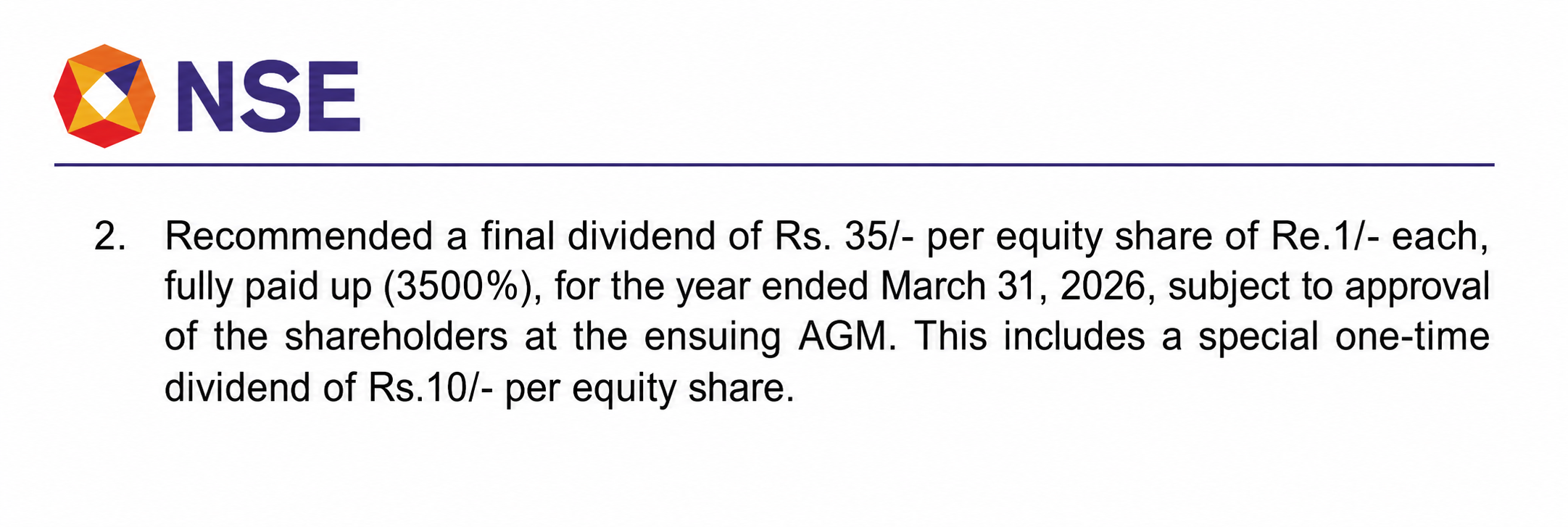
Despite regulatory and expense pressures, the board recommended a final dividend of ₹35 per equity share, described in disclosures using convention around face value (sometimes represented as 3500% in dividend terminology).
The payout includes a special one-time dividend of ₹10 per share. Special dividends can signal comfort with liquidity and a willingness to return surplus cash, but they can also reflect non-recurring gains. Treat them as a prompt to read cash flow, capital plans, and future investment needs, not just headline yield.
Official dividend declaration excerpt from NSE FY26 filing:
What retail investors should take away from NSE FY26 results
FY26 reads like a year of regulatory de-risking on paper: Large provisions and settlements can be painful in the year they land, but they can also reduce overhang if markets were waiting for closure on long-running matters.
Operationally, trading and clearing revenue softness is worth monitoring because it connects to ecosystem activity and structure of market participation. Strategically, monetisation of non-core stakes and businesses shows management can pull levers beyond day-to-day fee lines.
If your primary investing lens is unlisted and pre-IPO opportunities, remember that exchange economics and ecosystem regulation shape the backdrop for listings, liquidity culture, and investor protection standards. When you evaluate private companies, pairing company-level research with market-structure context helps you avoid blind spots. Explore ideas systematically with the Precize screener, and deepen concepts on the Precize blog. For platform basics, see Precize FAQs.
How to read exchange filings (without getting lost)
If NSE FY26 results are your first time opening an exchange annual report, use a simple checklist:
Start with consolidated totals (income, expenses, PAT) so you know the headline shape.
Read exceptional items and notes on provisions next; that is where regulatory stories hide.
Scan segment revenue to see whether trading, clearing, or market data drove the change.
Finish with cash flow and dividend policy language, not only PAT.
This approach keeps you from mistaking a noisy year for a broken business model, and it helps you ask better questions when management explains National Stock Exchange profit trends on calls or in letters to shareholders.
Final Verdict
NSE’s FY26 results reflect a period of regulatory de-risking. By making substantial provisions for long-standing SEBI matters, the exchange is clearing the path for a cleaner balance sheet in future periods. While the operational revenue slowdown in trading and clearing warrants monitoring, the high margins and successful monetization of non-core assets like NSDL demonstrate a robust financial foundation.
Explore unlisted opportunities with research-led screening on Precize. Questions about investing workflows or eligibility? Visit Precize Care. Stay updated with unlisted companies through our Precize Community.
Disclaimer: This article is for informational purposes only and should not be considered as investment advice. Investing involves risks, including potential loss of capital. Unlisted securities carry additional risks such as illiquidity and limited disclosures. Please consult a qualified financial advisor before making investment decisions. Precize is not a stock exchange and is not authorized by any capital markets regulator as a stock exchange. Past performance of any business discussed here does not guarantee future results. This is not a recommendation to buy or sell any security mentioned.

Stay in the Loop
Join our newsletter for exclusive access to thoughtfully curated content and we promise, no spam
Company
Our Office
Office No. 1219, The Summit Business Park, Andheri Kurla Road, Andheri East, Mumbai, Maharashtra - 400093
Find us on Googlesupport@precize.in
+91 7738336457
All trademarks and logos or registered trademarks and logos found on this Site or mentioned herein belong to their respective owners and are solely used for informational and educational purposes.
The material presented in this advertisement is for informational purposes only and should not be construed as investment advice or investment availability. It is not a recommendation of, or an offer to sell or solicitation of an offer to buy, any particular unlisted share, security, strategy, or investment product. Investing in the private market and securities involves risks, including the potential loss of money, and past performance does not guarantee future results. Market trends, data interpretations, graph projections are provided for informational and illustrative purposes and may not reflect actual future performance. Nothing on this website should be construed as personalized investment advice or should not be treated as legal, financial, or any other form of advice. Precize is not liable for financial or any other form of loss incurred by the user or any affiliated party based on information provided herein.
Precize is neither a stock exchange nor does it intend to get recognized as a stock exchange under the Securities Contracts Regulation Act, 1956. Precize is not authorized by the capital markets regulator to solicit investments. The securities traded on these platforms are not traded on any regulated exchange.
The website will be updated regularly.
Copyright © 2026 - Precize - All Rights Reserved