
Have you ever wondered why the economy keeps fluctuating? Let's discuss the fascinating world of economic trends – influenced by politics, geography, finances, and the ever-changing socio-economic landscape.
These shifts often bring along some unexpected changes: economic bubbles.
Picture this: assets, securities, and shares pretending to be worth way more than they are. Curious? Let's jump into the world of economic bubbles and uncover the secrets behind these financial mysteries!
What triggers an economic bubble?
Well, it's a bit like a puzzle with no single answer – economists and analysts have different opinions. However, certain situations often pave the way for a bubble to form:
Boom Phase:
Industries and companies are thriving, and everyone's pockets are getting heavier with higher salaries. People, excited about their extra cash, start investing in various assets. This rush of investments causes the prices of these assets to skyrocket, creating a bubble.
Expanding Economy:
Picture this: when the economy is doing well and growing, there's more money floating around, making it easier to buy and sell things like unlisted shares or property. At the same time, the cost of borrowing money (interest rates) goes down. So, people who want to invest but need more cash can borrow money more affordably. This makes everyone want these unlisted shares and investments, and because everyone is buying, the prices shoot up fast. That's what happens when the economy expands, and we see a sudden rise in the prices of assets!
Bubble Journey: The Rise and Fall in Five Stages.
An economic bubble typically goes through five stages:
Displacement: Investors shift their attention to a new trend or technology in the market. For instance, if home loan interest rates drop, many people may start taking out home loans, leading investors to focus more on real estate. This can drive up property prices.
Boom Phase: The trend speeds up as more people join in, and prices rise quickly.
Euphoria: The prices of various assets shoot up, but that doesn't discourage investors. They continue paying higher prices in the hopes of getting better returns.
Taking profits: Careful investors, aware of a potential 'bubble burst,' begin selling their assets to secure profits.
Panic: Finally, the bubble pops, and prices drop fast.
Variety Of Bubbles
Various types of bubbles can happen in the market, but they generally fall into four categories:
Stock Market Bubble: This occurs when the prices of stocks go up rapidly, surpassing their actual value.
Credit Bubble: Credit Bubble Involves a surge in demand for consumer loans, bonds, and other forms of credit. For instance, a credit bubble might happen if lending rates drop or debt instruments offer higher interest rates.
Commodity Bubble: This bubble forms when prices of commodities like oil, gold, and metals experience a significant increase.
Market Bubble: A market bubble happens when there are bubbles in different parts of the economy. For example, if there's a bubble in real estate, it's called a market bubble.
Economic Bubble History
Economic bubbles have occurred and may happen again; instead of worrying about 'when,' it's essential to focus on 'how' to handle them. This includes safeguarding investments and unlisted shares, preserving purchasing power, and building up reserves to face crises. Let's explore past economic bubbles and gather valuable lessons.
The Dutch Tulip Bubble
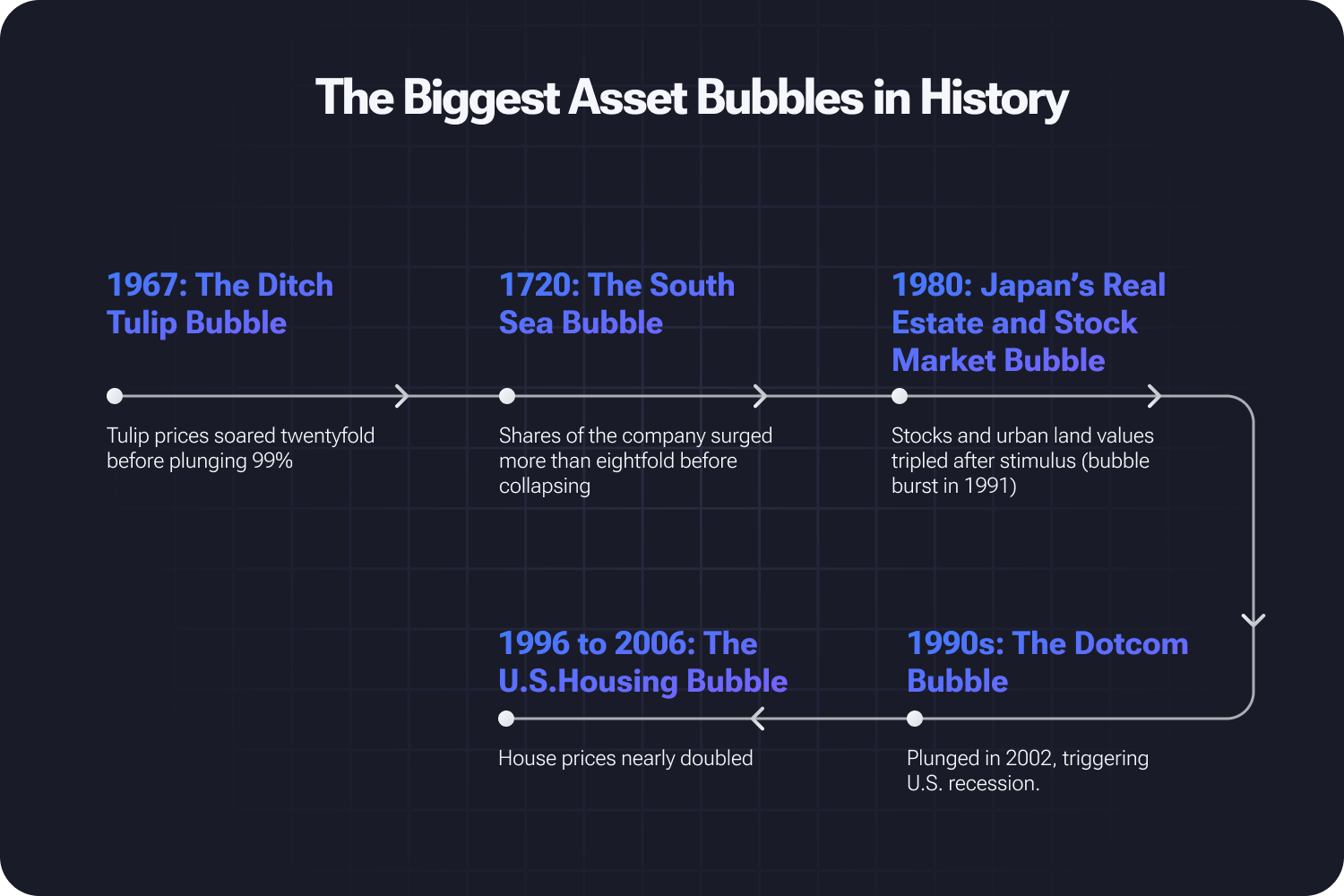
In the 1630s, Holland experienced Tulipmania, one of the earliest recorded irrational asset bubbles. Tulip prices skyrocketed twenty times between November 1636 and February 1637, only to crash by 99% in May 1637, as former UCLA economics professor Earl A. Thompson reported.
Like most bubbles, Tulipmania affected a broad section of the Dutch population. At its peak, some tulip bulbs were valued higher than the price of certain houses.
The South Sea Bubble
In 1720, the South Sea Bubble unfolded through a more complex series of events than Tulipmania. The South Sea Company, established in 1711, was promised a trade monopoly by the British government with the Spanish colonies in South America. With hopes for success similar to the East India Company's trade with India, investors eagerly bought shares in the South Sea Company.
As company directors spun tales of immense wealth in the South Seas (modern-day South America), share prices skyrocketed eightfold in 1720, jumping from £125 in January to £950 in July. However, the bubble burst in the following months, triggering a severe economic crisis.
Japan's Real Estate and Stock Market Bubble
In the 1980s, Japan experienced an economic bubble driven by an overly stimulative monetary policy. The yen's 50% surge in the early 1980s caused a recession in 1986, prompting the government to implement monetary and fiscal stimulus. However, these measures led to excessive speculation, causing Japanese stocks and urban land values to triple between 1985 and 1989. At its peak in 1989, the Tokyo Imperial Palace grounds were valued higher than all real estate in California. The bubble burst in 1991, marking the start of Japan's "Lost Decade" with price deflation and stagnant economic growth.
The Dot-com Bubble
The dot-com bubble of the 1990s was one of the largest in scale. The rising popularity of the Internet triggered speculation in "new economy" businesses, with hundreds of dot-com companies achieving multi-billion dollar valuations upon going public. The NASDAQ Composite Index, housing these tech/dot-com stocks, soared from about 750 in early 1990 to over 5,000 in March 2000. Shortly after, it crashed, plummeting 78% by October 2002, leading to a U.S. recession. The Index didn't reach a new high until 2015, more than 15 years after its previous peak.
The U.S. Housing Bubble
Following the bursting of the dot-com bubble, some experts believe U.S. investors turned to real estate, mistakenly considering it a safer asset class. From 1996 to 2006, U.S. house prices nearly doubled, with two-thirds of that increase occurring from 2002 to 2006. Signs of an unsustainable frenzy included rampant mortgage fraud, condo flipping, and houses bought by subprime borrowers. U.S. housing prices peaked in 2006, leading to a slide that resulted in the average U.S. house losing one-third of its value by 2009. The U.S. housing boom and subsequent bust and its impact on mortgage-backed securities triggered the Great Recession, the most significant global economic contraction since the 1930s Depression.
Conclusion: Smart Investing in Economic Bubbles
Identifying bubbles in real time is tricky, so caution is critical. Before jumping into a rising market, scrutinize asset values. If prices exceed intrinsic worth, be cautious. While you can profit in a bubble, be ready to exit at any sign of trouble. Use financial ratios for insight.
Match your investment strategy to your risk tolerance and time your exits strategically. Investors have thrived during bubbles by staying sharp and analyzing market conditions. Be smart, stay informed, and make savvy investment choices to navigate economic bubbles successfully.