With rising temperatures, rapid urban growth, and a clear shift towards energy-efficient solutions, air conditioning has become more of a necessity than a luxury in Indian homes and offices. As demand grows, companies in the HVAC space are gaining serious attention, not just for their products, but also in the investment world. One such name is Carrier Airconditioning & Refrigeration, a key player in this space.
The India HVAC (Heating, Ventilation, and Air Conditioning) market was valued at USD 9.1 billion in 2023 and is expected to grow at a strong pace with a CAGR of 14.5% during 2025–2029. This growth reflects rising demand across commercial, residential, and industrial sectors, pushing companies like Carrier further into the spotlight.
In this blog, you'll get a complete update on the Carrier Aircon unlisted share price, a quick look at the company’s background, its financial performance, pros and cons, and how you can buy or sell its unlisted shares in India.
Everything is explained properly to help you stay informed!
TL;DR
Carrier Airconditioning & Refrigeration is the Indian arm of Carrier Global, operating since 1986 with a strong presence across India’s HVAC market.
As of 18 July 2025, the unlisted share price is ₹523.00 per share with a lot price of ₹10,460.00.
The company reported a market cap of ₹5,563.50 crore in FY 2024, with strong financials including an ROE of 34.14% and EPS of ₹14.15.
Buying or selling shares is easy on platforms like Precize, which offers secure transactions, updated pricing, and portfolio diversification tools.
What is Carrier Air Conditioning & Refrigeration?
Carrier Air Conditioning & Refrigeration is the Indian arm of Carrier Global Corporation, a global leader in the HVAC industry. The company started its journey in India back in 1986, when it set up its first manufacturing facility in Gurgaon, Haryana, spread across 19 acres. Since then, it has grown steadily and become a trusted name in air-conditioning and refrigeration solutions.
Today, Carrier offers a wide range of products, from light commercial air conditioners to large-scale chillers and advanced refrigeration systems.
These are either manufactured in India or imported and sold across domestic and international markets.
Over the years, the company has built a strong presence with 14 sales and service offices and a network of more than 800 sales and service channel partners across the country.
Whether it’s homes, offices, hospitals, or shopping malls, Carrier products are widely used in both residential and commercial spaces.
Carrier also puts focus on innovation and social responsibility.
In FY 2022–23, it invested ₹4.29 crore in research and development to improve its technology and products, and ₹2.17 crore in CSR initiatives, supporting various community projects.
[Source: Financial reports]
Now that you know what the company does, let’s take a look at its current unlisted share price.
Unlisted Share Price of Carrier Air Conditioning & Refrigeration
As of 18 July 2025, the unlisted share price of Carrier Air Conditioning & Refrigeration stands at ₹523.00 per share. The face value of each share is ₹10.00, and the minimum lot size available for purchase is typically 20 shares, making the price per lot ₹10,460.00.
It’s important to know that the price of unlisted shares is not fixed and can change daily.
Since these shares aren’t traded on public stock exchanges, their value depends on supply and demand in the private market, recent company performance, and investor interest.
This means prices may go up or down based on how the company is performing or how much interest buyers and sellers are showing at any given time.
If you’re tracking the unlisted space, it's a good idea to check the price regularly through trusted platforms like Precize that deal in unlisted shares. These platforms update prices based on recent transactions and ongoing demand in the grey market.
[Source: Financial reports]
Next, let’s explore the financial side of things to see what’s driving interest in Carrier’s unlisted shares.
Financial Performance of Carrier Air Conditioning & Refrigeration
When it comes to understanding the Carrier Aircon unlisted share price, it helps to look at the company’s latest financial performance.
As per FY 2024, the company reported a market capitalization of ₹5,563.50 crore, showing its strong presence in the Indian HVAC industry.
The company’s operating revenue stood at ₹2,131.14 crore, with a year-on-year growth of 5.88%, indicating steady performance despite market fluctuations.
Its Profit After Tax (PAT) was ₹150.52 crore, and it posted an Earnings Per Share (EPS) of ₹14.15, which gives a fair idea of its profitability.
From a returns perspective, Return on Equity (ROE) came in at 34.14%, and Return on Capital Employed (ROCE) was 27.25%, both reflecting strong operational efficiency and effective capital use.
The Price-to-Earnings (P/E) ratio for the period was 36.96, which is often used to compare valuation in the unlisted market.
[Source: Financial reports]
With the financials in place, let’s explore its pros and cons.
Pros and Cons of Carrier Air Conditioning & Refrigeration
Like any leading company, Carrier Airconditioning & Refrigeration comes with its own strengths and challenges. Here is a balanced look at the key pros and cons:
Pros
Strong Market Leadership: Carrier is widely recognised as a global name in HVAC, refrigeration, and building systems, known for its innovative and reliable technology.
Solid Financial Performance: The company has shown consistent growth in both revenue and profitability, helping it maintain a strong presence across markets.
Sustainability-Driven Approach: With a strong focus on energy efficiency and reducing carbon emissions, Carrier aligns well with evolving environmental standards and customer expectations.
Cons
High Operating Expenses: Significant investments in R&D, digital initiatives, and sustainability programs can drive up costs.
Competitive Market Environment: Carrier operates in a space with several global competitors, which puts pressure on pricing and market share.
Regulatory Pressures: Adhering to changing environmental laws and energy efficiency norms can add complexity and cost to operations.
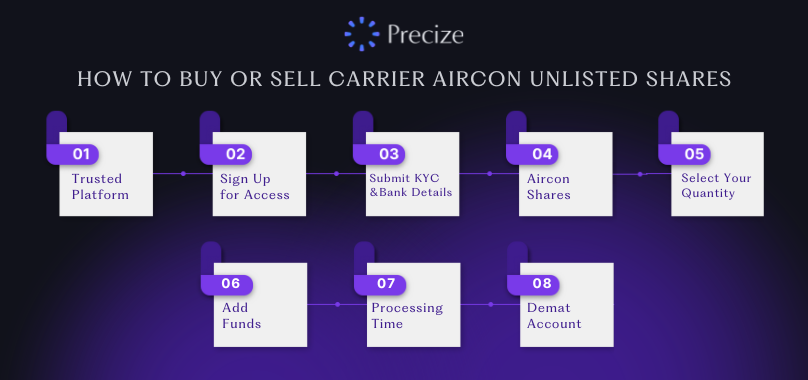
With pros and cons in mind, let’s break down the simple steps to buy or sell these shares in the unlisted market.