When you look at a company’s letterhead, invoice, or even check its details online, you might come across a long alphanumeric code, that’s the CIN number of a company. If you’ve ever wondered what it means or why it’s there, you’re not alone. For every registered business in India, this number isn’t just a formality; it’s a key part of its legal identity.
In this blog, you’ll get a clear idea of what a Corporate Identification Number (CIN) really is. We’ll walk you through what each part of the CIN means, its importance and which types of companies receive it. You’ll also understand how it benefits your business, how to find or verify it, and what can happen if you ignore CIN compliance.
We’ll also explain how CIN is different from other numbers like LLPIN, PAN, and GSTIN. And before you wrap up, you’ll learn a few useful tips on how to use the CIN number correctly in official documents and how to change it.
Keep scrolling down!
A Corporate Identification Number (CIN) is a 21-character code assigned to companies registered under the Companies Act, 2013 in India.
CIN reveals key details like listing status, industry type, registration state, incorporation year, and company structure.
It is legally required to mention the CIN on invoices, letterheads, annual reports, and filings submitted to the Ministry of Corporate Affairs (MCA).
Non-compliance with CIN requirements can lead to penalties, delays in filings, and loss of credibility.
The Corporate Identification Number, or CIN, is a unique 21-digit alphanumeric code assigned to every company registered in India by the Registrar of Companies (RoC) under the Ministry of Corporate Affairs (MCA). It serves as an official identification number that helps track a company’s registration details, structure, and location. The CIN number of a company is used in all government filings and legal records.
This number is issued when a company is incorporated and remains the same unless there are significant changes, like shifting the registered office to another state or changing the type of company. It is compulsory for all registered companies in India, including private limited companies, public limited companies, one-person companies, and Section 8 companies, as per the Companies Act, 2013.
Now that you know what a CIN is, let’s look at why this number is so important for every registered company in India.
Key Importance of CIN Number
The CIN number of a company is more than just a registration code, it’s a vital part of running a legally recognized and compliant business in India. Here is why it matters:
Required for Compliance Filings: You need to mention your CIN in all filings with the Registrar of Companies, including annual returns and updates.
Mandatory on Official Documents: It must appear on invoices, company letterheads, audit reports, and other formal documents.
Easy Company Verification: Clients, government bodies, and banks can use the CIN to check your company’s basic details through the MCA portal.
Supports Financial Transactions: Banks and NBFCs ask for your CIN when you apply for business loans or open a current account.
Helps in Building Trust: CIN adds transparency and makes it easier for others to verify that your company is active and compliant.
Unique Identity for Every Company: It distinguishes your business from others, even those with similar names or operations.
Now that you know why the CIN number is so important for your business. The next step is knowing how to read it correctly.
A Corporate Identification Number (CIN) is a 21-character alphanumeric code assigned to companies registered in India. This code includes key details about the company, such as its listing status, industry, location, year of registration, and type. Here is how to read and understand it, using an example: U12345DL2022PTC123456
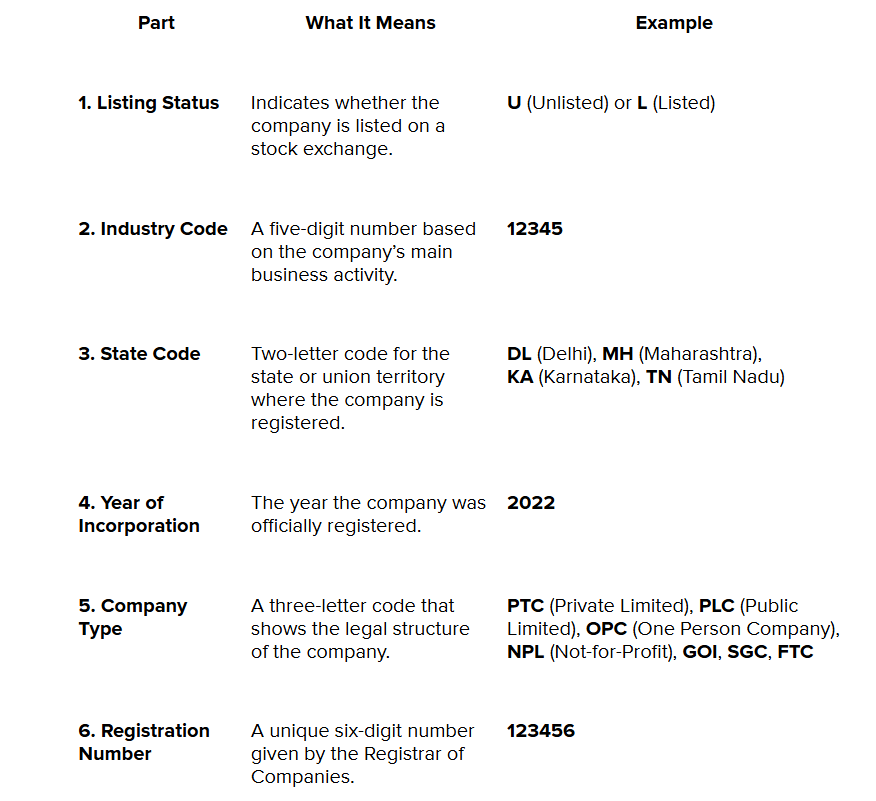
Let’s say the CIN is L01631KA2010PTC096843. Here’s what it reveals:
L: Listed company
01631: Industry classification
KA: Registered in Karnataka
2010: Incorporated in 2010
PTC: Private Limited Company
096843: Unique registration number
Now that we’ve decoded the CIN format, let’s explore the types of companies that are required to have one.

In India, when a company is registered under the Companies Act, 2013, the Registrar of Companies (RoC) assigns it a CIN. This number is mandatory for most registered company types. Here's a quick look at the different types of companies that receive a CIN:
Private Limited Companies (Pvt Ltd): This is the most common type of business structure, especially among startups and small to mid-sized businesses. Every private limited company receives a CIN after registration.
Public Limited Companies: These companies can offer shares to the public and are often listed on stock exchanges. They are also issued a CIN.
One Person Companies (OPCs): If you’re a solo entrepreneur looking to start a company with limited liability, registering an OPC will get you a CIN.
Section 8 Companies: These are non-profit organizations formed for charitable, educational, or social purposes. They receive a CIN when registered under Section 8 of the Companies Act.
Nidhi Companies: Formed to encourage savings and mutual financial support among members, Nidhi companies also get a CIN upon registration.
Government Companies: Companies fully or partially owned by the central or state government are issued a CIN like any other registered company.
Note: Limited Liability Partnerships (LLPs) are not assigned a CIN. Instead, they receive a separate identification code known as an LLPIN (Limited Liability Partnership Identification Number).
Now that you know which companies are assigned a CIN, let’s look at why this number matters beyond registration.


The CIN number of a company plays a vital role in establishing and maintaining its legal and professional standing in India. Here’s how it supports your business:
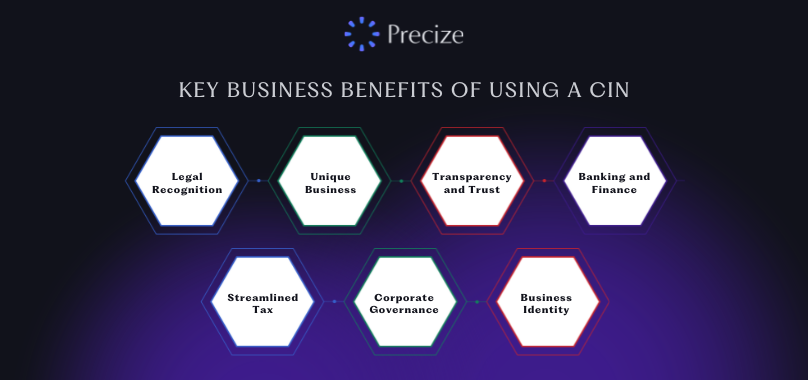
Legal Recognition
CIN gives your company official recognition under Indian law.
It confirms that your business is registered and legally allowed to operate.
It’s also required for filings like annual returns, compliance reports, and other statutory documents.
Unique Business Identity
Every company gets a unique CIN, which helps avoid confusion between businesses, even if they have similar names.
It serves as a clear identifier in all government and financial records.
Builds Transparency and Trust
Details linked to your CIN are available on the MCA website.
This open access helps clients, investors, and partners verify your company’s legal status, boosting credibility and trust.
Easier Access to Banking and Finance
When applying for a business loan, opening a current account, or dealing with financial institutions, your CIN is often a required detail.
It makes financial processes smoother and more reliable.
Streamlined Tax and Regulatory Filings
Since your CIN is linked to company records, it ensures that filings related to income tax, GST, and other compliance tasks are accurate and traceable, reducing the risk of errors or legal issues.
Better Corporate Governance
CIN appears on all official documents, such as invoices, letterheads, and reports, helping maintain clear and accountable records. It supports responsible management and regulatory transparency.
Protection of Business Identity
By assigning a unique number to your business, CIN helps prevent duplication or misuse of your company name and structure. This protects your brand from identity-related issues or disputes.
The CIN brings several advantages, but it’s equally important to know how to get it and where to find it when required.
If you're starting a business or checking the background of another company, it’s important to know how the CIN number of a company is issued and where to verify it. The process is simple and handled entirely by the MCA. Here is what you need to know:
How to Obtain a CIN
When you register a company with the MCA in India, the Registrar of Companies (RoC) automatically issues a CIN as part of the incorporation process.
It appears on your Certificate of Incorporation once your registration is approved.
This applies to all types of registered companies in India, including Private Limited Companies (Pvt Ltd), One Person Companies (OPC), Section 8 Companies (non-profits), Nidhi Companies, and government-owned entities.
However, Limited Liability Partnerships (LLPs) do not receive a CIN; they are issued an LLPIN instead.
How to Verify a Company’s CIN
You can easily check a company’s CIN online through the official MCA website. Here is how:
Visit the MCA portal.
Go to “MCA Services” and select “Find CIN or LLPIN.”
Enter the company’s name or other relevant details.
The system will display the company’s CIN along with basic details like registration date, company type, state of registration, and current status.
You can also find the CIN printed on official company documents such as invoices, letterheads, annual reports, and e-filing submissions. Verifying the CIN helps ensure that the company is registered and operating legally under Indian law.
While getting and verifying a CIN is straightforward, ignoring the rules around it can lead to serious consequences.

Failing to follow the rules related to your company’s CIN can lead to serious consequences under Indian law. Here's what you should be aware of in 2025:
Legal Penalties
As per Section 12(3)(c) of the Companies Act, 2013, if your company doesn’t print its CIN on official documents like invoices, letterheads, notices, and business communications, you may face a penalty of ₹1,000 for each day the mistake continues.
There’s no upper limit to this fine, it keeps adding up until the issue is fixed.
Regulatory Action
The Registrar of Companies (RoC) can issue notices and seek explanations from your company for not following the CIN rules.
In some cases, legal action may be taken if the non-compliance is ignored for too long.
Operational Delays
Not complying with CIN requirements can slow down processes like filing annual returns, financial statements, or other submissions on the MCA portal.
This could affect your company’s ability to function smoothly and meet important deadlines.
Reputation Risk
CIN is used by banks, investors, and government bodies to check your company's legal status.
If your documents are missing a CIN or show incorrect details, it can hurt your company’s image and reduce trust among stakeholders.
Legal Complications
In legal matters, missing or inaccurate CIN information can lead to confusion during audits, contract reviews, or court proceedings.
It may weaken your position and make it harder to protect your business interests.
Staying compliant isn't difficult, as long as you know how to use your CIN correctly in everyday business activities.

To stay compliant and maintain a professional image, it's important to use your Corporate Identification Number (CIN) correctly across all company documents. Here are some easy-to-follow tips to help you manage it properly:
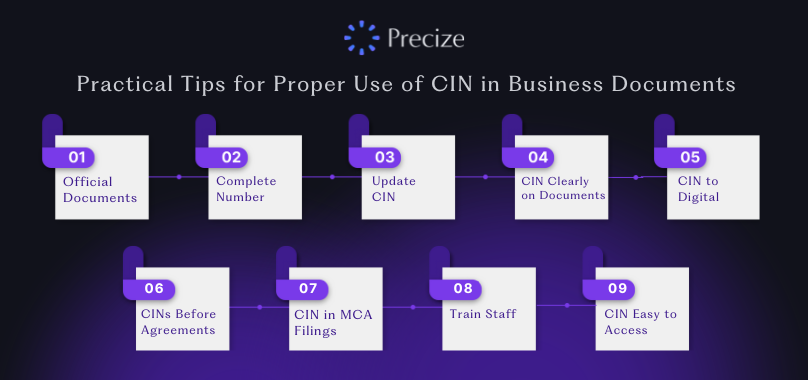
Always Include CIN on Official Documents
Make sure your CIN is clearly printed on key documents like invoices, letterheads, notices, annual reports, and any official communication. This is a legal requirement under Section 12(3)(c) of the Companies Act, 2013.
Use the Correct and Complete Number
CIN is a 21-character alphanumeric code. Always double-check for accuracy when adding it to documents. Even a small error can lead to compliance problems or delays in processing.
Update CIN After Any Company Changes
If there’s a change in your company’s structure or location, such as shifting the registered office to a different state or changing the company type, your CIN may also change. Be sure to update it immediately across all documents and platforms.
Place CIN Clearly on Documents
Your CIN should be easy to find, preferably at the top or bottom of the first page. This helps clients, authorities, and partners quickly verify your company’s legal status.
Add CIN to Digital Communication
Don’t forget to include your CIN in digital materials like email signatures and e-invoices. This adds transparency and keeps your official communication complete and compliant.
Verify Others' CINs Before Agreements
Before signing contracts or entering partnerships, check the other party’s CIN on the MCA portal. It’s a simple way to confirm their registration and avoid potential fraud.
Mention CIN in MCA Filings
Your CIN must be included in all documents filed with the Ministry of Corporate Affairs, like annual returns and financial statements. Missing it could result in penalties or rejection of your submission.
Train Staff to Avoid Mistakes
Ensure your legal, admin, and accounts teams know the importance of correctly using the CIN. A quick training or reminder can help reduce errors and non-compliance.
Keep CIN Easy to Access
Store your CIN where it's easily available for reference, whether during audits, document creation, or when asked by officials. Having it handy helps save time and avoids last-minute issues.
Now that you're clear on how to use the CIN correctly, let’s look at situations where your company’s CIN might actually need to be changed and what steps you need to follow.
Your company’s CIN number doesn’t change often, but if certain major details are officially modified, the CIN gets updated by the Ministry of Corporate Affairs (MCA). Here is when and how it happens.
When Does the CIN Number Change?
If You Shift the Registered Office to Another State
The 7th and 8th characters of your CIN show the state in which your company is registered (e.g., MH for Maharashtra, DL for Delhi). So, if your registered office moves to a different state, say from Maharashtra to Gujarat, your CIN will be updated to reflect the new location.
If You Change the Type of Company
The 14th to 16th characters of your CIN show your company’s type. For example:
PTC – Private Limited Company
PLC – Public Limited Company
OPC – One Person Company
So, if you convert an OPC into a Private Limited Company or change from Private to Public, your CIN will be updated accordingly.
How Is the CIN Number Updated?
The CIN doesn’t need to be changed manually. Once the required changes (like office relocation or company conversion) are approved through proper legal steps, the MCA updates your CIN automatically. Here is what the process looks like:
If You're Moving to Another State
Pass Board and Special Resolutions: These are internal approvals to shift the registered office.
File Form MGT-14: Submit this on the MCA portal to record the resolution.
Submit Form INC-23: This is for getting approval from the Regional Director.
After Approval, File INC-28 and INC-22: These forms help update the company records with the Registrar of Companies (RoC).
Once done, your new CIN with the updated state code will be generated.
If You're Changing the Company Type
Hold Required Resolutions: Pass board and shareholder resolutions to approve the change.
File MGT-14 and INC-27: These forms are used to report the conversion and submit supporting documents.
Once processed and approved, the updated CIN is issued reflecting the new structure of your business.
By now, you’ve seen how the CIN number of a company plays a central role in ensuring legal identity, compliance, and operational clarity in India’s corporate ecosystem. From understanding its format to knowing where and how to use it, being aware of CIN requirements helps you stay on the right side of the law and maintain professional transparency.
In today’s dynamic business world, staying informed is just one part of the equation, making smarter financial choices is the next. That’s where platforms like Precize come in. Precize is an alternative investment platform in India that offers access to carefully selected private equity and private credit opportunities.
If you’re looking to build a more diversified portfolio through trusted, well-screened deals, you can reserve your access with Precize and take a step toward informed wealth building!
A company must include its Corporate Identification Number (CIN) on all important business documents. This includes invoices, letterheads, official notices, annual reports, and any forms or filings submitted to the Ministry of Corporate Affairs (MCA).
Yes, a CIN can change if there are major updates to the company’s details, such as a change in the registered office state, listing status, or industry classification. In such cases, the Registrar of Companies (RoC) updates the CIN accordingly.
You can search for a company’s CIN on the MCA website by entering the company’s name or registration information. The portal will show the correct CIN along with basic company details.
If a company fails to include its CIN on mandatory documents, it may face penalties under the Companies Act, 2013. This can also lead to compliance issues and notices from regulatory authorities.
Yes, CIN is often asked for when registering for GST, filing taxes, opening a business bank account, or completing other official verifications. It helps confirm the company’s legal identity.
The information provided in this blog is for general awareness and informational purposes only. While every effort has been made to ensure accuracy, this content should not be considered legal or professional advice. For specific guidance related to company registration, CIN compliance, or other legal matters, please consult a qualified professional or refer to the official guidelines issued by the MCA, Government of India.

Join our newsletter for exclusive access to thoughtfully curated content and we promise, no spam
Company
Our Office
Office No. 1219, The Summit Business Park, Andheri Kurla Road, Andheri East, Mumbai, Maharashtra - 400093
Find us on Googlesupport@precize.in
+91 7738336457
All trademarks and logos or registered trademarks and logos found on this Site or mentioned herein belong to their respective owners and are solely used for informational and educational purposes.
The material presented in this advertisement is for informational purposes only and should not be construed as investment advice or investment availability. It is not a recommendation of, or an offer to sell or solicitation of an offer to buy, any particular unlisted share, security, strategy, or investment product. Investing in the private market and securities involves risks, including the potential loss of money, and past performance does not guarantee future results. Market trends, data interpretations, graph projections are provided for informational and illustrative purposes and may not reflect actual future performance. Nothing on this website should be construed as personalized investment advice or should not be treated as legal, financial, or any other form of advice. Precize is not liable for financial or any other form of loss incurred by the user or any affiliated party based on information provided herein.
Precize is neither a stock exchange nor does it intend to get recognized as a stock exchange under the Securities Contracts Regulation Act, 1956. Precize is not authorized by the capital markets regulator to solicit investments. The securities traded on these platforms are not traded on any regulated exchange.
The website will be updated regularly.
Copyright © 2026 - Precize - All Rights Reserved