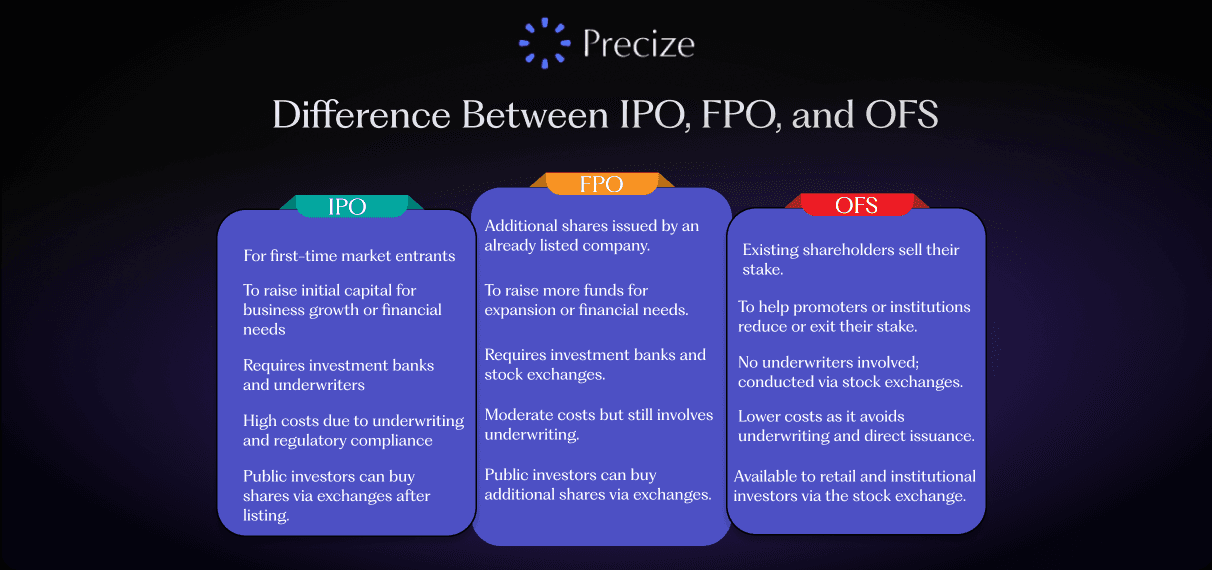
Have you ever wondered how companies raise money to expand and strengthen their position in the stock market? Businesses have several ways to raise funds, but three of the most common methods are Initial Public Offerings (IPOs), Follow-on Public Offerings (FPOs), and Offer for Sale (OFSs). Each serves a different purpose and benefits investors in unique ways.
An IPO is the first time a company offers its shares to the public, allowing it to raise capital for company growth. In contrast, an FPO is when an already listed company issues additional shares to secure more funds. Meanwhile, an OFS is not about raising new capital but instead provides a way for existing shareholders to sell their stakes in the open market.
Understanding these three methods is crucial for any investor looking to make informed decisions in the stock market. Let’s break down how each of them works and what differentiates them.
Understanding IPO (Initial Public Offering)
An IPO is a major milestone for a company, as it transitions from being privately held to a publicly traded entity. Through this process, businesses issue new shares to the public for the first time, raising capital for expansion, research, debt repayment, or other strategic initiatives.
The IPO process starts with the company filing a Draft Red Herring Prospectus (DRHP) with the Securities and Exchange Board of India (SEBI). This document provides potential investors with essential information about the company's financials, business models, and plans. After SEBI approves the IPO, the company sets a price band and opens a subscription period for investors to bid on the shares.
Once the bidding process is complete, shares are allotted, and the company's stock is listed on the stock exchange. This marks the beginning of its journey in the public market, with investors now able to trade the stock freely.
Understanding FPO (Follow-on Public Offering)
Unlike an IPO, which is a company’s first share issuance, an FPO is when a company that is already listed on the stock exchange issues additional shares. Companies opt for FPOs to raise extra capital for growth, acquisitions, or debt repayment.
The process of an FPO is similar to that of an IPO, starting with the company filing a DRHP with SEBI. Once approved, a subscription period is opened where investors can bid for shares. The price of an FPO is influenced by the company’s current market valuation and demand from investors.
FPOs can be classified into two types:
Dilutive FPO: The company issues new shares, increasing the total number of shares available, which may dilute the value of existing shareholders' stakes
Non-Dilutive FPO: In this type, existing shareholders, such as promoters, sell their shares, similar to an OFS, without issuing new ones
Investing in an FPO allows investors to gain exposure to a company that already has an established market presence, reducing some of the risks associated with IPOs.
Understanding OFS (Offer for Sale)
An OFS is a method through which existing shareholders, such as promoters, institutional investors, or large stakeholders, sell their shares to the public. Unlike an IPO or FPO, OFS does not involve issuing new shares or raising fresh capital for the company.x`
The process of an OFS is much simpler and faster compared to IPOs and FPOs. The seller announces the number of shares they intend to sell, and investors can bid for these shares within a single trading day. The price of shares in an OFS is determined by market demand.
Since the company itself is not issuing new shares, the proceeds from an OFS go directly to the selling shareholders rather than benefiting the company’s growth. However, this method increases the stock's public float, making shares more accessible to investors.
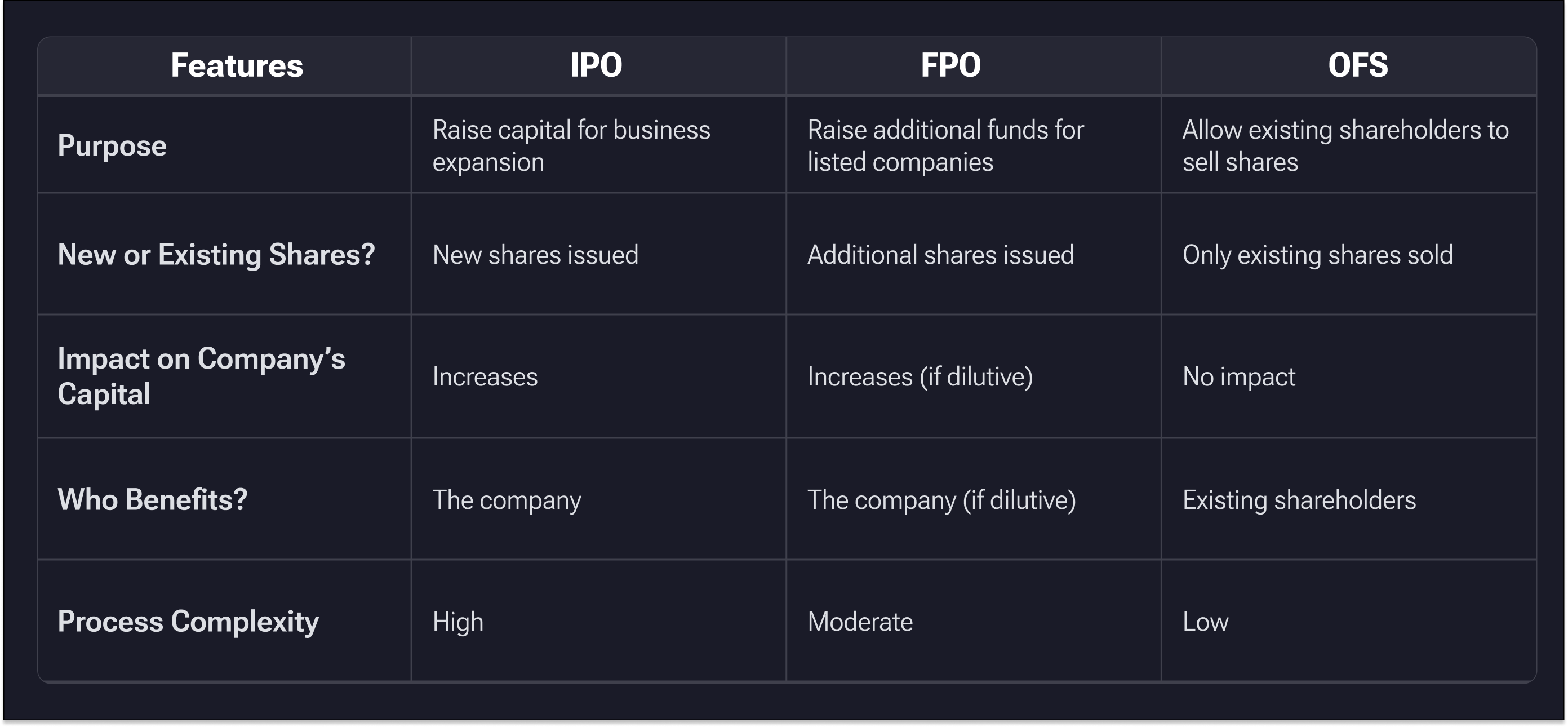
Key Differences Between IPO, FPO, and OFS
How to Invest in IPO, FPO, and OFS?
Research the Company: Understand the company's financial health, business model, and future potential.
Review Offer Documents: For IPOs and FPOs, analyse the DRHP to assess investment opportunities.
Choose a Broker: Select a reliable and trustful brokerage firm that provides access to IPO, FPO, and OFS investments.
Place Your Bid: Submit your application during the subscription window through your broker.
Monitor Market Trends: Stay updated on market conditions that might affect the stock’s price.
Advantages of IPO, FPO, OFS
IPO
An IPO allows a private company to go public by offering its shares to the general public for the first time. One of the biggest advantages of an IPO is capital generation. It provides companies with significant funds to expand operations, invest in new projects, or pay off debt. Additionally, going public enhances brand credibility, attracts top talent through stock-based compensation, and offers early investors an opportunity to exit with substantial returns.
FPO
An FPO enables an existing publicly listed company to issue additional shares to raise more capital. A key benefit of an FPO is that it allows the company to secure additional funds without taking on debt. It also increases stock liquidity, which can attract more investors. Since the company is already listed, regulatory scrutiny is lower compared to an IPO, and existing shareholders may benefit from potential stock price appreciation due to business expansion.
OFS
An OFS is a route through which existing shareholders, such as promoters or institutional investors, sell their stakes in a publicly traded company. The main advantage of an OFS is its quick and cost-effective execution, as it follows a simplified regulatory process. It provides retail investors with an opportunity to buy shares at a discounted price. For the selling shareholders, it offers an efficient exit strategy while ensuring market transparency.
Conclusion
Understanding the differences between IPO, FPO, and OFS is essential for making informed investment decisions. Each method has its advantages and is suitable for different investment strategies. IPOs offer opportunities to invest in new companies entering the market, FPOs allow investment in companies with an established track record, and OFS provides a chance to buy shares of existing companies without new capital being raised. By carefully analyzing these offerings, investors can make better financial decisions aligned with their goals.
(Disclaimer: The information provided in this article is for educational and informational purposes only and should not be considered financial or investment advice. Investing in stocks, including IPOs, FPOs, and OFS, carries risks, and past performance is not indicative of future results. Always conduct thorough research and consult a financial advisor before making investment decisions. Neither the author nor the platform assumes any responsibility for financial losses resulting from investment decisions based on this content.)