Future business in India in 2026 sits at the intersection of digital habits, climate-aware choices, and capital-light distribution (UPI, social commerce, SaaS).
This guide lists 15 practical idea areas, not a guarantee of profit. Treat each as a starting map, then validate demand where you live.
Resilient founders focus on clear customer pain, repeatable delivery, and clean books before chasing scale.
Government programmes can reduce friction for credit and recognition; always read official eligibility rules.
If you are also building long-term wealth, you can explore more structured private-market education on the Precize blog.
India’s market is mobile-first, price-sensitive, and quick to copy what works. Future business in India is less about chasing hype and more about picking a lane where you can serve a narrow audience exceptionally well, then expand.
If you are reading this in 2026, you are already thinking in the right direction: which problems will still matter in three to five years, and which parts of the stack you want to own (distribution, technology, operations, or brand).
Below you will find what makes a venture future-ready, 15 idea areas with plain-language notes, a shortlisting framework, risks to plan for, a comparison table, and a concise list of government programmes that founders commonly research. This is not legal, tax, or investment advice; confirm details with professionals and official portals.
Why “future business in India” is a search worth taking seriously: household savings still rotate across gold, bank deposits, mutual funds, and increasingly direct equity and alternatives. On the operating side, founders can reach buyers through UPI, marketplaces, creator-led distribution, and WhatsApp-first funnels. That combination rewards businesses that can prove delivery, refunds, and service quality fast. You do not need a perfect idea on day one; you need a test loop: offer, price, proof, repeat.
What Makes a Business Future-Ready in India?
Future-ready does not mean “only AI” or “only climate.” It means your model can survive policy shifts, platform algorithm changes, and working-capital stress.
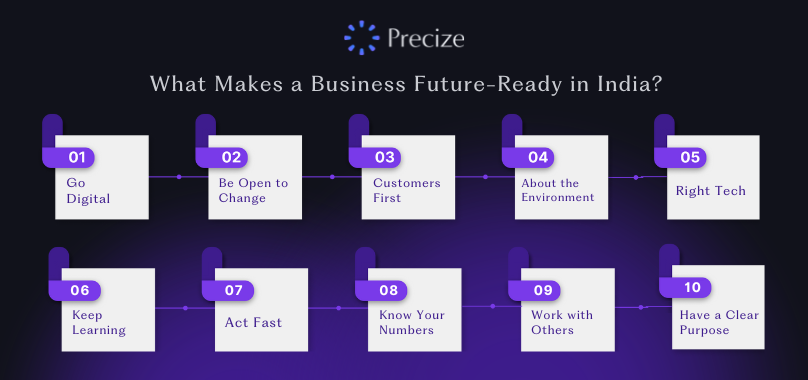
Go digital where it matters. A simple website, WhatsApp Business workflow, UPI collections, and clear GST invoicing often beat a fancy app nobody downloads.
Stay adaptable. Indian demand can swing with festivals, crop cycles, elections, and fuel prices. Build small batches, watch cash weekly, and keep one backup offer ready.
Solve a sharp customer problem. Narrow positioning beats “we do everything” for early trust, referrals, and pricing power.
Bake in sustainability practically. Less packaging waste, honest sourcing, and energy efficiency can be cost savers, not only marketing lines.
Use technology to multiply output, not theatre. Automate repeat tasks first: reminders, billing, inventory alerts, and basic dashboards. If you want a forward-looking view of how tech is changing decision-making in markets, read how AI is shaping the future of investing.
Keep learning. Skills decay fast. Your edge is often execution speed plus domain depth in one vertical.
Watch cash and compliance. Late filings, weak contracts, and informal partner deals create silent risk.
Collaborate. Distribution partnerships, white-label manufacturing, and local service tie-ups can cut capex.
Stand for something clear. Buyers and talent both gravitate toward brands with a simple promise and proof.
If you want a second lens, think in three layers: demand (who pays), delivery (how you ship reliably), and defence (what stops a competitor from cloning you tomorrow). Most early failures are not “bad categories”; they are weak delivery plus weak cash discipline.
Top 15 Future Business Ideas in India 2026
Each block below is a direction, not a prescription. Validate locally: talk to 20 potential buyers before you commit serious capital. Ask for specific past behaviour (“what did you pay last time?”) instead of polite opinions (“would you buy this?”). Capture screenshots of competitor pricing, delivery times, and review complaints; those complaints are your product roadmap.
1. Digital Marketing Services
Indian MSMEs still need help with performance ads, local SEO, and content in regional languages. Tier 2 and Tier 3 cities are underserved if you can deliver reporting clients actually read.
Start with one vertical (dental clinics, industrial suppliers, coaching institutes) so your case studies look similar and referrals compound.
2. Online Education and Skill Training
Coding, workplace English, government exam support, and job-ready digital skills stay in demand. Short cohorts, weekly outcomes, and employer tie-ups beat endless recorded libraries.
Publish sample lessons publicly and keep the premium layer for feedback, grading, and community; Indian learners often convert after they trust your teaching style.
3. Health and Wellness Services
Tele-consults, chronic-care coaching, fitness for busy professionals, and mental health support are expanding. Trust hinges on qualified partners, privacy, and clear scope of service.
Avoid blurred lines between wellness coaching and regulated medical advice; contracts and consent forms are part of the product, not paperwork you “handle later.”
4. Niche E-Commerce
Curated organic foods, handicrafts, hobby supplies, and specialty B2B inputs can work when you own sourcing quality and returns policy. Niche beats “another general store.”
Invest early in returns logistics and batch quality checks; one viral complaint thread can erase months of margin in competitive categories.
5. Green and Renewable Energy
Solar maintenance, energy audits, and efficiency retrofits fit rising utility costs and ESG pressure from larger buyers. Expect technical certification expectations to rise over time.
Commercial rooftops and small factories often want predictable savings math more than environmental storytelling; build calculators your sales team can defend line by line.
6. Electric Vehicle (EV) Services
Charging, battery health checks, fleet maintenance, and EV accessories follow vehicle adoption curves. Geography matters; start where delivery density is already high.
Fleet operators care about uptime; retail customers care about transparent pricing and safety. Pick one customer type first so your spare parts and technician training stay focused.
7. Cloud Kitchens and Delivery-First Food
Lower front-of-house cost than a full restaurant, but unit economics are tight. Winning comes from repeat orders, menu discipline, and platform fee math you recalculate monthly.
Track contribution margin per SKU weekly; hero dishes should subsidize discovery items, not the other way around.
8. AI and Automation Services for SMBs
Chatbots, workflow automation, and lightweight analytics for clinics, retailers, and logistics firms. Sell time saved and error reduction, not buzzwords.
Package offers as monthly support with a defined ticket volume; SMBs fear one-off builds that nobody maintains after launch week.
9. FinTech-Adjacent Solutions (Compliance-First)
Payments, collections, and simple credit workflows for small businesses remain important. UPI normalized digital money; trust and compliance are the moat. Secure, easy tools are in high demand, especially with clear KYC flows and transparent fees.
If you are not already deep on RBI rules, partner with licensed institutions rather than improvising around regulated flows.
10. EdTech for Kids and Exam Prep
Parents pay for outcomes. Interactive mobile-first lessons, test analytics, and honest difficulty calibration beat gimmicks.
Add parent dashboards that show effort, not only scores; that reduces churn when exams get harder mid-year.
11. Smart Farming and Agritech
Soil moisture sensors, advisory via WhatsApp, rental marketplaces for equipment, and better price discovery for farmers can all help. Crop planning tools and weather alerts should map to agronomy sources you trust; treat agronomy content as specialist territory.
Field trust beats slick UI: hire or co-found with people who already spend time in mandis and farmer meetings.
12. Custom Skincare and Beauty
Formulations tuned to Indian climates and skin concerns can win when backed by transparent ingredients and patch testing discipline.
Micro-influencer proof and batch codes for traceability matter as much as packaging design for premium positioning.
13. Eco-Friendly Packaging
Paper, cloth, jute, and certified compostable options are pulled by e-commerce brands and restaurants trying to cut plastic backlash.
Be explicit about moisture limits and storage guidance; restaurants hate surprises when compostable wraps fail mid-service.
14. Cybersecurity Services for SMBs and Schools
Phishing training, basic hardening, backup drills, and incident response templates are practical entry points before you promise advanced red-teaming.
Sell playbooks (what to click, what to never share) in Hindi and English; many incidents start with one tired employee, not genius hackers.
15. Warehousing and Logistics for E-Commerce
Micro-hubs, last-mile partnerships, and reliable SLAs for SMB shippers are still fragmented outside top metros.
SMBs will pay for predictable cut-off times and honest exception handling when a parcel misses the promised date.
How to Shortlist One Idea Without Overthinking
Use a simple scorecard. Rate each idea from 1 (weak) to 5 (strong) for:
Pain intensity: Will people pay this month if you solve it?
Your edge: Skills, network, or assets you already have.
Delivery complexity: Can a small team ship version one in 90 days?
Regulatory load: Licences, data rules, food safety, and finance compliance.
Repeat purchase: Subscription, consumables, or steady retainers.
Pick the idea with the highest total and an honest plan for the lowest-scoring dimension.
Example: a strong marketer might score digital marketing high on pain and edge, but still needs a plan for talent churn (low repeat purchase as a service unless you retain retainers). A strong operator might score logistics high on repeat purchase, but must respect capital intensity for vehicles and hubs.
Risks Every Founder Should Budget For
Working capital: Revenue lags while salaries and inventory do not. Map a 6-month cash runway where possible.
Platform dependence: Marketplaces and ad platforms change fees and rules. Build owned channels early (email, community, B2B contracts).
Talent churn: Train documentation into the business, not only into one person’s head.
Compliance: GST, contracts, labour rules, and sector regulators (RBI/SEBI-facing adjacency if you touch money) deserve professional review.
Copycats: Speed of service recovery and brand trust beat “secret sauce” fantasies.
Add two practical habits: a 13-week rolling forecast (cash in, cash out) and a single-page risk register you review with your co-founders monthly. Founders who treat compliance and contracts as product features usually sleep better than those who treat them as annoyances.
Government Programmes Founders Commonly Explore
Official names and amounts change. Use these as research entry points, then confirm on .gov portals. If a consultant promises “guaranteed approval,” pause and verify on official channels; programmes differ by entity type, turnover, innovation tests, and lender policies.
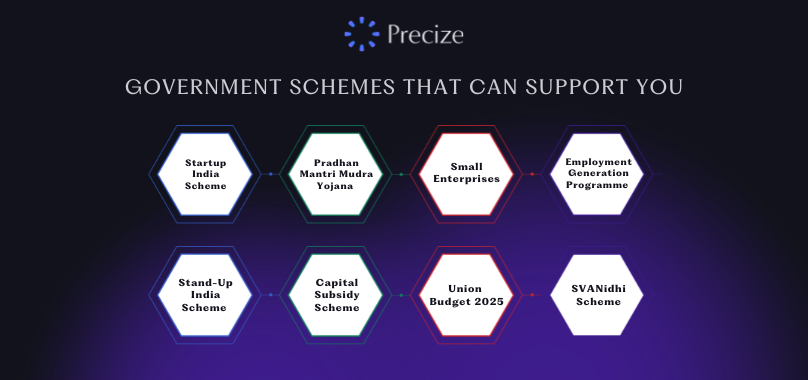
Startup India offers recognition benefits, easier patent routes for eligible startups, and access to ecosystem programmes. Overview: Startup India recognition.
Pradhan Mantri Mudra Yojana (PMMY) supports collateral-free loans for micro and small enterprises in stages (Shishu, Kishore, Tarun, and Tarun Plus in applicable cases). Official structure: PMMY on MyScheme.
CGTMSE helps eligible MSMEs access credit guarantees on loans; coverage ratios depend on loan size. Start here: CGTMSE.
PMEGP supports new manufacturing and service units with subsidies, subject to rules. MSME overview: PMEGP.
Stand-Up India targets women and SC/ST entrepreneurs for eligible greenfield projects; banks publish current slabs. Reference overview: SBI Stand-Up India.
CLCSS offers technology upgrade subsidies for eligible manufacturing equipment purchases. Scheme page: CLCSS.
Union Budget headlines still shape credit and startup narratives year to year. For a readable recap tied to India’s policy conversation, see Precize’s Union Budget 2025 note and cross-check with the official budget documents for your year of interest.
Recent illustrative policy news examples (verify freshness before citing in decks): customised credit support for micro-enterprises as reported by The Hindu; startup fund coverage as reported by Economic Times; PM SVANidhi context as reported by India Today.
Conclusion
Future business in India rewards operators who combine clear customer insight, disciplined cash management, and ethical speed. The 15 areas above are a menu, not a ranking. Your best option is usually the one you can ship consistently while staying compliant.
If part of your personal strategy includes studying India’s private growth companies alongside operating or investing in traditional assets, Precize helps facilitate access to that ecosystem. You can learn how to buy and sell unlisted shares, explore pre-IPO style opportunities responsibly, and read common questions about unlisted shares. When you want to compare names systematically, use the unlisted shares screener to screen unlisted companies by theme.
Reserve your access on the Precize portal to continue in a structured way. For broader reading on portfolio construction, see the steps to build a diversified portfolio. Alternative income and credit strategies are discussed in Precize’s coverage of global trade finance opportunities; always read risk disclosures.
Frequently Asked Questions
1. What business will grow in India through 2026?
Sectors with durable tailwinds include digital services, climate-adjacent products, energy efficiency, health access, education outcomes, EV support infrastructure, and logistics for e-commerce. Growth is never uniform across states; local validation still wins.
2. How much capital do you need to start?
It ranges widely. Service businesses can start lean; hardware-heavy models need more upfront capex and maintenance budgets. Build a monthly cash plan before you sign leases or hire.
3. Are there government grants for startups?
India uses a mix of recognition, credit guarantees, subsidies, and directed funds depending on sector and entity type. Start on official portals, then involve a CA for structuring.
4. Should I quit my job immediately?
Usually not without a runway and a validated offer. A common pattern is weekend pilots, paid pilots with three to five customers, then a staged transition once repeat orders or retainers cover baseline costs.