India’s role in the global economy is growing faster than ever, making global finance more relevant to you today. As of July 2025, India has overtaken Japan to become the world’s 4th largest economy with a nominal GDP of $4.19 trillion, and the IMF projects that by 2028, India will surpass Germany to secure the 3rd spot.
Against this backdrop, understanding global finance is not just about numbers; it’s about seeing how economies connect, trade flows, and financial systems shape opportunities worldwide.
In this blog, you will learn what global finance means, how it works, and where it stands today. You will learn about the key trends influencing its direction and the challenges it encounters in today’s interconnected global economy.
Let’s get started!
Key Takeaways
Global finance connects countries, markets, and businesses, influencing trade, investments, and economic growth worldwide.
Key trends include digital transformation, ESG focus, AI adoption, CBDCs, and shifts in global economic power.
Challenges include market volatility, currency fluctuations, regulatory complexity, cybersecurity risks, and gaps in financial inclusion.
Platforms like Precize enable access to private growth companies, pre-IPO shares, and global trade finance opportunities.
Diversifying your portfolio through such platforms can help navigate the evolving global financial landscape effectively.
What is Global Finance?
Global finance refers to the financial system that connects countries, markets, and institutions across the world. It includes the movement of money, investments, trade, and capital that link one economy to another.
When you hear about global finance, it covers everything from international banking, stock markets, and foreign exchange to cross-border trade and government policies that affect the world economy. It is not limited to one country; it works as a network where decisions made in one part of the world can influence businesses, currencies, and markets in another.
Now that you know what global finance means, let’s look at the mechanics behind how it functions worldwide.
How Global Finance Works
To understand global finance, it helps to see how money moves across countries and how these flows affect economies worldwide. Here is a clear look at the main parts of the process:
Step 1: Currency Exchange and Foreign Markets
Money moves between nations through currency exchange.
The value of one currency against another changes due to economic conditions, political events, and market demand.
Foreign exchange markets facilitate these transactions and are essential in driving global trade and investment.
Step 2: International Trade and Investment
Global finance drives the exchange of goods and services between countries.
It also supports foreign investments in companies, infrastructure, and financial assets.
Capital crosses borders through loans, direct investments, and portfolio investments, helping economies expand and create opportunities.
Step 3: Balance of Payments
Every country maintains a record of its financial transactions with the rest of the world, called the balance of payments.
This shows money coming in from exports, investments, and loans, as well as money going out for imports, repayments, and investments abroad.
Step 4: Global Financial Markets
Markets for stocks, bonds, and other securities operate across borders. These platforms enable companies to secure funding from global investors and provide investors with opportunities to spread their investments across different markets.
Step 5: Risk Management
Global finance also involves managing risks like currency fluctuations, inflation, or political changes.
Countries, businesses, and financial institutions use tools such as derivatives and insurance to protect themselves against these risks.
Step 6: Regulations and Compliance
A set of international rules and standards guides global financial activities to ensure fairness, stability, and transparency.
Organizations such as the World Bank and the International Monetary Fund (IMF) help countries follow these standards and provide guidance during financial or economic challenges.
Step 7: Impact on National Economies
Global finance directly influences economic growth, currency strength, interest rates, and trade competitiveness. Any sudden changes in global capital flows can affect a country’s financial stability and the decisions policymakers make to manage their economy.
Now that you understand how global finance operates, it’s important to see where it stands today and how current trends are shaping markets worldwide.
The Current State of Global Finance
Today, global finance is influenced by rapidly evolving markets, technological progress, and a growing focus on sustainability. Here are some key highlights that explain the present situation:
Highly Interconnected Markets
Financial markets across the world are closely linked. Every day, more than $6.6 trillion is traded in foreign exchange markets, making it the biggest and most actively traded financial market globally.
Global Growth Outlook
The World Bank estimates that global GDP is expected to grow to be around 3.2% in 2025. This shows a steady pace of expansion, even as countries face challenges such as geopolitical tensions and economic uncertainties.
Rise of Digital Currencies
Digital currencies, including central bank digital currencies (CBDCs), are becoming more common. By mid-2025, over 100 countries will be either testing or developing their own CBDCs, showing how finance is moving towards digital transformation.
Performance of Sustainable Funds
Sustainable funds attracted $20 billion in inflows during the first half of 2024, a bit lower compared to earlier periods, while their total assets grew to $3.5 trillion. During the same period, these funds delivered slightly better returns than traditional funds, outperforming them by 0.6 percentage points, largely due to strong performance in equities.
Having seen where global finance stands today, the next step is to explore the major trends shaping its evolution.
Major Trends Driving the Future of Global Finance
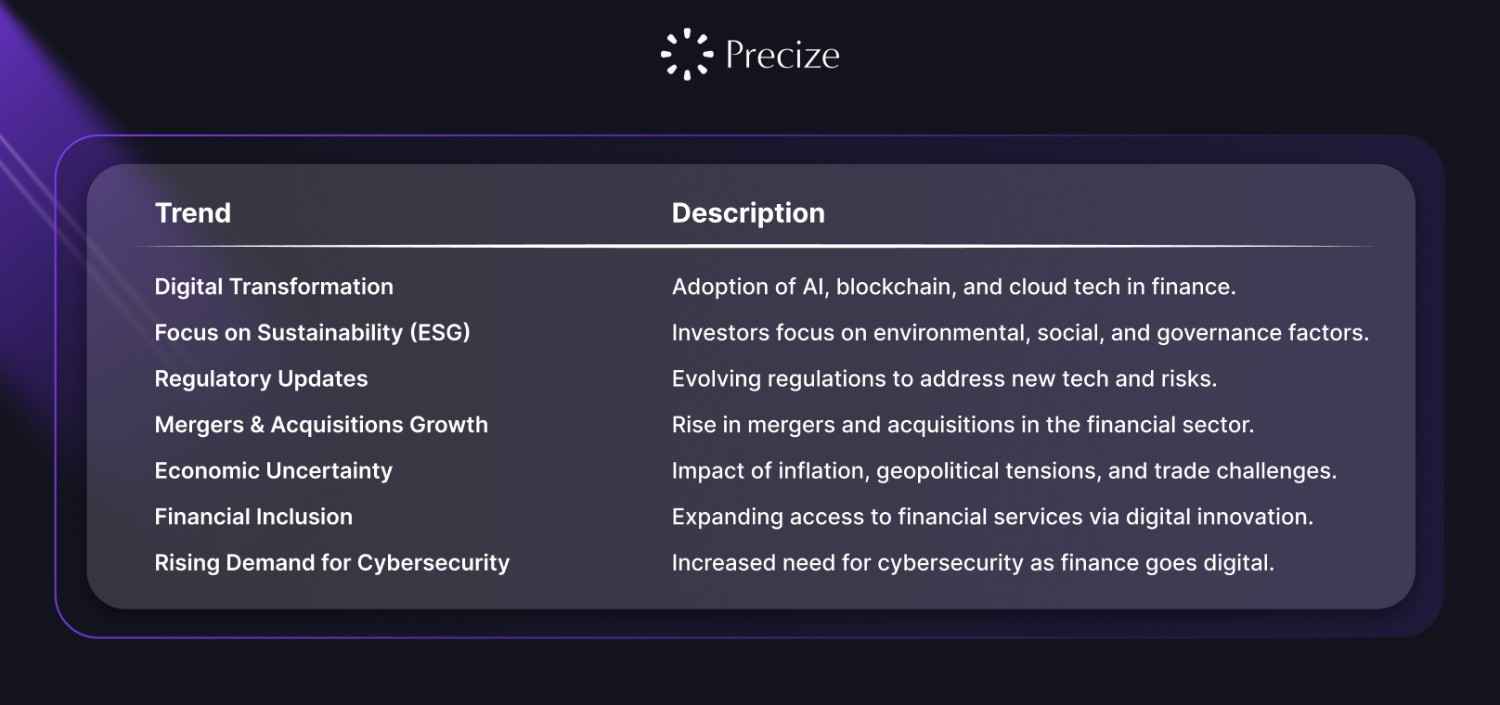
The world of global finance is evolving quickly, influenced by technology, sustainability, and shifting economic power. Here are the key trends shaping its future:
Digital Transformation
Banks and financial services are adopting technologies like Artificial Intelligence (AI), blockchain, and cloud computing at a fast pace.
These tools make transactions faster, safer, and more convenient.
Blockchain cuts out middlemen, which helps reduce costs and makes cross-border payments faster, while AI improves fraud prevention and enhances customer service.
This digital shift is making banking more accessible, often 24/7, without relying on physical branches.
Focus on Sustainability
Environmental, Social, and Governance (ESG) considerations are increasingly influencing how financial decisions are made.
Investors and institutions are increasingly evaluating how companies impact the environment, society, and governance.
This focus is shaping global investment choices and the types of financial products available.
Regulatory Updates
Governments and regulators are continuously updating rules to keep up with new technologies and emerging risks.
Regulations around cryptocurrencies, digital payments, and data privacy are evolving, affecting how financial institutions operate and deliver services.
Growth in Mergers and Acquisitions
Financial companies are increasingly merging or acquiring other firms to expand their scale and capabilities. You will notice larger financial groups and fintech firms buying startups to enhance their technology and service offerings.
Economic Uncertainty
Global inflation, geopolitical tensions, and trade challenges create unpredictable market conditions. These factors can make financial markets more volatile and impact economic stability.
Financial Inclusion
Digital innovation is making financial services accessible to previously underserved populations, especially in countries like India.
Mobile banking, digital wallets, and microloans are helping more people participate in the financial system.
Rising Demand for Cybersecurity
As financial services go digital, the risk of cyberattacks and data breaches grows. Organizations are putting significant resources into cybersecurity to safeguard data and maintain the safety of transactions.
While the future of global finance is exciting, it also presents several hurdles that institutions and markets must address.