Have you ever wondered how many people invest in the stock market in India? With the rise of online trading platforms and increasing financial awareness, more Indians are beginning to explore the world of investing.
However, the numbers might surprise you regarding the percentage of the population actively involved in the stock market.
In this blog, we’ll look at how many people in India are currently investing in the stock market and how this trend is growing. We’ll also compare India’s stock market participation with other countries and explore how Indian households allocate their money.
By the time you finish reading, you’ll have a clearer understanding of the stock market landscape in India and actionable insights to help you make more informed investment decisions.
Percentage of Indians Investing in the Stock Market
As of 2023, about 3% of the Indian population actively invests in the stock market. This number has gradually grown, thanks to factors like easier access to technology and more people becoming financially aware.
According to the National Stock Exchange (NSE), more than 120 million investors were registered between 2019 and 2023, indicating a significant rise in the Indian stock market. In January 2024 alone, over 5.4 million new investors joined.
These numbers indicate a strong shift towards investing, and it's evident that more Indians are looking to grow their wealth through stocks.
Now that we have a clearer picture of India's stock market participation, let's examine how India’s investment trends compare with those of other countries.
Comparison of India with Other Countries Investing in the Stock Market
When you compare India to other countries regarding stock market investments, several factors come into play, such as market performance, volatility, sector composition, and overall market size. Here’s a look at how India stands compared to five major countries:
United States
The United States has a well-established stock market known for its long-term growth and stability.
Market Performance: The U.S. stock market has historically provided slightly better returns than India. Over the past decade, the Dow Jones Industrial Average (DJIA) achieved a compounded annual return of 9.75%, while India’s BSE Sensex delivered 9.70%.
Japan
Japan’s stock market offers stability but has historically lagged behind other countries regarding growth potential.
Market Characteristics: Japan’s stock market, represented by the Nikkei 225 index, has been recovering from a long period of stagnation after the 1990s asset bubble burst. It offers stability but generally has lower growth potential than emerging markets like India.
Germany
Germany’s stock market is known for its stability and strong industrial base, but it generally offers lower returns than emerging markets like India.
Market Stability: The German stock market, represented by the DAX index, is known for its stability and strong industrial base. It offers lower returns than emerging markets like India but comes with significantly less risk.
Sector Focus: Germany’s stock market heavily focuses on industrial sectors, particularly manufacturing and engineering.
United Kingdom
Despite challenges, the UK stock market remains a significant global player.
Market Performance: The UK stock market has faced challenges due to Brexit and other economic uncertainties but remains a key global player. The FTSE 100 index offers moderate returns with relatively low volatility.
Sector Composition: The UK market features various sectors, including finance, energy, and consumer goods.
After comparing India’s stock market involvement with other nations, it’s crucial to understand how Indian households prefer to manage their investments.
Household Investment Preferences in India

Household investment behavior in India has changed significantly in recent years. Traditionally, Indian families preferred safer, government-backed schemes, fixed deposits, and physical assets like gold and real estate. However, more investors are now turning to the stock market. Here are trends shaping household investments in India.
Increased Participation: Around 20% of Indian households now invest their savings in the stock market. This shift has accelerated post-COVID-19, as more people seek better returns than traditional savings options.
Mutual Funds: Mutual funds have become a popular investment vehicle. In FY24, their assets Under Management (AUM) grew 35% year over year to ₹53.4 lakh crore, indicating growing trust in this investment vehicle.
Systematic Investment Plans (SIPs): SIPs have gained traction, with annual net flows doubling over the past 3 years. This trend shows that more investors are adopting a disciplined, regular approach to investing.
After exploring household investment preferences, let’s examine how these preferences are reflected in the distribution of household assets.
Household Asset Distribution in India
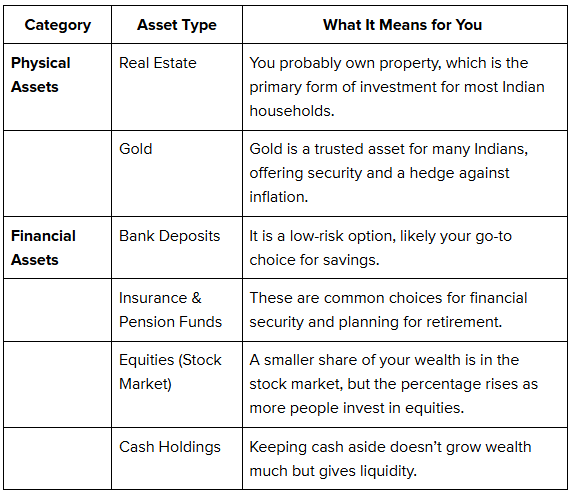
As of March 2023, Indian households hold a total asset value of around $11.1 trillion. Much of this wealth is tied up in physical assets like real estate and gold, which have always been favored. But there’s also a growing shift towards financial assets. Here’s how these assets are distributed:
Conclusion
India’s stock market participation has experienced impressive growth, reflecting a significant shift towards investing in financial assets. Given the number of people investing in the stock market in India, the rise in investor numbers shows a substantial opportunity for further growth, especially as more Indians gain access to technology and financial knowledge.
As the culture around financial assets evolves, more people are expected to explore stock market investments. A greater emphasis on financial literacy and the ease of digital platforms can drive further inclusion in the stock market, helping more individuals build wealth through informed investment choices.
If you’re seeking new ways to diversify your investment portfolio, Precize offers alternative investment options in India. With Precize, you can explore opportunities like private credit and private equity, also known as pre-IPO shares.
The platform allows you to easily explore unlisted companies, participate in global trade finance, and access in-depth research to guide investment decisions.
Reserved access to explore new investment opportunities and diversify your portfolio!