Everywhere you look, the world around you is changing, whether it’s the way you travel, the way you learn, or even the technology that powers your daily life. These shifts are being driven by new industries that are quickly becoming the backbone of the future economy.
In India, the pace of growth has shown some ups and downs, with industrial growth easing to around 4% in September 2025 compared to 2.9% in May and 3.0% in March, mainly because of slower manufacturing, electricity, and a dip in mining activity. This makes it even more important to look at the sectors that are picking up speed and shaping tomorrow.
In this blog, you’ll learn what defines an emerging industry and discover the top new industries to watch in 2025, including AI and ML, Renewable Energy and Clean Tech, Healthcare and Biotechnology, and many more.
Let’s get into it!
Overview
Emerging industries are sectors built on innovation, technology, and changing global needs, driving future growth.
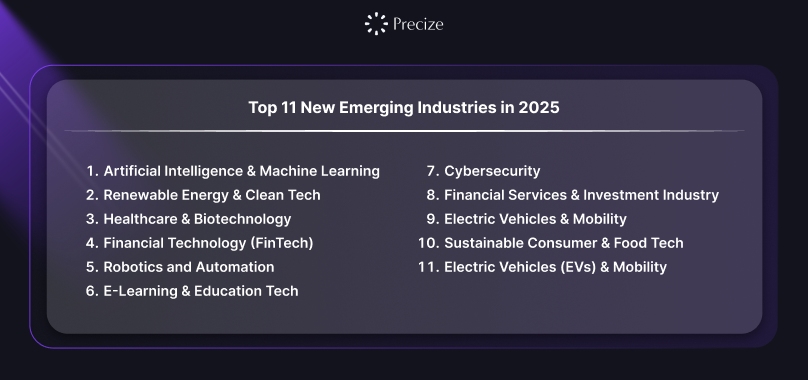
Key new industries in 2025 include AI & Machine Learning, Renewable Energy, Healthcare & Biotechnology, FinTech, Robotics, E-Learning, Cybersecurity, Financial Services, Electric Vehicles, and Sustainable Consumer Tech.
These industries focus on solving global challenges like clean energy, digital security, healthcare innovation, and sustainable living.
Growth is driven by rising technology adoption, policy support, consumer demand, and a shift toward sustainability.
What Defines an Emerging Industry?
An emerging industry is a new sector of the economy that is still in its early stage of development but shows strong potential for long-term growth. It is usually built around modern technologies, innovative solutions, or changing consumer needs that traditional industries cannot fully meet. Unlike well-established sectors, an emerging industry is not yet mature, but it grows quickly as new products, services, and business models are introduced.
Once we define what an emerging industry is, the next step is to see which sectors are currently driving growth and creating new opportunities in 2025.
Top 11 New Emerging Industries in 2025
The business world is evolving quickly, and many new industries are gaining momentum because of innovation, changing consumer needs, and government support. These sectors are set to drive major changes in the global economy while opening new opportunities in the years ahead. The following are the top 10 emerging industries in 2025 that you should know about:
1. Artificial Intelligence (AI) & Machine Learning (ML)
AI and ML create systems that use data to identify patterns and make decisions with little to no human involvement. In India, AI is moving from pilots to real adoption across healthcare, finance, agriculture, and public services.
Applications
When you look at where AI/ML show up in daily life and business, you’ll see wide, practical uses:
Chatbots, voice assistants, and automated customer support.
Fraud detection, risk scoring, and algorithmic trading in finance.
Medical imaging analysis, triage tools, and clinical decision support.
Demand forecasting, route optimization, and predictive maintenance.
Personalization in e-commerce, media, and marketing campaigns.
Smart farming: yield prediction, disease detection, and input planning.
Growth Drivers
What’s pushing AI/ML forward right now is a mix of tech, policy, and demand:
Exploding data volumes and affordable cloud compute.
India’s digital public infrastructure (Aadhaar, UPI, ONDC) is enabling new use cases.
Government programs, research funding, and GPU access for startups.
Enterprises need automation, accuracy, and faster decisions.
Growing talent pool and active startup ecosystem.
Future Outlook
AI and ML are expected to expand into multiple sectors, including healthcare, education, retail, and governance.
In India, the rise of digital adoption means these technologies will become central to improving productivity, reducing manual work, and fostering innovation.
India’s AI market is expected to grow to USD 7.84 billion by 2025, with an annual growth rate of 26.37% from 2025 to 2031, which could take the market size to USD 31.94 billion by 2031.
On a global scale, the United States will remain the largest market, valued at USD 73.98 billion in 2025.
2. Renewable Energy & Clean Tech
Renewable energy uses naturally replenishing sources like solar, wind, and hydro, while clean tech reduces emissions and improves efficiency. For India, it supports energy security, cleaner air, and long-term growth.
Applications
If you scan the energy landscape, clean solutions are appearing across segments:
Utility-scale solar and wind parks; rooftop solar for homes and MSMEs.
Advanced battery storage and smart power plants.
Green hydrogen for industry and long-haul mobility.
Smart grids, smart meters, and demand-response programs.
Waste-to-energy, biogas, and efficient industrial processes.
Growth Drivers
The momentum comes from policy, costs, and corporate action:
National targets toward 2030 and state-level tenders.
Falling capex for solar, wind, and storage technologies.
ESG goals and decarbonization plans across industries.
Grid modernization and better financing models.
Energy security needs and rising urban demand.
Future Outlook
India’s renewable energy sector is witnessing strong growth and is expected to expand even more in the coming decade. By mid-2025, the country had installed 242.8 GW of non-fossil fuel capacity, which includes 233.99 GW from renewable sources and 8.8 GW from nuclear power.
This makes up just over 50% of India’s total power capacity of 484.82 GW. What makes this growth more remarkable is that renewable energy has nearly tripled from 76.37 GW in 2014 to 233.99 GW in 2025, marking a clear shift toward cleaner and sustainable energy.
With continued policy support and private investment, the sector is set to remain one of the most important industries shaping India’s future.
3. Healthcare & Biotechnology
Healthcare and biotech blend medical science with advanced technology to improve diagnosis, treatment, and prevention. India’s strengths in pharma, clinical research, and digital health are accelerating progress.
Applications
When you map use cases, you’ll notice innovation from lab to patient:
Vaccine platforms, biosimilars, and novel biologics.
Genomics, precision medicine, and companion diagnostics.
Telemedicine, eICU/remote monitoring, and e-pharmacy.
Bio-agriculture: improved seeds, biofertilizers, and biopesticides.
Diagnostics: rapid tests, point-of-care devices, and AI triage.
Growth Drivers
Several shifts are driving steady, long-term demand:
Rising lifestyle diseases and aging populations in cities.
Public health programs and expanding insurance coverage.
Strong pharma manufacturing base and export capabilities.
Digital health adoption by hospitals, payers, and patients.
Global R&D partnerships and contract research growth.
Future Outlook
Looking ahead, healthcare and biotechnology are set to transform India’s economy as well as global healthcare systems.
India’s bioeconomy was valued at USD 165.7 billion in 2024 and is projected to double, touching USD 300 billion by 2030, with an impressive 17.9% CAGR.
At the same time, the healthcare sector is becoming one of the country’s largest employers.
These figures highlight the strong potential of this industry, which will continue to drive innovation, create jobs, and improve access to advanced medical solutions.
4. Financial Technology (FinTech)
FinTech uses software and data to deliver faster, safer, and more inclusive financial services. India’s UPI-led payments and digital KYC stacks make it a global standout.
Applications
If you consider everyday money tasks, you’ll find FinTech simplifying each step:
UPI payments, wallets, and merchant QR ecosystems.
Digital lending and BNPL for consumers and MSMEs.
Insurtech: instant policies, claims automation, risk scoring.
Wealthtech: robo-advice, micro-investing, and goal-based planning.
Regtech and fraud analytics for safer transactions.
Cross-border payments and remittances.
Growth Drivers
Adoption is rising due to strong digital rails and changing behavior:
Smartphone penetration and low-cost data.
Public digital infrastructure and simplified KYC.
Shift to cashless and contactless experiences.
Open banking frameworks and API ecosystems.
Startup innovation and bank–FinTech partnerships.
Future Outlook
FinTech in India is growing at an extraordinary pace and is set to remain one of the country’s most dynamic industries.
India also has more than 9,000 FinTech entities, making it the third-largest hub in the world.
With FinTech adoption at 87%, much higher than the global average of 67%, India continues to lead in digital finance innovation.
The industry is also backed by strong startup funding, contributing about 14% of overall investments in the country, ensuring that FinTech will remain central to India’s financial growth story.
5. Robotics and Automation
Robotics handles physical tasks with precision, while automation streamlines repetitive digital work. Together, they boost quality, speed, and safety across factories, hospitals, and warehouses.
Applications
When you step onto the shop floor or into a warehouse, automation is everywhere:
Industrial robots for assembly, welding, and inspection.
Collaborative robots (cobots) assist human operators.
Robotic Process Automation (RPA) for back-office workflows.
Drones for surveying, inventory counts, and agriculture.
Surgical robots and automated pharmacy systems.
Autonomous mobile robots (AMRs) for material movement.
Growth Drivers
A few practical needs are accelerating adoption:
Demand for higher throughput and consistent quality.
E-commerce growth and just-in-time logistics.
Industry 4.0, sensors, and IIoT connectivity.
Declining hardware costs and better ROI models.
Safety, compliance, and labor upskilling needs.
Future Outlook
The future of robotics and automation looks extremely promising, especially as industries continue to push for greater efficiency and precision. In India, robotic process automation (RPA) is witnessing rapid adoption across sectors.
The market, which generated around USD 73.4 million in 2024, is expected to grow significantly and reach USD 729.1 million by 2030.
This reflects a strong CAGR of 48.8% from 2025 to 2030, showing how quickly businesses are embracing automation to streamline processes and cut down on repetitive tasks.
With factors like digital transformation, growing labor shortages, and the rising need for cost efficiency, robotics and automation are set to become a central pillar of industrial growth in the coming years.
6. E-Learning & Education Tech
EdTech delivers flexible, affordable learning through digital platforms. It supports schools, colleges, and lifelong learners with content, assessments, and analytics.
Applications
If you look at how people learn today, you’ll see digital tools at every level:
K–12 platforms, smart classrooms, and teacher tools.
Test prep, language learning, and foundational skills.
Professional upskilling, placements, and certification paths.
Corporate L&D, compliance training, and simulations.
Assistive tech for inclusive education and accessibility.
Growth Drivers
Several trends are shaping steady, nationwide demand:
Wider internet access and device affordability.
NEP-aligned focus on skills and blended learning.
Employers need job-ready, digital skills.
Regional language content and micro-learning formats.
Outcome tracking with analytics and AI tutoring.
Future Outlook
Looking ahead, the future of online education in India appears extremely promising. The industry is expected to generate close to US$7.57 billion in revenue by 2025 and is projected to grow at an annual rate of nearly 25.8% between 2025 and 2029, reaching almost US$18.94 billion by 2029.
Within this, online learning platforms alone are forecasted to contribute around US$6.20 billion in 2025.
With innovations like gamified learning, AI-driven personalization, and regional language content, digital education is set to become a mainstream and long-term solution for both academic and professional learning needs.
7. Cybersecurity
Cybersecurity protects data, identities, apps, and infrastructure from attacks. As payments, healthcare, and government services go digital, resilience becomes essential.
Applications
When you examine real risks, defense layers cover people, process, and tech:
Identity and access management; multi-factor authentication.
Network, endpoint, and email security; zero-trust architectures.
Cloud security posture management and container security.
Threat intelligence, SOC operations, and incident response.
Data loss prevention and encryption; backup and recovery.
Growth Drivers
Threat levels and compliance needs are raising the bar:
More ransomware, phishing, and fraud in digital channels.
Cloud adoption and distributed work models.
Data protection regulations and sectoral guidelines.
Board-level focus on operational resilience.
Shortage of skilled professionals driving tooling and services.
Future Outlook
Cybersecurity is set to grow rapidly as the number of threats keeps rising. In India, the Data Security Council of India reported that over 369 million malware detections were recorded across 8.44 million endpoints in 2025, reflecting the scale of challenges businesses face.
This shows how important it will be to develop advanced defense systems using artificial intelligence, real-time monitoring, and automated threat detection.
Looking ahead, cybersecurity will remain one of the most essential industries, as both individuals and organizations demand stronger digital protection.