
Raising money is one of the biggest needs for any growing business, and companies often look at different ways to bring in funds. One such method is private placement of shares, where shares are offered to a selected group of investors instead of the general public.
In this blog, you will learn what private placement of shares means, the advantages and disadvantages it brings, and the complete step-by-step process followed in India.
You will also see how private placement is different from preferential allotment and rights issue, so you gain a clear understanding of how this method works in practice.
Let’s get into it!
Overview
Private placement of shares means raising funds by offering shares to a limited group of investors, not the general public.
It is faster, cost-effective, and more private compared to a public issue, but comes with strict compliance rules.
The process involves board approval, drafting offer letters, shareholder approval, receiving funds, allotment, and regulatory filings.
It differs from preferential allotment and rights issue in terms of investor base, pricing, compliance, and purpose.
What is Private Placement of Shares?
When you hear the term private placement of shares, it simply means that a company is offering its shares to a selected group of investors, instead of opening it up to the public. In India, this process is regulated under the Companies Act, 2013, and SEBI guidelines to make sure everything stays transparent and within the law.
Unlike an IPO, where anyone from the public can subscribe, a private placement is limited to a small number of chosen investors such as institutions, venture capital firms, banks, or high-net-worth individuals.
Once the concept is clear, it becomes easier to explore the main advantages that come with private placement of shares.
Advantages of Private Placement of Shares
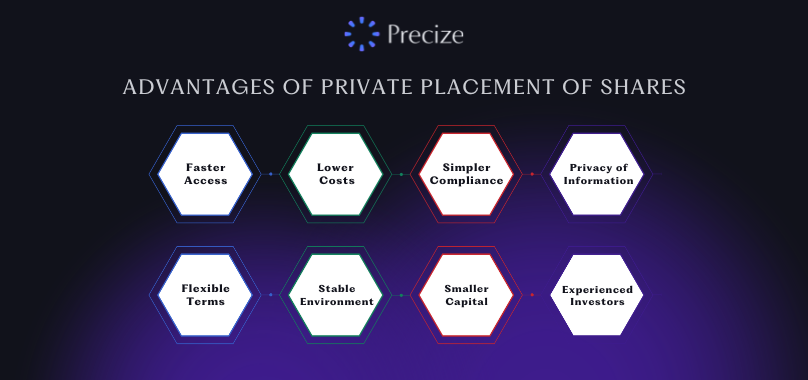
When you go for the private placement of shares, there are several advantages that can make the fundraising process simpler and more practical for your company in India.
Faster Access to Funds
The process takes less time compared to a public issue. Since you avoid lengthy procedures, you can raise money within a shorter period.
Lower Costs
You don’t need to spend on heavy advertising, printing a prospectus, or other expensive paperwork. This makes it more budget-friendly, especially for small and medium-sized businesses.
Simpler Compliance
The legal requirements are fewer than in a public offering. With less documentation and reduced scrutiny, following the rules becomes easier.
Privacy of Information
Since shares are offered to a selected group of investors, your company details and strategies remain confidential. Unlike public issues, you don’t need to reveal everything to the open market.
Flexible Terms
You have the freedom to negotiate directly with investors. This helps create agreements that suit both sides and allows more customized arrangements.
Stable Environment
Private placement is not affected by the daily ups and downs of the stock market. This makes fundraising more stable and predictable.
Suitable for Smaller Capital Needs
If you only require a smaller amount of funds, private placement allows you to raise them without the pressure of collecting large sums as in a public issue.
Access to Experienced Investors
Many times, private placements bring in investors who not only provide funds but also share knowledge, experience, and business insights that can support your growth.
Even though private placement offers many positives, it’s equally important to look at the disadvantages.
Disadvantages of Private Placement of Shares
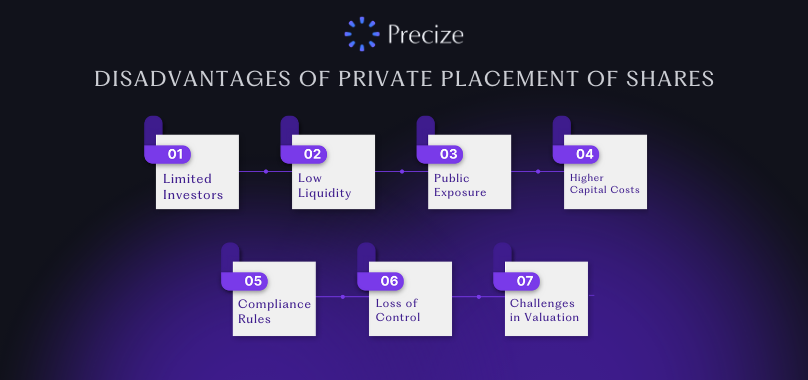
If you’re considering the private placement of shares, it’s important to understand the challenges that come with this route. Here are the main drawbacks you should know:
Limited Number of Investors
In India, private placement can be made only to a maximum of 200 investors in one financial year (excluding institutional buyers and employees under ESOPs). This limited pool makes it harder to raise large amounts of money compared to a public issue.
Low Liquidity
Shares issued through private placement are not easily tradable in the open market. This means investors may find it difficult to quickly convert them into cash when needed.
Less Public Exposure
Unlike an IPO, a private placement does not increase your company’s visibility or reputation. Since it happens quietly and with fewer investors, it doesn’t create the same level of goodwill or recognition in the market.
Higher Capital Costs
While you save on advertising and public issue expenses, you may still need to pay fees to placement agents or banks. At times, companies may also have to issue shares at a discount or promise higher returns to attract investors, which increases the overall cost of capital.
Strict Compliance Rules
Even though private placement avoids some IPO regulations, it still comes with strict requirements under the Companies Act, 2013 and SEBI rules. Any mistake in filing forms, exceeding investor limits, or missing steps can lead to penalties, fines, or even legal consequences for directors.
Possible Loss of Control
Bringing in external investors often means sharing decision-making power or profits. This can reduce the level of control your company’s management has over certain decisions.
Challenges in Valuation
With no open market pricing, deciding the fair value of shares can be difficult. This sometimes leads to negotiation issues with investors.
With the advantages and disadvantages in mind, let’s walk through the step-by-step process of private placement in India.
Step-by-Step Process of Private Placement of Shares
The private placement of shares follows a defined legal procedure in India. Below is a step-by-step process that you need to follow to complete it correctly.
Step 1: Board Approval
You begin by getting approval from the board of directors.
The board identifies the selected group of investors and approves the private placement plan.
Step 2: Draft the Offer Letter (Form PAS-4)
You then prepare the private placement offer letter in Form PAS-4.
This document should include details such as the number of shares, the price, and the payment terms.
You must send it directly to the chosen investors, either in written or electronic form.
Step 3: Shareholder Approval by Special Resolution
Next, you organize a general meeting where shareholders must pass a special resolution to approve the private placement of shares.
Step 4: Send Offer Letters to Identified Investors
You issue serially numbered offer letters only to the investors recorded by the company. You cannot use public advertisements, media, or marketing channels to announce the offer.
Step 5: Investor Acceptance
Interested investors accept the offer by filling out and submitting the application form attached to the offer letter.
Step 6: Receive Application Money
You collect the subscription money from the identified investors. This money must be kept in a separate bank account until the shares are allotted.
Step 7: Allot Shares
After receiving the funds, you allot the shares to the investors. The allotment must be completed within 60 days from the date you receive the application money.
Step 8: File Return of Allotment (Form PAS-3)
Within 15 days of allotment, you file Form PAS-3 with the Registrar of Companies (ROC).
This form must include details of the allottees and the number of shares issued.
Step 9: Update Registers and Ensure Compliance
Finally, you update the register of members and complete all other compliance requirements under the Companies Act, 2013 and SEBI regulations.
After looking at the process, the next step is to understand how private placement differs from similar fundraising methods available to companies.
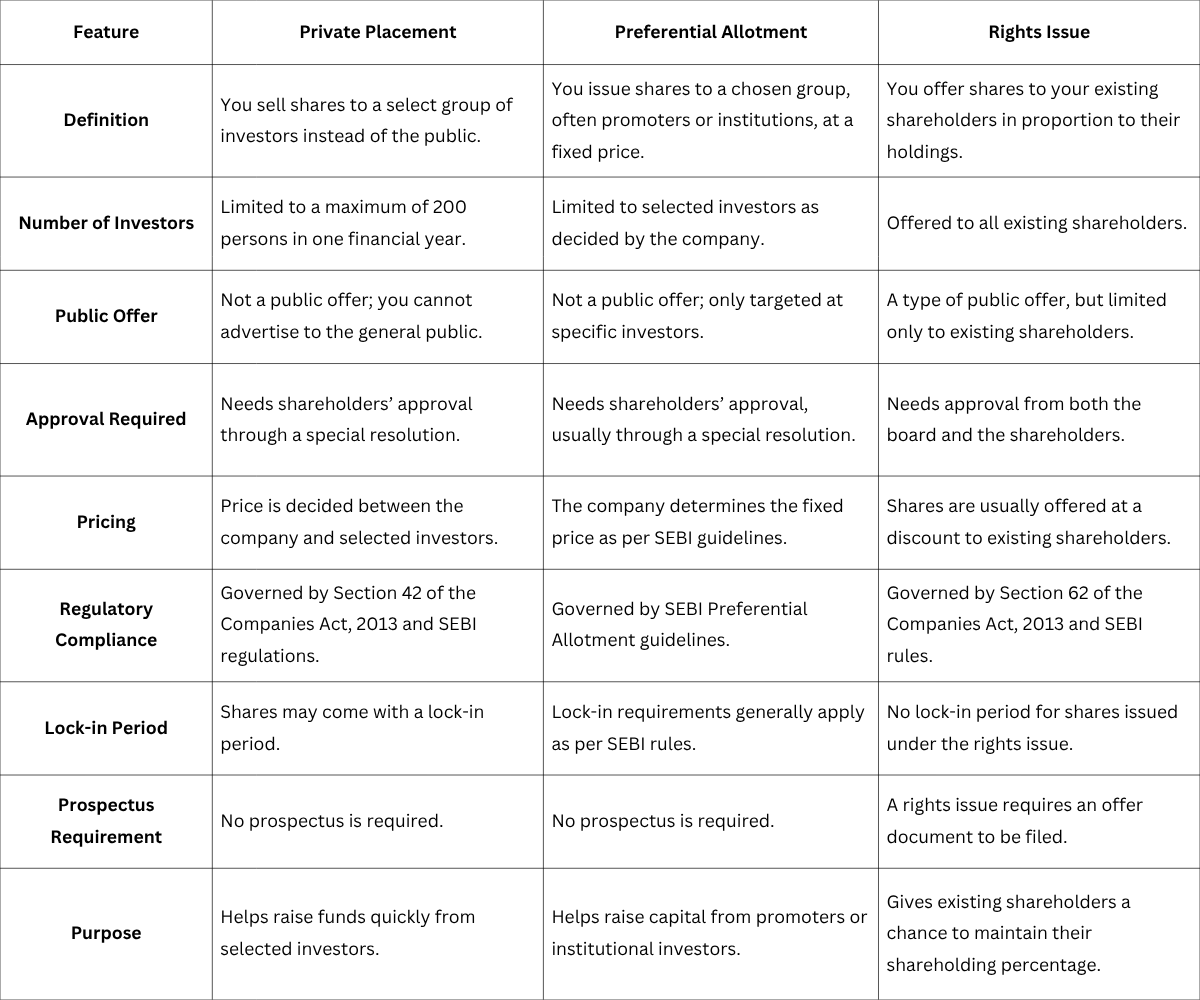
Private Placement vs Preferential Allotment vs Rights Issue
When your company needs to raise funds by issuing shares, you can choose from different methods such as private placement, preferential allotment, or rights issue. Each method has its own rules, process, and compliance requirements. Here’s a comparison to help you understand how they differ:
Conclusion
By now, you have gone through everything about private placement of shares, its meaning, the key features, the pros and cons, the detailed process, the legal framework in India, and how it differs from preferential allotment and rights issue. With this understanding, you can clearly see how private placement works as a structured method for companies to raise funds in a faster and more controlled way.
At Precize, the approach goes beyond just explaining the concept. It focuses on facilitating access to private companies, where investors can buy and sell unlisted and pre-IPO shares with ease. Along with this, Precize also creates global trade finance opportunities, opening doors for portfolio diversification through alternative fixed-income investments.
Reserve your access today to discover these exclusive opportunities for a diversified portfolio!