Transline Technologies IPO: Why 100% OFS changes the investment question
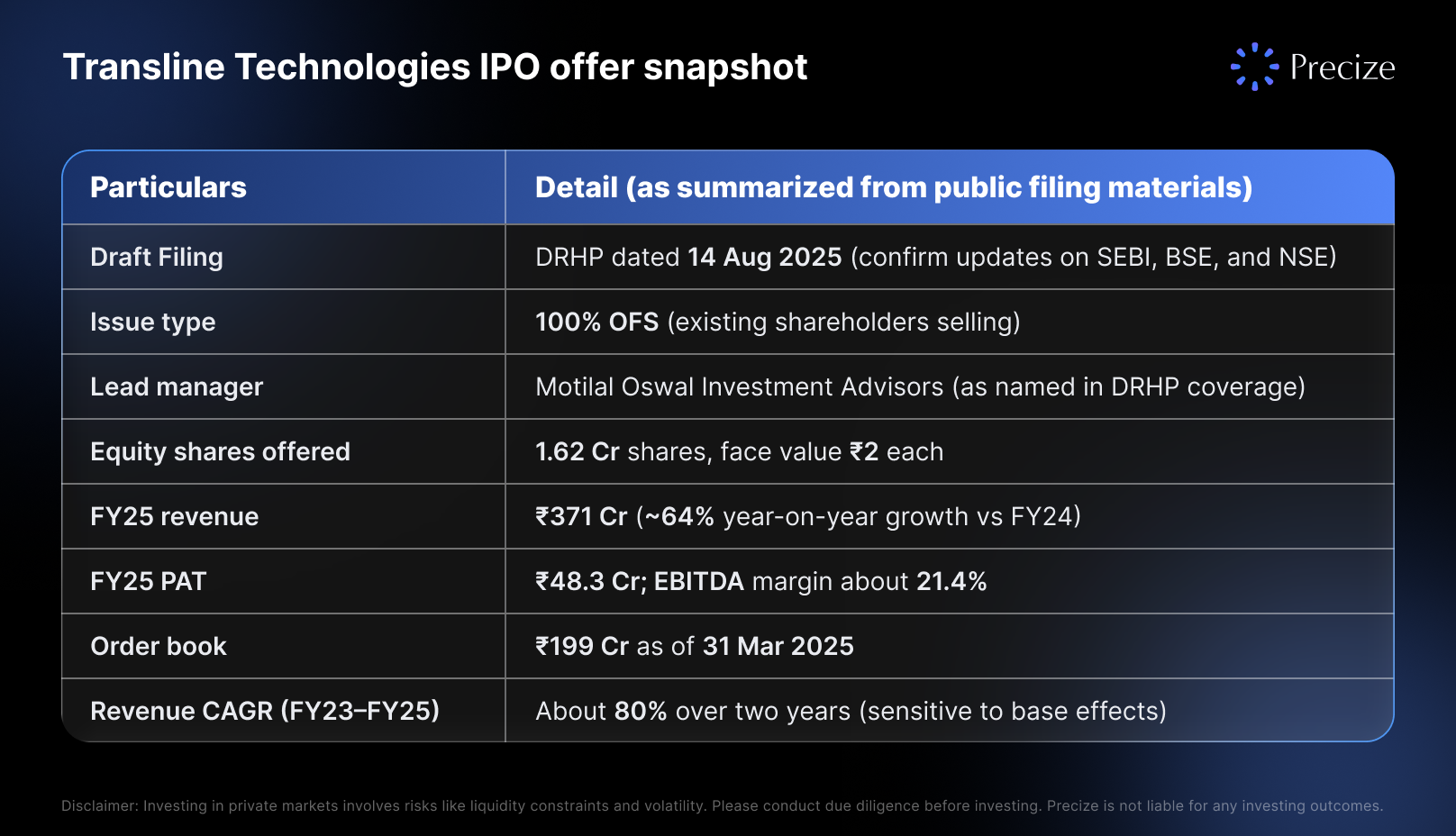
An offer for sale means existing shares change hands; the issuer does not raise primary capital for capex, research and development, or balance sheet repair through the public offer (unless a separate programme exists outside this tranche).
Reported sellers (illustrative from coverage): promoter family entities and related shareholders, including large blocks attributed to Amita Gupta, RKG Enterprises Pvt. Ltd., Arun Gupta HUF, and a smaller slice from Rahul Jain. Weighted average acquisition costs cited in commentary span from under ₹1 to about ₹54 per share on legacy positions. That creates listing-day economics that favour long-term holders who got in early; public buyers price risk today.
Post-offer: promoter holding steps down from about 71% while total shares outstanding stay on the same base (no new issuance in a pure OFS). Liquidity improves; alignment questions deserve an investor meeting answer set on use of proceeds elsewhere (internal cash, related ventures, diversification).
Fair takeaway: OFS can be legitimate liquidity. It still forces you to ask why now, and whether valuation compensates for no primary cash and issuer-side constraints.
Transline Technologies IPO sector backdrop (interpret cautiously)
India’s video surveillance and biometrics markets sit inside smart cities, transport, SAFE City, and Aadhaar-linked workflows. You can track policy direction through official programmes such as the Smart Cities Mission and identity infrastructure updates from UIDAI. Third-party market size forecasts vary widely; treat CAGR figures as directional. The operational truth is policy budgets plus installation cycles, which lag headlines.
Peers: Rough compass, not a scoreboard
Until IPO pricing lands, price-to-earnings comparisons are guesswork. Qualitatively, names such as Nelco, Orient Technologies, and Allied Digital Services offer listed anchors with different mixes (satellite, IT services, integrated IT). Transline’s growth slope may deserve attention; government exposure and working capital often drive discounts versus capital-light SaaS.
Other signals investors notice:
Some pre-IPO registers include well-known minority shareholders (commentary often names Ramesh Damani, Green Portfolio, Chryseum Advisors). Smart money presence can reduce information asymmetry somewhat; it does not replace your own checks on cash conversion and related-party flows.
The lead manager brand helps distribution and process discipline; it does not guarantee post-list performance.
Grey market premium (GMP)
Informal GMP (~₹33 per share mentioned in street chatter at times) reflects sentiment, not DCF. Ignore it for fair value; watch institutional subscription, pricing, and margins post-listing instead.
Transline Technologies IPO valuation checklist before you apply
Before you decide on the Transline Technologies IPO, treat this as a valuation and risk exercise, not a headline-growth trade. A simple checklist keeps decision quality high:
Check valuation versus listed peers: Once the price band is out, compare implied P/E, EV/EBITDA, and growth-adjusted multiples with integrator peers. If the Transline Technologies IPO asks for a software-style premium without software-scale revenue, you should discount aggressively.
Stress-test working capital: Model receivables at current levels and at a slower collection scenario. If the cycle stays around 165 days, ask what that means for debt, interest costs, and free cash flow.
Track customer concentration risk: Test what happens if one large government account is delayed or reduced. For the Transline Technologies IPO, concentration is not a side note; it is central to downside math.
Review promoter intent and post-list behavior: In a pure OFS, governance and communication quality after listing become even more important. Listen for clear capital-allocation language in management commentary.
Separate listing pop from business quality: Even if subscription is strong, your base case should come from earnings durability and cash conversion, not only demand momentum.
If this checklist still supports your thesis, a measured position size can make sense. If it does not, skipping the Transline Technologies IPO is also a valid investment decision. In short, your Transline Technologies IPO decision should come from valuation discipline, not momentum alone.
What to monitor after the Transline Technologies IPO lists
The first four quarters after listing will tell you whether the Transline Technologies IPO case is durable or mostly cyclical timing. This is where the Transline Technologies IPO narrative either strengthens with data or weakens under execution pressure.
Receivables days and cash from operations: This is the biggest health signal. Reported profit must increasingly convert into operating cash.
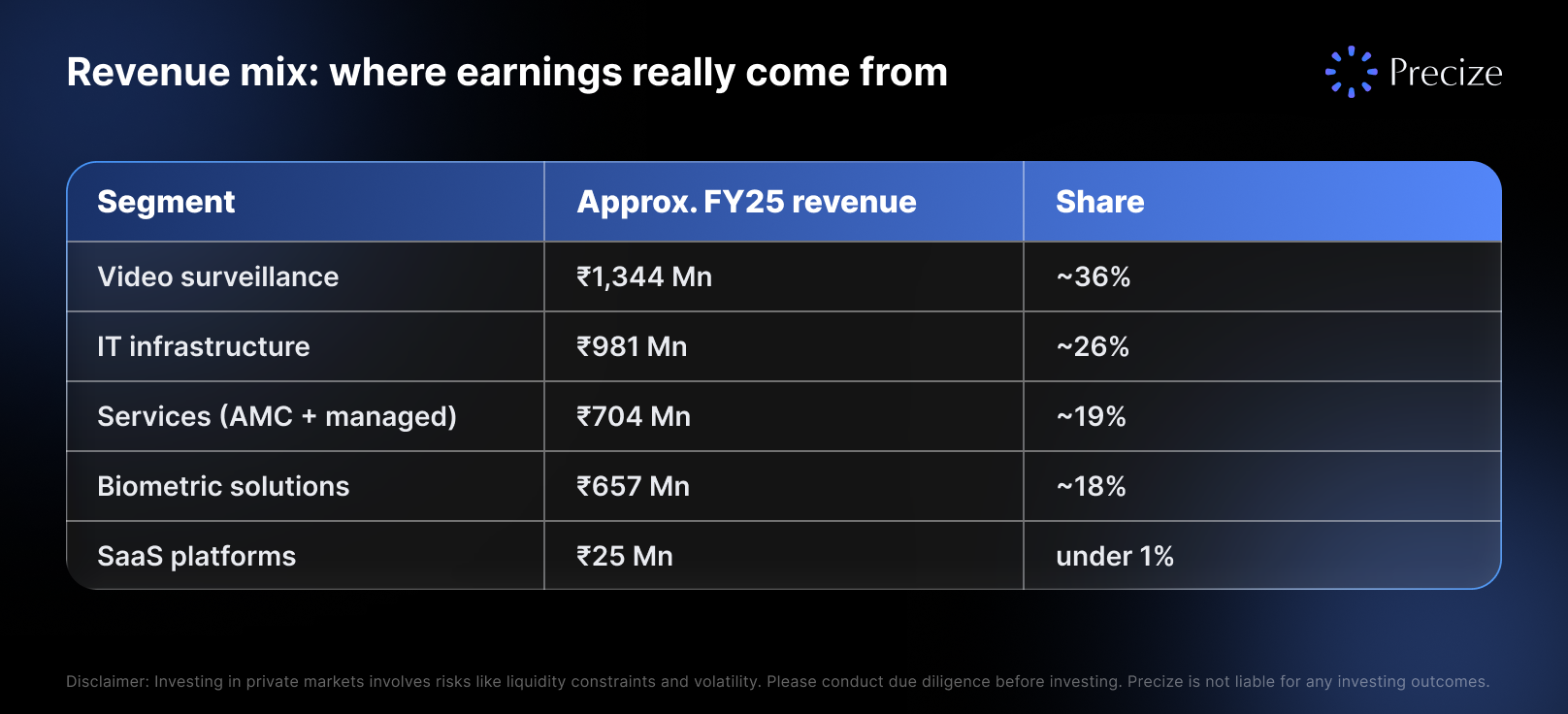
Mix shift toward services and software: Watch whether SaaS and managed-service contribution rises in a measurable way.
Margin quality by segment: Growth with stable or improving gross and EBITDA margins is better than growth purchased through low-margin bidding.
Customer diversification: Reduction in top-customer share would materially improve risk-adjusted valuation.
Order-book conversion speed: Large order books look strong on paper, but billing cadence and execution quality decide actual revenue quality.
For readers building a broader pipeline, compare this setup with other pre-listing opportunities in the Precize screener, then read similar company updates on the Precize blog.
Strengths and risks
Strengths
Strong growth and profitability versus many mid-market integrators.
Four pillars (surveillance, biometrics, infra, services) reduce single-product reliance.
Software modules could raise attachment rates over time if adoption grows.
Order book near ₹199 Cr supports near-term visibility (subject to execution and approvals).
Sector spend themes aligned with urban security and digital identity.
Debt ratios not alarmist on headline metrics.
Risks
100% OFS; no primary capital for growth or working capital optimization via the IPO.
Legacy acquisition costs vs IPO price create winner/loser asymmetry among holders.
Customer concentration (top 10 ~81% in cited materials).
Government billing delays and tender risk.
Working capital length (~165 days) vs scaling ambition.
SaaS revenue still a rounding error in disclosed mix.
Margin pressure possible as competition intensifies.
Verdict (educational, not a rating)
Transline blends a rare growth print with credible software hooks, but the OFS-only shape and government project economics argue for valuation discipline. If pricing embeds a fair discount for customer concentration and working capital, long horizon investors who understand integration cycles may still find the story worth studying. Traders should wait for the final price band, anchor book, and subscription data rather than chase grey market prints. At the right price, the Transline Technologies IPO can be watchlist-worthy; at an aggressive price, it becomes easy to pass. For most readers, the best way to handle the Transline Technologies IPO is to size small, track quarterly evidence, and add only if execution keeps matching the story.
For more on how we think about private and pre-IPO research, browse the Precize blog. General platform questions are covered in our FAQs.
Disclaimer: This article is for informational purposes only and is not investment, legal, or tax advice. IPO and unlisted investing involve risk of loss and illiquidity. Numbers and dates are summarised from public commentary and draft filings and may change; always read the latest prospectus, SEBI filings, and exchange notices. Precize is not a stock exchange and is not a substitute for professional advice.