Heyy Guys!! What’s up? In the unlisted share market world, up in the air is the question of “ What are unlisted share / Can these shares be Dematerialized?”
Let's start unwrapping the answer to this question by knowing.
WHAT ARE UNLISTED SHARES/ PRE-IPO?
Unlisted shares, or pre-IPOs, are shares of a company that are not publicly traded on a stock exchange. To know in depth about unlisted shares, See 1. Little money, big profit 3. Are unlisted shares a good investment..
To know the answer to whether or not unlisted shares can be dematerialized, we first have to know what are the forms of unlisted shares and the differences between them so that we can draw a conclusion about dematerialized shares.
There are two forms of unlisted shares:
Physical form
Dematerialized form
What are physical unlisted shares?
Physical unlisted shares are like paper certificates showing that you own a part of a company that isn't on the stock market. They are harder to sell because there's no open market for them, and figuring out how much they're worth can be tricky. You need to keep these certificates safe because they prove your ownership. Regulations for these shares are different from those of publicly traded companies. While they have challenges, they can offer unique investment opportunities, especially in smaller, private companies. Some companies allow you to turn these paper certificates into digital records to make them easier to trade.
Now let's see “What is Dematerialization of shares?”
In simple words, the Dematerialization of shares is like turning physical, paper-based share certificates into digital or electronic records. It makes owning and trading shares much simpler because you can manage them online, just like money in a bank account.
To dive into the depth of the dematerialization of shares, let's see what the process is.
A central depository system often facilitates the transition from physical to electronic shares and is a significant step in modernizing and streamlining the securities market.
Process of dematerialization of shares for Listed and Unlisted shares
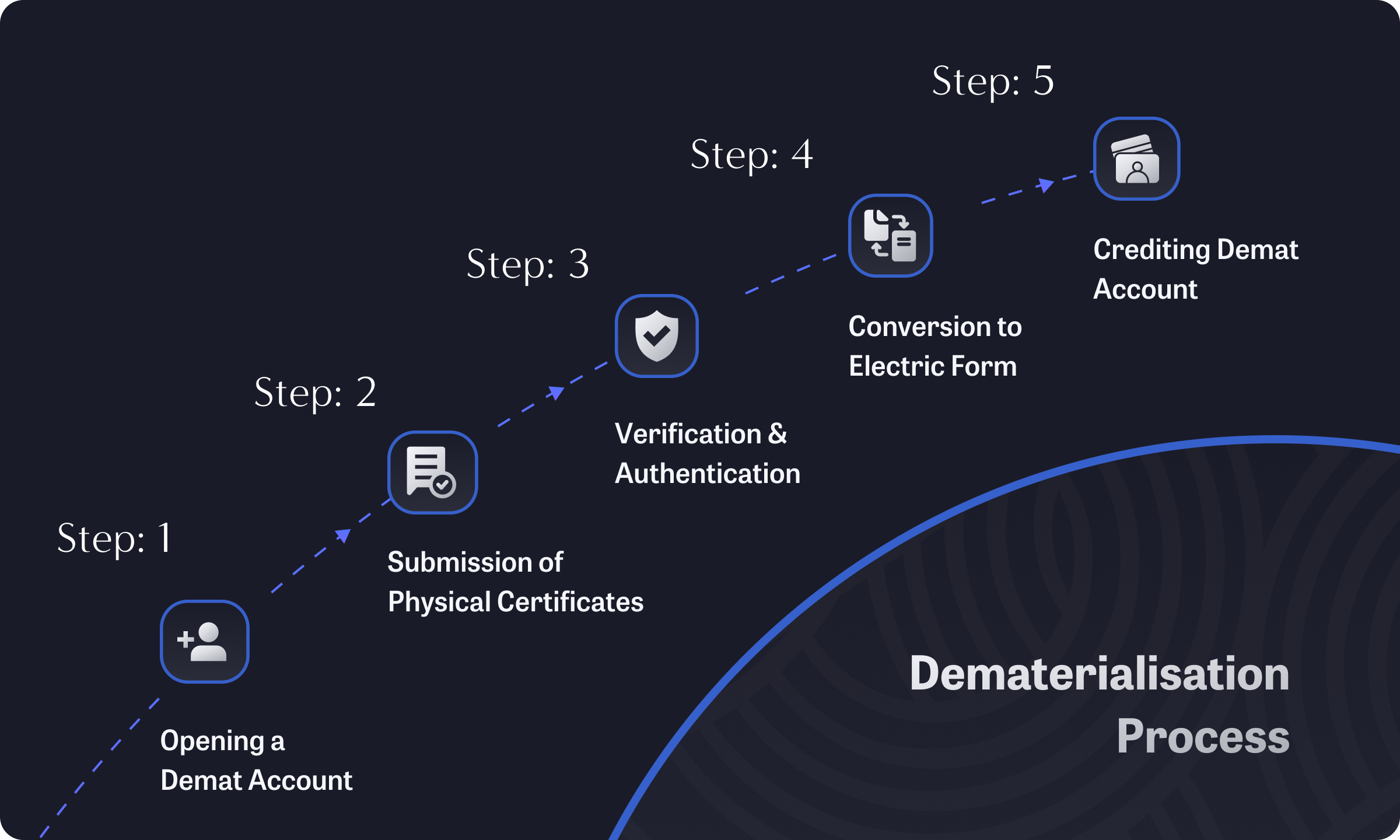
Opening a Demat Account: To initiate the dematerialization process, an investor must open a Demat (Dematerialized) account with a registered DP. A DP is a financial institution or brokerage authorized to offer Demat services.
Submission of Physical Certificates: The investor submits the physical share certificates they wish to dematerialize to their DP. These certificates represent their ownership of shares in a company.
Verification and Authentication: The DP verifies the authenticity of the share certificates and ensures that they are eligible for dematerialization. The certificates must be free from any encumbrances, such as liens or legal disputes.
Conversion to Electronic Form: Once the verification is complete, the DP requests the depository, e.g., Central Depository Services Limited (CDSL) in India, to convert the physical shares into electronic form. The depository records the ownership of these shares electronically.
Crediting Demat Account: After successful dematerialization, the investor's Demat account is credited with the equivalent number of electronic shares. These electronic shares are held and managed digitally within the Demat account.
Here are some of the differences between physical and digital shares.
Storage
Physical Shares: Physical share certificates must be stored safely, as they can be lost, stolen, or damaged. Losing the certificate can be problematic because it serves as legal proof of ownership.
Dematerialized Shares: Dematerialized shares are stored electronically in a Demat account, making them immune to physical loss or damage.
Transfer and Trading:
Physical Shares: Transferring or trading physical shares typically involves the physical delivery of share certificates, which can be time-consuming and cumbersome.
Dematerialized Shares: Transferring or trading dematerialized shares is done electronically, enabling faster and more efficient transactions through online trading platforms.
Liquidity:
Physical Shares: Physical shares may have lower liquidity because they require manual processes and are less convenient for trading.
Dematerialized Shares: Dematerialized shares are more liquid as they can be easily bought or sold online, making them more accessible to investors.
Valuation and Record-keeping:
Physical Shares: Determining the value of physical shares can be challenging, as there are no readily available market prices. Record-keeping may involve keeping track of paper certificates.
Dematerialized Shares: Valuing dematerialized shares is more straightforward as their prices are readily available online. Additionally, record-keeping is simplified because all transactions are electronically recorded.
Regulatory Compliance:
Physical Shares: The regulatory requirements for physical shares can vary by jurisdiction and may involve physical document submissions.
Dematerialized Shares: Dematerialized shares typically comply with modern electronic trading and regulatory requirements, making them more convenient for both investors and regulators.
Now, jumping to the main conversation of the topic:
Can unlisted shares be dematerialized?
Yes, unlisted shares can often be dematerialized, which means converting them from physical paper certificates into electronic or digital forms. Dematerialization of unlisted shares can make them easier to manage, trade, and keep track of. However, the ability to dematerialize unlisted shares may depend on the specific policies of the company issuing the shares and the regulatory framework in your region. The process for dematerializing unlisted shares is similar to that of listed shares, as explained above.
The Benefits Unleashed by the Digital Transformation of Shares:
Ease of Transfer: Electronic shares can be transferred more quickly and efficiently compared to physical certificates, which require physical delivery.
Reduced Risk: The risk of loss, theft, or damage associated with physical certificates is eliminated when shares are held electronically.
Convenience: Investors can monitor their holdings and transactions online, making it convenient to track and manage their investments.
Facilitation of Online Trading: Electronic shares are easily tradable on stock exchanges through online trading platforms.
Now that you have the answer to your question, I, Bhumi, sign off for the day. See you soon with new blogs, fresh readings, and more knowledge.