
A simple, detailed read on the 10 moves that could shape MSMEs, manufacturing, and capital flows.
Union Budget 2026-27 positions itself around “Viksit Bharat” with an emphasis on sustained growth, stronger domestic manufacturing, trust-based governance, and easier compliance. The big headline is clear: the budget is trying to push productivity and resilience, while funding capacity in strategic sectors.
Below is a detailed description of the 10 key takeaways, along with what each announcement really means on the ground.
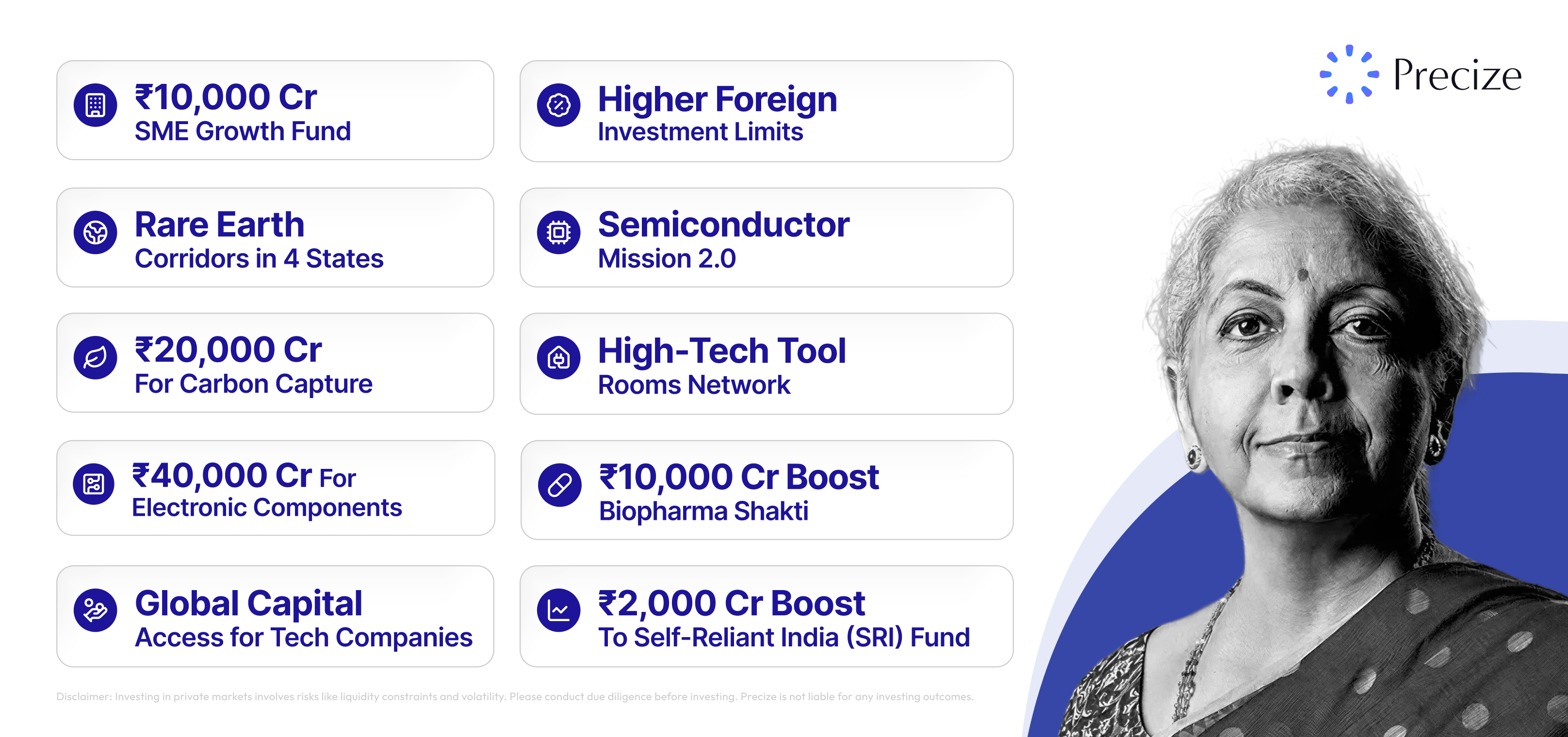
1) Rs. 10,000 crore SME Growth Fund
A dedicated SME Growth Fund is meant to expand access to growth capital for tech-enabled SMEs and scaleups. The simplest way to view this is: more risk capital for scaling, not just survival.
This matters because many SMEs hit a wall after early revenue, when they need money for capacity expansion, distribution, product upgrades, or hiring, but do not fit traditional bank underwriting.
What readers should understand:
This is not the same as working capital loans. This is about growth-stage financing.
If implemented well, it can increase the number of SMEs that “graduate” into larger enterprises over time.
2) Rs. 2,000 crore top-up to Self-Reliant India (SRI) Fund
The budget also proposes topping up the Self-Reliant India (SRI) Fund (launched in 2021) with Rs. 2,000 crore. This is basically a continuation of risk capital support for early-stage and micro startups.
Why this is important:
Early-stage capital cycles can dry up quickly when markets turn cautious.
A committed pool helps keep innovation pipelines alive, especially in deep-tech and manufacturing-linked startups.
3) Biopharma SHAKTI
Under “Manufacturing - Strategic and Frontier Sectors,” the budget highlights Biopharma SHAKTI as a dedicated push area.
How to understand it (without jargon):
Biopharma is not just “healthcare.” It is high-value science-led manufacturing.
The intent typically includes building capabilities in biotech, biosimilars, and pharma innovation ecosystems (your creative mentions biotech, biosimilars and AI-led discovery).
Why it’s included in a manufacturing bucket:
Biopharma manufacturing is export-relevant, IP-driven, and can create high-skill jobs.
It also reduces dependency in critical health supply chains.
4) Rare Earth Corridors and a push for permanent magnets
The budget explicitly calls out a scheme for Rare Earth Permanent Magnets covering research, mining, processing, and manufacturing.
Why this is a big deal:
Rare earth magnets sit behind EVs, wind turbines, electronics, and industrial motors.
The “corridor” framing is useful because this is not one factory. It’s a chain: mining → processing → magnet manufacturing → end-use integration.
In practical terms, this is about:
Reducing import vulnerability in advanced materials
Creating the building blocks needed for EV and electronics ecosystems
5) Semiconductor Mission (ISM) 2.0
The budget includes India Semiconductor Mission (ISM) 2.0 within the strategic manufacturing thrust.
A clean way to explain this:
Semiconductors are not only “chips.” They are the control layer for modern hardware.
ISM 2.0 signals continued policy support for building an ecosystem across manufacturing and potentially equipment, packaging, design, and supply chains.
Why it matters even to non-tech readers:
Electronics, autos, defence, telecom, and industrial manufacturing all depend on chips.
The winners over time are usually the countries that build reliable supply chains, not just assembly capacity.
6) Rs. 40,000 crore for Electronic Components
The budget highlights an Electronics Components Manufacturing Scheme under strategic manufacturing.
How to interpret “components”:
Components are the messy middle of electronics: connectors, sub-assemblies, modules, power systems, sensors, and more.
This is where value-add and supplier ecosystems form. Without components, you end up importing the real value and only assembling the last step.
Why it’s strategically placed:
Components drive supply chain depth for EV, IoT hardware, telecom, and consumer electronics.
Components manufacturing also tends to create large MSME supplier clusters around bigger plants.
7) Rs. 20,000 crore outlay for Carbon Capture (CCUS)
The budget proposes a scheme to adopt Carbon Capture Utilization and Storage (CCUS) with an outlay of Rs. 20,000 crore.
What CCUS actually is:
Capture CO₂ from industrial plants (like cement, steel, refineries)
Utilize it (for chemicals, materials, enhanced processes) or
Store it safely (underground or in engineered formations)
Why this is relevant:
Heavy industries are hard to decarbonise using only renewables.
CCUS becomes a “bridge” for sectors that cannot easily eliminate emissions.
8) High-Tech Tool Rooms Network
The budget calls out Hi-Tech Tool Rooms in CPSEs as part of its manufacturing push.
Why tool rooms matter more than they sound:
Tool rooms are the backbone of precision manufacturing. They enable molds, dies, fixtures, and prototyping.
If India wants more high-quality manufacturing, it needs more places where firms can build and test components quickly.
A reader-friendly way to frame it:
Tool rooms reduce the time between idea → prototype → production.
9) Global Capital Access for Tech Companies via PROIs
On the capital flow side, the budget notes that Individual Persons Resident Outside India (PROIs) will be permitted to invest in equity instruments of listed Indian companies through the Portfolio Investment Scheme (PIS).
What this changes (in simple terms):
It is a structural ease measure aimed at improving participation and liquidity routes.
For high-quality listed companies, broader participation can support deeper markets over time.
10) Higher Foreign Investment Limits (10% and 24%)
Your highlights creative also calls out higher foreign investment limits (per-investor cap 10%, overall limit 24%). In plain terms, this kind of change typically improves flexibility for foreign participation where permitted and helps companies widen their investor base.
The practical point for a reader:
These caps determine how much overseas capital can participate, and easing them can improve liquidity and broaden demand in eligible companies.
Conclusion
Union Budget 2026’s most visible theme is capacity-building: funding MSME growth, backing strategic manufacturing sectors like semiconductors, rare earth magnets and electronics components, and supporting long-horizon initiatives like carbon capture. Alongside that, the budget also signals smoother capital participation routes through measures like PROI portfolio access.