Investing in an Initial Public Offering (IPO) can open the door to exciting returns but it also carries a fair amount of risk. To help investors make more informed decisions, the Securities and Exchange Board of India (SEBI) introduced IPO grading.
IPO grading is not a prediction of returns or share price movement. Instead, it provides a snapshot of a company’s fundamentals before it hits the stock market. So, what exactly is IPO grading and how does it work? Let’s break it down.
What is IPO Grading?
IPO grading is an independent and expert-driven assessment of a company's fundamental strengths at the time it plans to go public. It is conducted by SEBI-registered Credit Rating Agencies (CRAs), who assign a grade based on the company's financial health, governance, growth prospects, and market position. The grading scale ranges from 1 to 5, where a higher number indicates stronger fundamentals.
This system helps investors gauge the reliability and business strength of an IPO at a glance, making it a valuable tool for evaluating IPO investment opportunities.
Grade 1 represents weak or unstable fundamentals. Companies with this rating may have concerning financial metrics, governance lapses, or unclear growth strategies making them speculative and high-risk for investors.
On the other hand, Grade 5 denotes strong fundamentals. These companies typically showcase a sound financial base, credible governance, strong leadership, and future-ready business plans, offering higher confidence to long-term investors.
Such grading simplifies IPO comparison for investors by offering a quick, expert-backed view into a company’s business strength and investment reliability.
How Does IPO Grading Work?
Initially, from 1st May 2007, SEBI made IPO grading mandatory. However, as of 4th February 2014, it became optional for companies planning to launch an IPO.
Here’s how the process works:
The issuer company approaches a SEBI-registered Credit Rating Agency.
The agency evaluates various factors like financials, management, risks, and industry position.
Based on this evaluation, the agency assigns a grade from 1 to 5.
This grade and a detailed report are disclosed in the company’s offer documents and advertisements.
Even if a company disagrees with the rating, it must disclose it. However, they are free to seek grading from more than one CRA if they wish.
IPO Grading Scale Explained
The grades reflect the relative fundamentals of the company at the time of the IPO:2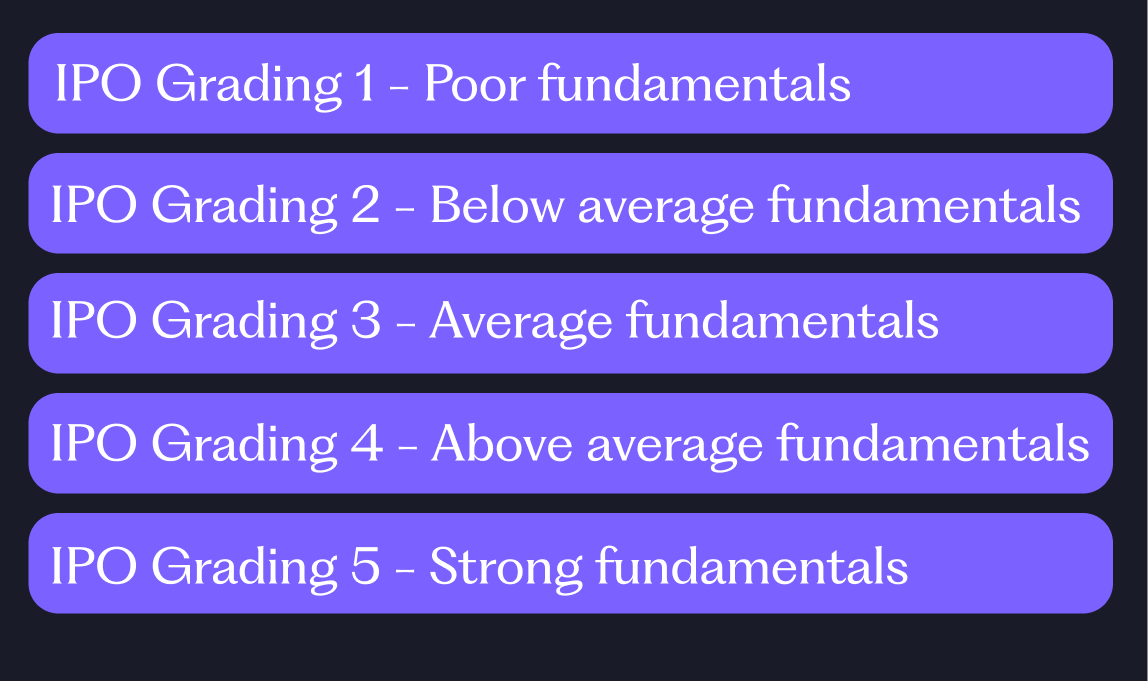 It’s important to note that this grading is not a recommendation to buy, sell, or avoid an IPO; it only reflects the company's internal strength.
Key Factors Influencing IPO Grading
Credit Rating Agencies consider multiple aspects while assigning a grade, including:
The financial health of the company- A strong financial track record with consistent revenue growth and manageable debt levels contributes positively to IPO grading.
Management quality and their track record- Leadership experience, past performance, and the credibility of the management team play a key role in assessing future company prospects.
Industry prospects and market dynamics- The potential for growth in the industry, regulatory environment, and market trends are assessed to determine the long-term viability of the business.
Corporate governance practices- Transparency, ethical conduct, compliance with legal frameworks, and board independence are key indicators of strong governance.
Business model and sustainability- A scalable and adaptable business model that addresses real market needs and shows long-term profitability impacts the grading positively.
Competitive strengths and weaknesses- Unique selling propositions (USPs), market share, barriers to entry, and innovation determine how well-positioned a company is in its sector.
Project risks and future opportunities- Risk assessment of current and upcoming projects, as well as the ability to capitalize on future opportunities, is a significant factor in grading.
Each of these elements plays a role in evaluating the overall fundamentals of the company launching the IPO.
Why is IPO Grading Important for Investors?
The purpose of IPO grading is to empower investors with transparent and comparable information. It provides a base-level understanding of the company’s strengths, helping investors:
Compare multiple IPOs in a structured manner
Understand the risk-reward profile of an IPO
Make better investment decisions, especially if they lack detailed knowledge
Investors can find the IPO grades in:
Prospectus and Abridged Prospectus
Official advertisements
Grading letters available at the company’s registered office
When Shouldn't IPO Grading Be Relied Upon?
While IPO grading can provide some insights into a company’s fundamentals and prospects, it has its limitations. Investors should be cautious and avoid relying solely on IPO grading in the following scenarios:
As a Buy/Sell Recommendation
IPO grades are not investment advice. They do not indicate whether you should buy or sell the shares. They simply reflect the relative fundamentals of the company at the time of the IPO and do not consider market conditions or investor sentiment.To Predict Listing Prices of Shares
An IPO grade does not forecast how the stock will perform on listing day or in the secondary market. Many factors influence listing gains or losses, such as demand, overall market trends, and sector performance, none of which are factored into the grading.To Assume the Absence of Fraud in the Company
A good IPO grade doesn’t guarantee that the company is free from fraudulent practices. The grading agency assesses available information, but it might not uncover hidden financial misstatements or corporate governance issues.To Judge the Valuation or Bid Price
IPO grading does not assess whether the issue is overvalued or undervalued. It focuses on the company’s fundamentals, not the pricing of the IPO. Hence, a high-grade IPO might still be overpriced.To Believe SEBI Has a Role in Assigning the Grade
SEBI does not assign or endorse IPO grades. Its role is only to regulate the IPO process and ensure disclosures are made as per guidelines. The grades are provided by credit rating agencies registered with SEBI, operating independently.To Replace Your Due Diligence
IPO grading should supplement your analysis, not replace it. Investors must still read the Draft Red Herring Prospectus (DRHP), understand the company’s financials, industry outlook, and risks involved, and evaluate whether the offering aligns with their investment goals.To Expect Long-Term Performance Guarantees
IPO grades are assigned based on information available at a specific point in time. They do not guarantee future financial performance or business success. A company’s circumstances can change drastically post-IPO.
Conclusion
IPO grading serves as a valuable indicator of a company’s fundamentals during its IPO launch. It allows investors to make more informed decisions by offering a deeper look into the company’s financial and business profile.
Although IPO grading was made optional after 2014, it still remains a helpful tool for those navigating the primary markets. However, investors should always consider other key aspects like market conditions, risks, and valuation before making investment decisions.
In short, think of IPO grading as a compass, not a guarantee. Use it wisely, but don’t forget to do your research!
If you're interested in exploring alternative investment opportunities, Precize offers a platform that provides access to pre-IPO shares and global trade finance opportunities. With a minimum investment of ₹10,000, these investment options become accessible to a wide range of investors. Precize emphasizes security and provides research-driven insights to help you make informed investment decisions.
So, take the first step in diversifying your portfolio by Reserving your access on Precize.
(Disclaimer: This blog is intended for informational purposes only and does not constitute investment advice or a recommendation to buy or sell any securities. IPO grading is just one of many factors to consider before investing. Readers are encouraged to conduct their own research and consult with a certified financial advisor before making any investment decisions.)