
If you’re a retail investor in India looking to expand your portfolio, understanding the concept of a Mainboard IPO is essential. While IPOs (Initial Public Offerings) have become a popular way for companies to raise capital and for investors to earn potential returns, not all IPOs are created equal. In this blog, we’ll break down the basics of Mainboard IPOs, how they work, and how they differ from SME IPOs. We’ll also discuss the pros and cons of investing in these offerings, so you can make an informed decision.
What is a Mainboard IPO?
An IPO is the first time a private company offers its shares to the public. Before an IPO, shares are usually held by the company’s founders, promoters, employees, and private investors. However, when a company decides to go public, it raises capital by offering shares to retail and institutional investors.
In India, companies that want to issue an IPO need to meet certain criteria to be eligible. A Mainboard IPO is a type of public offering for large, well-established companies with significant financial stability and operational history. To launch a Mainboard IPO, a company must have a minimum net worth of INR 15 crore for each of the last three years, and the post-issue paid-up capital should be a minimum of INR 10 crore. These requirements help ensure that only financially stable companies with solid growth prospects are eligible to raise funds through Mainboard IPOs.
How Does a Mainboard IPO Work?
The process of launching a Mainboard IPO in India involves multiple steps. Here’s a breakdown of the process:
1. Company’s Decision to Go Public: The company decides to go public to raise funds for expansion, research, development, and other growth initiatives.
2. Underwriting the IPO: The company partners with investment banks (called underwriters) who help determine the share price, create the offering, and file the necessary documents with the Securities and Exchange Board of India (SEBI).
3. Filing the Draft Red Herring Prospectus (DRHP): The company submits a DRHP to SEBI, which contains detailed information about its business, financial performance, risks, and future plans.
4. Approval and Roadshows: After SEBI’s approval, the company releases the Red Herring Prospectus (RHP) and conducts roadshows to attract investors. These roadshows are aimed at generating interest from both retail and institutional investors.
5. Subscription Period: The IPO is opened to the public for a period of 3 to 21 days. Retail investors can apply for shares during this time.
6. Allotment: After the subscription period ends, the company allocates shares to successful applicants based on demand and eligibility.
During the process, investors can apply for the IPO through their demat accounts, which are necessary for holding shares in electronic form. Once the shares are allotted, investors can choose to hold them for the long term or sell them on the stock exchange.
Exploring Pre-IPO:
Pre-IPO, also known as unlisted shares, refers to investing in companies that are not yet listed on stock exchanges like the NSE or BSE. In simple terms, it means investing in a company before it goes public.
Before launching an IPO, a company may choose to raise funds through the Pre-IPO market. In this phase, investors can become shareholders of the company even before it is listed. If the company grows and decides to go public, it can file for an IPO by submitting a DRHP. The type of IPO—Mainboard IPO for established companies or SME IPO for smaller businesses—depends on the company's size and structure.
Difference Between Mainboard IPOs and SME IPOs
Investors often confuse Mainboard IPOs with SME IPOs. While both are types of public offerings, there are significant differences between them: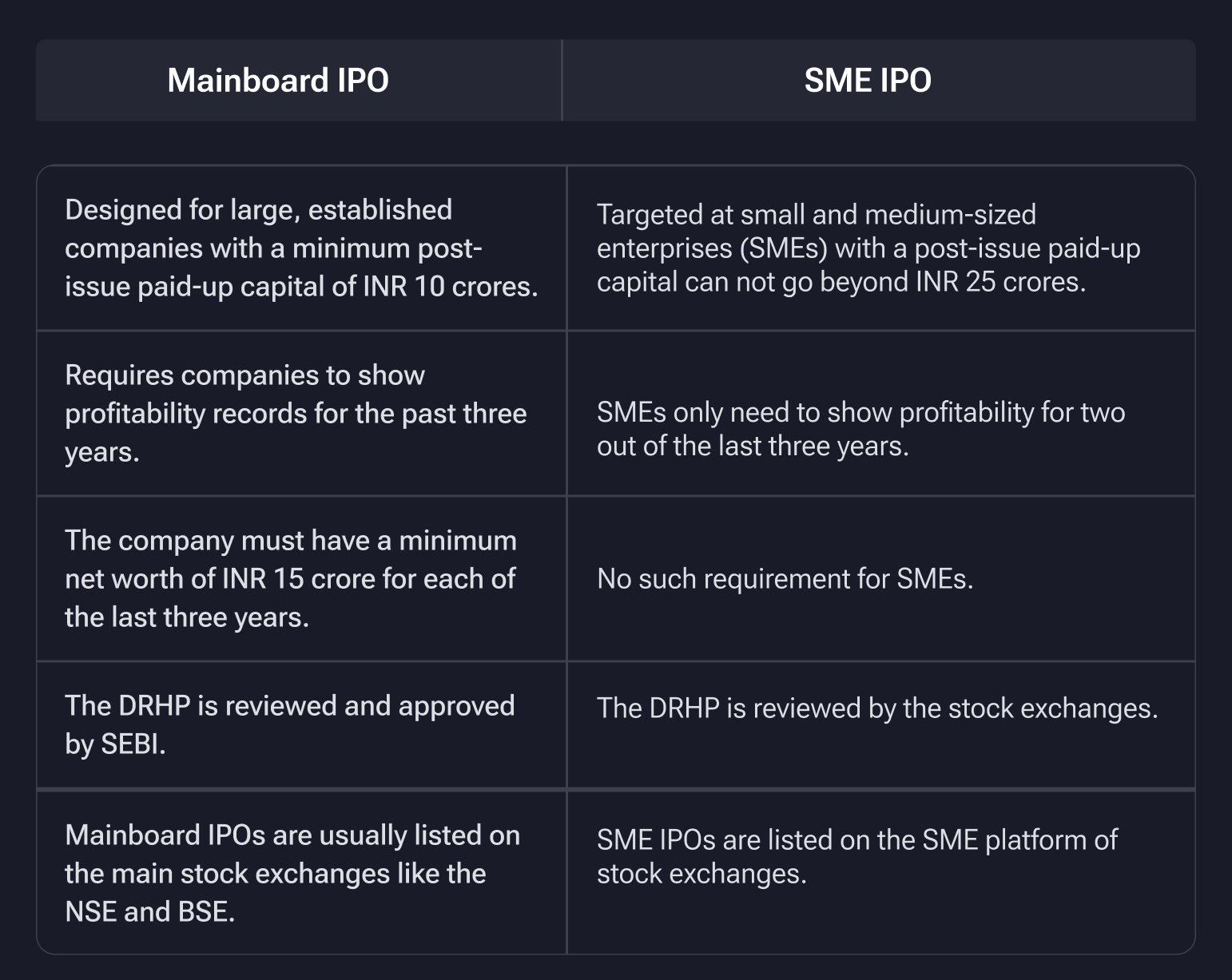
Mainboard IPOs are for larger, more established companies, while SME IPOs cater to smaller companies looking to raise capital for growth.
Pros and Cons of Mainboard IPOs
Investing in Mainboard IPOs offers several advantages, but there are also risks to be aware of. Here’s a quick overview of the pros and cons of Mainboard IPO investments:
Pros of Mainboard IPOs:
1. Capital Appreciation: When you invest in a Mainboard IPO, you have the opportunity to benefit from long-term capital appreciation as the company grows and its market value increases.
2. Public Market Liquidity: After the IPO, shares become available for trading on stock exchanges. This means you can sell your shares whenever needed, providing liquidity.
3. Access to Growth: Many large, well-established companies use IPO proceeds to fund growth initiatives, which can improve the company’s financial performance and, in turn, benefit investors.
4. Retail Investor Access: SEBI mandates that 25% of shares in a Mainboard IPO are reserved for retail investors, offering opportunities for smaller investors to participate.
Cons of Mainboard IPOs:
1. Price Volatility: Newly listed shares can be volatile, with prices fluctuating significantly in the initial days or weeks of trading.
2. Lack of Historical Data: IPOs often come with limited historical data, making it challenging for investors to analyze the company’s long-term performance.
3. Lock-Up Period: Some IPOs come with lock-up periods, preventing investors from selling their shares for a specified period after the listing.
4. Risk of Overvaluation: In some cases, IPOs may be overvalued, leading to short-term price corrections after the listing.
Conclusion
Investing in a Mainboard IPO can be an exciting opportunity for investors to enter the stock market and benefit from the growth of well-established companies. However, it’s important to understand the process, differences from SME IPOs, and the potential risks and rewards before committing your funds. By doing thorough research and analyzing the company’s fundamentals, you can make more informed decisions and build a solid investment portfolio.