
When it comes to managing your finances, whether for your personal use or a business, it’s important to have an understanding of basic accounting concepts. These concepts are the foundation of making smart financial decisions and ensuring everything is in order.
In this blog, we’ll explain what accounting is and its importance in financial decisions. We’ll clarify the difference between accounting concepts and principles, and provide simple examples to help you understand key accounting concepts. You’ll also learn about core accounting principles, and common mistakes to avoid. Whether managing personal finances or a business, this blog will give you the essential knowledge you need.
Let’s get started!
What is Accounting?
Accounting is all about keeping track of your money, how much you earn, how much you spend, and where it all goes. It gives you a clear picture of your business's financial situation by recording things like income, expenses, assets, and debts.
Now that you have a basic understanding of what accounting is, let’s take a look at how accounting concepts differ from accounting principles.
Difference Between Accounting Concepts vs. Accounting Principles
It’s important to distinguish between accounting concepts and accounting principles, to better understand the foundation of accounting. While both play a significant role in financial reporting, they serve different purposes in the accounting process. Here is a table on how they differ:
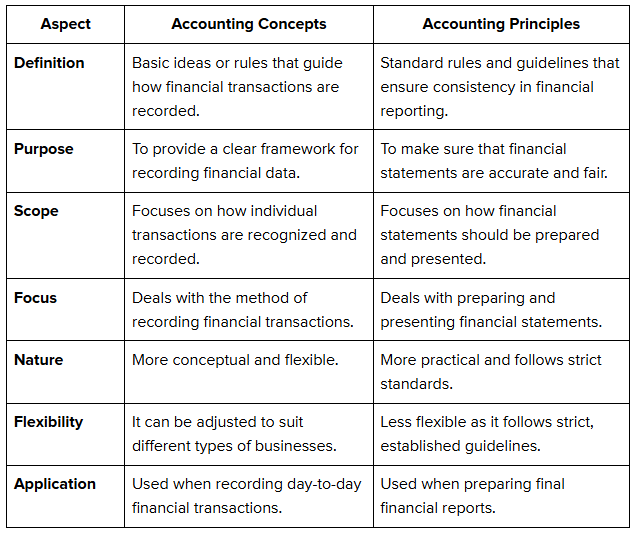
Now that we’ve covered the differences, let’s move on to the key accounting concepts that will help you build a strong financial understanding.
9 Key Accounting Concepts
To get a good grip on accounting, it's important to understand the key accounting concepts that form the backbone of financial management. Here are the essential accounting concepts you should know:
Business Entity Concept
This concept separates your business from your personal affairs. Your business is treated as an independent entity, and its transactions are recorded separately from your personal finances.
Example: If you put ₹1,00,000 into your business, it's considered as capital for the business, not your personal money.
Money Measurement Concept
Only those transactions that can be measured in terms of money are included in the financial records.
Example: When you buy goods for ₹10,000, it's recorded. However, the skill or effort of your employees isn't recorded because it cannot be expressed in money.
Accounting Period Concept
The life of a business is broken down into specific periods, such as a year or quarter, for which financial statements are prepared.
Example: You prepare a profit and loss statement every financial year to assess how your business performed during that year.
Cost Concept (Historical Cost Concept)
Assets are recorded in the books at the price paid to acquire them, rather than their current market value.
Example: If you purchase machinery for ₹2,00,000, it is recorded at that cost, even if its market value changes later.
Matching Concept
Expenses should be recorded in the same period as the revenues they help generate.
Example: If you incur advertising costs in January to boost sales made in January, both the expense and the income are recorded in January.
Revenue Recognition Concept
The moment revenue is earned, it’s recognized, even if the payment hasn’t come through.
Example: If you deliver goods in February but get paid in March, the revenue is recorded in February, when the goods were delivered.
Dual Aspect Concept (Accounting Equation Concept)
Every transaction impacts at least two accounts, keeping the accounting equation balanced: Assets = Liabilities + Equity
Example: If you purchase equipment for cash, it increases your equipment (asset) and decreases your cash (asset), keeping the accounting equation in balance.
Materiality Concept
Only significant items that impact decision-making are recorded in detail; smaller items can be simplified.
Example: Small expenses, like office stationery, are usually recorded directly as expenses, rather than being treated as assets.
Conservatism (Prudence) Concept
You should anticipate all possible losses but avoid recognizing potential gains until they are realized.
Example: If you suspect a customer may not pay, you record it as a potential loss. However, you don’t record any future gains until they are actually realized.
Now that you have a solid grasp of accounting concepts, let’s move on to the core principles that help ensure your financial records are consistent and reliable.
10 Core Accounting Principles

If you want to understand, prepare, or review financial statements, knowing the core accounting principles is essential. Below are the 10 core accounting principles:
Accrual Principle
According to this principle, you should record income and expenses when they are earned or incurred, rather than when the payment is made or received.
Example: If you provide a service in March but receive payment in April, the income should still be recorded in March.
Consistency Principle
Once you choose an accounting method, you should continue using it regularly. This helps maintain comparability across different periods.
Example: If you're using the straight-line method to calculate depreciation, you should apply the same method every year unless there's a valid reason to change.
Going Concern Principle
This principle assumes that your business will continue operating in the foreseeable future and won’t shut down suddenly.
Example: When recording assets, you don’t use their resale or liquidation value. You use the original purchase cost because the business isn’t planning to close.
Materiality Principle
Only record details that are significant enough to impact financial decisions. Minor, less important items can be simplified.
Example: Small office supplies like pens and paper can be recorded as immediate expenses instead of listing them as separate assets.
Full Disclosure Principle
All important financial information should be shared clearly in the financial statements, so users can make informed decisions.
Example: If there’s a pending legal case that may impact the business, it should be mentioned in the notes to accounts.
Monetary Unit Principle
This principle states that only transactions that can be measured in money should be recorded in the accounts.
Example: While your employees' dedication is valuable, it's not something that can be recorded. However, their salaries are measurable and should be included.
Economic Entity Principle
Keep business transactions separate from the personal financial activities of the owner or other individuals.
Example: If the owner takes money out for personal use, it’s recorded as a withdrawal from the business, not as a business expense.
Matching Principle
Expenses should be recorded in the same period as the revenues they help generate.
Example: If you spend on advertising for a sale held in January, the cost should be recorded in January along with the revenue from that sale.
Reliability Principle
Only transactions that can be verified with proper documentation should be recorded.
Example: A sale supported by an invoice or receipt can be recorded with confidence in the books.
Time Period (Periodicity) Principle
Financial statements should be prepared for clearly defined periods, like monthly, quarterly, or annually.
Example: Businesses usually prepare a profit and loss statement at the end of every financial year to evaluate their performance.
After learning the key accounting principles, it’s important to look at some common mistakes you should avoid.
Common Accounting Mistakes You Should Avoid
Applying basic accounting concepts and principles the right way is important if you want to keep your financial records clear and reliable. Here are some common errors you should watch out for:
Making Data Entry Mistakes
Even a small typing error, like switching digits or entering the wrong amount, can throw your accounts off balance. Missing a transaction or recording it in the wrong place can also create confusion later.
Misclassifying Transactions
Recording an expense as income or putting an item under the wrong category can mislead anyone reading your financial statements. It can also impact your taxes and business decisions.
Ignoring the Accrual and Matching Principles
If you don’t record income and related expenses in the same period, your profit figures may not show the real picture. Many people also record only when cash is received or paid, which doesn’t reflect the actual performance of the business.
Not Keeping Proper Records
Without bills, receipts, or supporting documents, it becomes difficult to prove that your entries are accurate, especially during audits or when filing taxes.
Skipping Bank Reconciliation
If you don’t regularly match your accounting books with your bank statements, you may miss out on errors or unauthorized transactions. This may cause problems with managing money and understanding your financial position.
Not Understanding Financial Statements
A lack of clarity on how to read basic financial statements can easily lead to errors in understanding your finances. Each report shows a different side of your business’s finances.
Calculating Depreciation Incorrectly
Using the wrong method or rate for depreciation can affect the value of your assets and also impact your profit numbers. Consistency and accuracy are key here.
Mixing Up Profit and Cash Flow
Just because your books show a profit doesn’t mean there’s enough cash in hand. If you don’t track cash flow separately, you might face shortages when you least expect it.
Not Staying Updated with Accounting Practices
Accounting standards and rules change from time to time. If you’re not aware of these updates, you may end up using outdated or incorrect methods in your accounting.
Conclusion
As we’ve covered in this blog, understanding basic accounting concepts and principles is key to keeping accurate financial records and making smart decisions. Whether you’re a student aiming for good grades or a business owner looking to stay financially healthy, knowing these basics is essential for success.
These principles help make sure your financial records are clear and consistent, which makes it easier to understand how your business is doing and plan for the future.
If you’re curious to explore investment opportunities, then you can use investment platforms like Precize.
It allows you to explore private companies or buy and sell unlisted shares and pre-IPO shares.
You can also access global trade finance opportunities, which allow you to diversify your investments with fixed-income options.
With detailed research reports, including balance sheets, cash flow statements, and industry analysis, you’ll gain the clarity needed to make thoughtful, well-informed choices.
Ready to take the next step? Reserve your access today!
Frequently Asked Questions (FAQs)
If you’re new to accounting or looking for clarification, here are some commonly asked questions about basic accounting concepts and principles.
Why are accounting principles important for businesses in India?
They help maintain accurate and consistent records, ensure legal compliance, support better financial decisions, and build trust with stakeholders.
What is the accrual principle?
It means recording income and expenses when they are earned or incurred, not when cash is received or paid.
What does the going concern principle mean?
It assumes the business will continue to operate, so assets are recorded at their original cost unless closure is expected.
How does the consistency principle affect accounting?
It ensures the same accounting methods are used every period, making it easier to compare financial results over time.
What is the reliability principle in accounting?
Only transactions backed by proper evidence, like bills or receipts, should be recorded to ensure accuracy.
Disclaimer
The details in this blog are shared for informational purposes and should not be seen as professional advice. Every financial situation is different, so it’s wise to consult with an accountant or financial advisor for guidance tailored to you. We are not responsible for any decisions made based on the information in this blog.