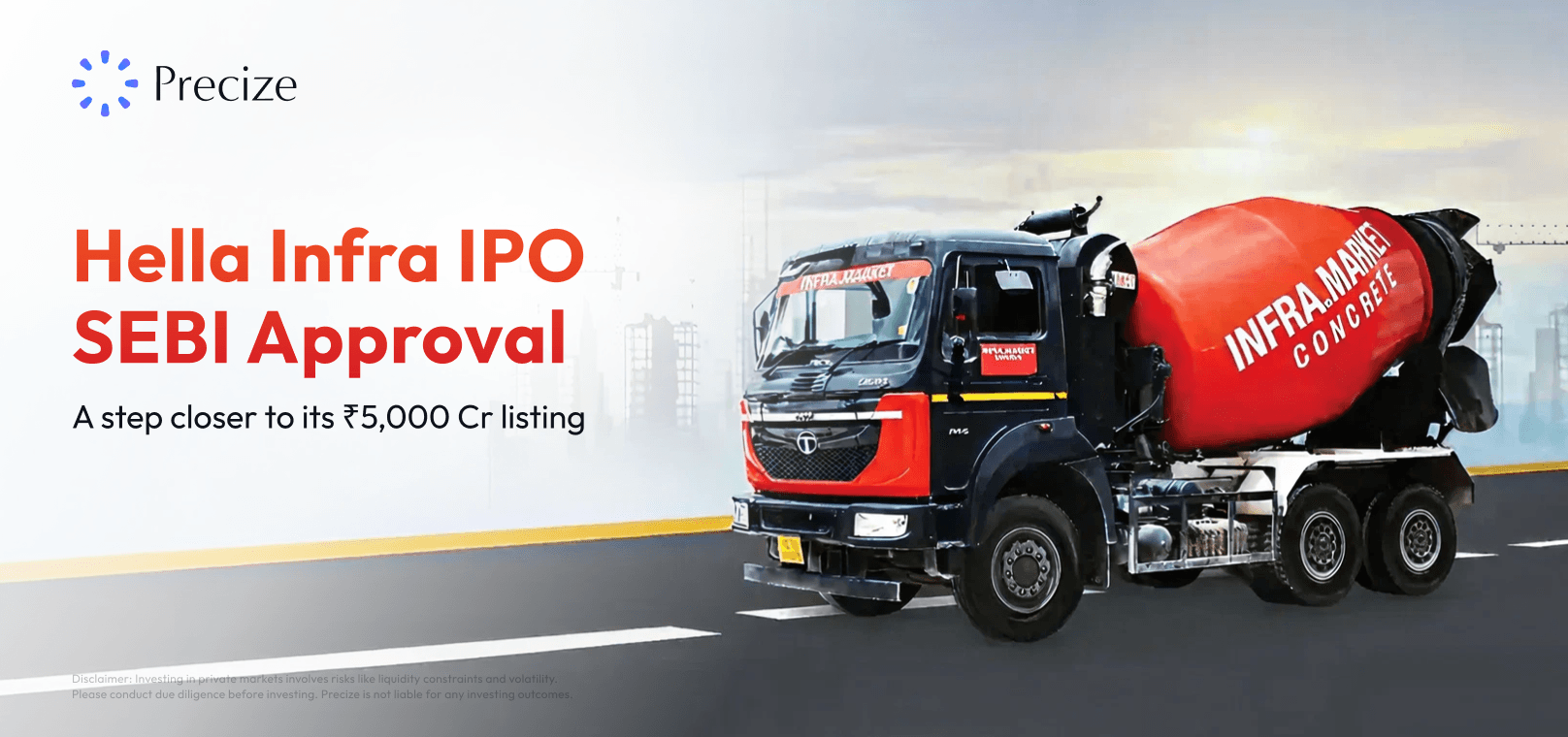
Hella Infra Market Limited (known widely through its brand Infra Market) has received SEBI’s clearance for a proposed IPO of around Rs 5,000 crore, according to recent reporting.
That headline matters, but the more useful story for readers is: what business is actually getting listed, why it scaled so fast, and why profitability and cash flows can look very different year to year in construction supply chains.
What just happened
SEBI has approved Hella Infra Market’s IPO proposal, with media reports putting the issue size at roughly Rs 5,000 crore.
The company is also reported to have used the confidential filing route earlier, which allows regulatory review before full public disclosures are made available.
About Hella Infra Market
Hella Infra Market is the corporate entity linked with Infra Market, a construction materials platform that supplies products across the building cycle, from core materials to finishing and home improvement categories.
If you think of construction as a chain of dependencies, the business sits at the “make it available on time” layer: procurement + logistics + category expansion + product standardisation, aimed at reducing delays and uncertainty in sourcing.
What Infra Market actually sells
Infra Market catalogue spans multiple layers of construction demand. On its own website, the company lists categories across structural products, finishing materials and lifestyle/home improvement products - ranging from concrete, aggregates, AAC blocks and steel to plywood/MDF, tiles, bath fittings, sanitaryware, fans, lights, appliances, modular kitchens and paints.
This breadth is important because procurement in construction is rarely one category. Projects need materials in sequence, and the supplier that can fulfil more of that basket often becomes harder to replace.
Why does this model exist in India
Construction procurement is still fragmented. Prices move with commodity cycles, quality consistency varies, and supply reliability can make or break execution timelines. That’s why platforms in this space try to compete on a few fundamentals:
Reliable fulfilment and availability
Consistent quality and standardisation
Wider category coverage under one platform
Logistics coordination at scale
In practice, the value proposition is not “cheaper than everyone.” It is closer to: fewer surprises during execution.
A key part of the story is manufacturing and private labels
Infra Market has also been positioned as more than a pure marketplace. It has built manufacturing capacity and has held stakes in multiple brands across construction and home improvement categories.
A YourStory report notes private label brands such as RDC Concrete, Shalimar Paints, Equiphunt, IVAS, Millennium Tiles, Emcer Tiles, Inicio and Amstrad, described as either fully or majority owned.
This matters because “marketplace-only” models often face margin pressure in commodity categories. Manufacturing and private labels can shift the economics toward higher control over product quality, supply reliability, and gross margins - though it also increases operational complexity.
Scale signals: footprint and throughput
The platform has been described as operating at high delivery volumes. YourStory has reported that Infra Market dispatches over 10,000 deliveries per day and supplies to 7,000+ projects across India.
It has also expanded its manufacturing footprint in products such as AAC blocks. A PR Newswire release described. Infra Market is becoming India’s largest AAC block manufacturer and has listed manufacturing facilities across multiple cities.
(These scale indicators don’t replace financial disclosures, but they explain why the company features among the larger private candidates for public markets.)
FY25 numbers: growth was strong, profit was softer
Reported financials for FY25 show a clear pattern that is common in supply-chain heavy businesses:
Revenue from operations: Rs 18,472 crore in FY25 (up 27% YoY)
Net profit: Rs 219.7 crore in FY25 (down from Rs 378 crore in FY24)
Higher costs - including materials, staffing and finance charges - were cited as reasons profit declined even while revenue grew.
The practical takeaway: this is a business where topline scale can rise steadily, but profitability can swing depending on input prices, logistics costs, working capital intensity, and financing structure.
Competitive landscape: who gets compared to Infra Market
In public coverage, Infra Market is often benchmarked against other large B2B and supply-chain platforms such as Zetwerk, OfBusiness and Moglix.
These comparisons usually matter in two ways:
They show how crowded the “organised B2B” space is becoming.
They highlight that execution and cash conversion often become the key differentiators - not just growth.
A note on cash flows and debt sensitivity
Supply-chain businesses that handle physical goods tend to carry working-capital and financing realities that don’t show up in “platform” narratives.
Earlier reporting has noted a credit rating downgrade by India Ratings for Infra Market, with references to refinancing risk, liquidity pressures and negative cash flow from operations during FY25, alongside IPO fundraising plans mentioned at that time.
This doesn’t automatically define the company’s long-term prospects, but it is an important context point: in construction supply chains, cash discipline can matter as much as growth.
Why SEBI approval matters for this IPO
SEBI’s clearance indicates the company has crossed a key regulatory gate for the public issue. What it does not do is lock in the launch date or guarantee the final pricing - those depend on the company’s readiness and market conditions closer to the issue window.
Conclusion
Hella Infra Market’s SEBI approval puts Infra Market firmly among the larger IPO candidates in India’s pipeline. The story is not just the Rs 5,000 crore headline - it is the attempt to build a scaled, organised construction procurement and manufacturing platform in a sector where execution reliability, category breadth, cost control and cash conversion decide outcomes.