
What is HNI?
HNI stands for High Net-worth Individual. It refers to individuals who have significant investable wealth, typically beyond a certain threshold set by financial institutions, wealth managers, or regulatory bodies. HNIs wealth is measured by liquid investable assets rather than total net worth including real estate and business holdings. HNIs play a crucial role in financial markets and economies. They contribute to capital markets, fund businesses, and drive luxury markets.
Why Does HNI Matter?
HNIs are important in financial markets as they have access to exclusive investment opportunities such as:
Unlisted shares & Pre-IPO investments
Private equity & venture capital funds
Alternative investment funds (AIFs) & structured products
Private credit & high-value real estate investments
What is HNI in IPO?
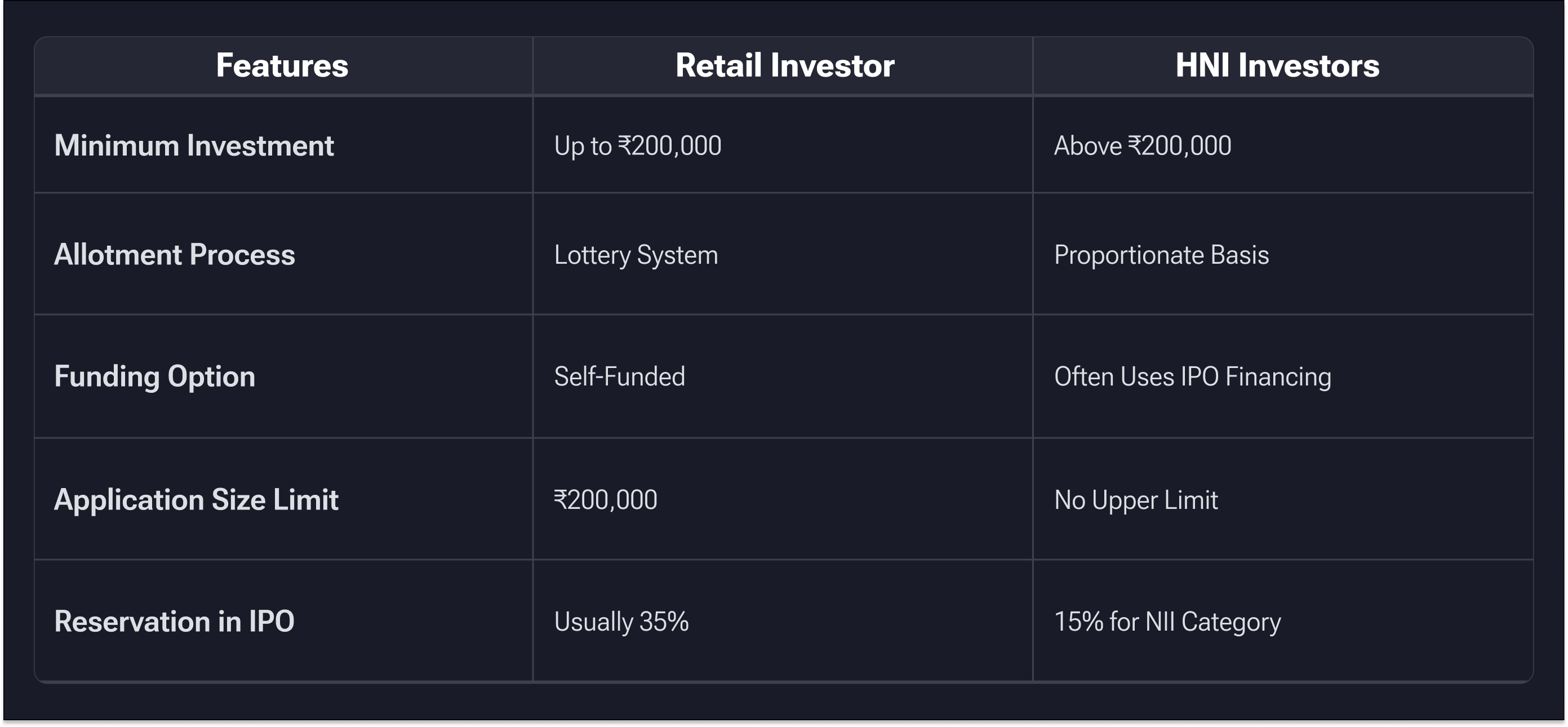
HNI, or High Net Worth Individual, refers to investors who apply for IPOs with bids exceeding ₹200,000. Such applications fall under the Non-Institutional Investor (NII) category, which is separate from retail and Qualified Institutional Buyer (QIB) categories. Unlike retail investors, HNIs receive shares on a proportionate basis rather than a lottery system.
The NII category is further divided into:
Small HNIs (sHNI): Investors applying between ₹200,000 and ₹10,00,000
Big HNIs (bHNI): Investors applying above ₹10,00,000
Since IPO allotment is based on demand and subscription levels, HNIs play a key role in
influencing the overall market sentiment.
Who is an HNI in India?
In general, a High-Net-Worth Individual (HNI) is someone with substantial financial assets. While different financial institutions have varying thresholds, the Securities and Exchange Board of India (SEBI) classifies an IPO investor as an HNI if they apply for more than ₹200,000 in an IPO. Banks and other wealth management firms typically consider individuals with a net worth of ₹5 crore or more as HNIs.
Categories of HNIs in India:
Affluent Individuals: Net worth between ₹2 crore to ₹5 crore.
HNI: Net worth between ₹5 crore to ₹50 crore.
Ultra HNI: Net worth above ₹50 crore.
Can I Apply for an IPO in the HNI Category?
Yes, any individual or entity can apply for an IPO in the HNI category, provided the bid exceeds ₹200,000. However, there are some key points to consider:
No Upper Limit: Unlike the retail category, there is no maximum limit on how much an HNI can invest in an IPO
Proportionate Allotment: HNIs do not receive shares via a lottery system. Instead, they are allotted shares based on the proportion of their application size
IPO Financing: Many HNIs use leveraged funds (IPO financing from NBFCs or banks) to maximize the size of their applications and their chances of receiving more shares
Lock-in Period: Unlike QIBs, HNIs do not have a mandatory lock-in period for shares allotted through the IPO
Who Can Apply in the HNI Category?
The HNI/NII category is open to various types of investors, including:
Individuals investing more than ₹200,000 in an IPO
Hindu Undivided Families (HUFs) investing above ₹200,000
Corporate entities and partnership firms
Non-resident Indians (NRIs) on a repatriation or non-repatriation basis
Trusts, Family Offices, and Investment Funds
Retail vs. HNI Investors in IPOs
HNI Investment Strategies in IPOs
HNIs use different strategies to maximize their returns in IPO investments:
IPO Financing: Many HNIs take loans to apply for large IPO applications, enhancing their chances of receiving a higher allocation.
Subscription Trend Analysis: HNIs closely monitor IPO demand, particularly in the QIB category, before making large bids.
Short-Term Gains vs. Long-Term Holding: Some HNIs sell allotted shares on listing day for quick profits, while others hold onto high-potential stocks for long-term growth.
Applying in Multiple IPOs: To diversify risk, HNIs often apply in multiple IPOs instead of concentrating their funds on a single offering.
Using Grey Market Premium (GMP) Insights: Many HNIs track GMP trends to assess potential listing gains before applying.
Staggered Bidding Approach: Instead of applying all at once, HNIs sometimes bid at different intervals based on demand.
How Do HNIs Impact IPO Subscriptions?
Increase Oversubscription Levels: HNIs often contribute to heavy oversubscription in the NII category, leading to increased demand
Improve Listing Gains: Their large-scale participation signals market confidence, often influencing IPO pricing
Impact Market Sentiment: If HNIs aggressively apply for an IPO, it generates positive sentiment among retail investors
Common Mistakes HNIs Should Avoid in IPO Investments
Over-leveraging through IPO Financing: Excessive borrowing can lead to heavy interest costs, reducing net returns.
Ignoring Fundamentals: Some HNIs apply for every IPO without assessing company fundamentals, increasing risks.
Not Monitoring Subscription Trends: Applying without checking NII subscription trends can lead to lower-than-expected allotment.
Mismanaging Liquidity: Blocking excessive funds in multiple IPOs can reduce flexibility for other investment opportunities.
Conclusion
HNIs play a vital role in the IPO market, adding substantial liquidity and impacting demand. If you have the capital to invest above ₹200,000, you can apply under the HNI category and benefit from proportionate allotment. However, it’s important to analyze market trends, leverage IPO financing wisely, and strategize investments to maximize gains.
Understanding the HNI category and its investment approach can help you make informed decisions, whether you're an experienced investor or someone looking to enter this segment. With the right strategy, HNIs can effectively optimize their IPO investments for both short-term and long-term gains.
If you're interested in exploring alternative investment opportunities, Precize offers a platform that provides access to pre-IPO shares and global trade finance opportunities. With a minimum investment of ₹10,000, these investment options become accessible to a wide range of investors. Precize emphasizes security and provides research-driven insights to help you make informed investment decisions.
So, take the first step in diversifying your portfolio by Reserving your access on Precize.