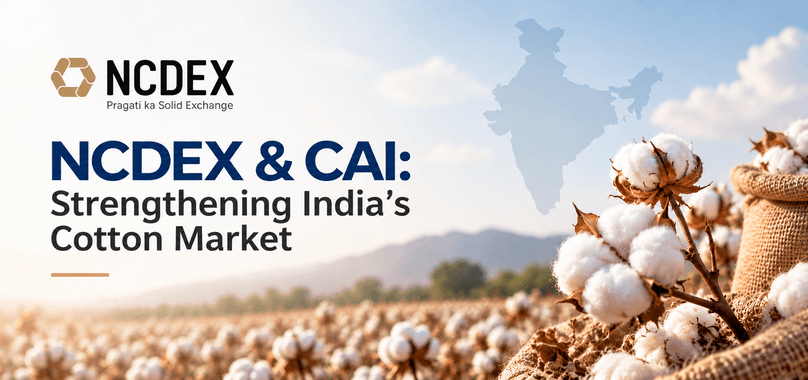
India is one of the world’s largest cotton producers, yet its cotton derivatives market has not fully reflected the scale of its physical cotton industry. In a move that could help bridge this gap, National Commodity & Derivatives Exchange (NCDEX) and the Cotton Association of India (CAI) have entered into a five-year partnership to deepen participation in cotton futures and strengthen price discovery and risk management across the cotton value chain.
The partnership is aimed at bringing more participants into the organised derivatives ecosystem, including farmers, ginners, spinners, traders and exporters.
Why Is India’s Cotton Derivatives Market Important?
Cotton plays a critical role in India’s agricultural and textile economy. According to the Economic Times, India accounts for around 20–23% of global cotton production and nearly 38% of the world’s cotton-growing area. However, fragmented physical markets and relatively low participation in derivatives have limited India’s influence on global cotton price discovery.
For businesses involved in cotton, price volatility can directly impact margins. Futures contracts can provide a mechanism to manage this price risk by allowing market participants to hedge against adverse movements in cotton prices.
The NCDEX-CAI partnership therefore focuses not just on increasing trading activity, but also on building greater awareness around the role of derivatives in managing commodity price risk.
NCDEX and CAI’s Five-Year Partnership
Under the agreement, NCDEX and CAI will work together to promote greater adoption of cotton futures across India’s cotton ecosystem.
The key areas of focus include:
Increasing awareness of cotton futures among industry participants
Improving price discovery for cotton in domestic markets
Strengthening price-risk management and hedging
Bridging the gap between physical and futures markets
Educating farmers, ginners, spinners and exporters about derivatives
Maharashtra and Gujarat are expected to be important focus markets, along with other major cotton-producing states such as Punjab, Andhra Pradesh and Telangana.
This could help create stronger connections between physical cotton markets and organised commodity derivatives markets.
Expanding NCDEX’s Cotton Complex
The partnership also comes as NCDEX looks to expand its presence in cotton derivatives.
NCDEX’s existing cotton-related contracts include Kapas, Cottonseed Oil Cake and Cotton Wash Oil, giving participants exposure to different parts of the cotton value chain.
Greater participation in these contracts could potentially improve market liquidity and make futures markets more relevant to businesses that deal with cotton on a regular basis.
For NCDEX, this represents an opportunity to strengthen its commodity derivatives ecosystem by connecting a large physical market with organised price-risk management tools.