
In India, regulations prohibit companies from issuing shares with multiple voting rights. Therefore, DVR shares are primarily used to restrict the voting rights of equities. Before diving into the difference between DVR and ordinary shares, it's essential to grasp these two option’s distinct meanings and implications.
What are Ordinary Shares?
Ordinary shares, also known as standard shares, represent ownership capital in a company. Shareholders holding these shares typically have voting rights at Annual General Meetings (AGMs). Having one share gives an individual the right to vote. In return for their capital contribution, shareholders receive dividends.
The company determines dividend payments, which can vary yearly due to market volatility.
What are Differential Voting Rights Shares?
Before diving into the differences between ordinary and DVR shares, it's crucial to grasp what DVR shares involve. A DVR share allows its owners to gain higher dividend earnings at the cost of surrendering some voting rights. So, these shares let a company share more decision-making power with shareholders with more voting rights.
As per the Companies Act 2013, a company can issue DVR shares if it has reported profits in the three preceding years from the DVR issue date. Certain conditions must be met, including filing accurate returns and annual accounts during the profitable period. Moreover, the issued DVR shares should not surpass 25% of the company's total share capital.
Difference Between DVR and Ordinary Share
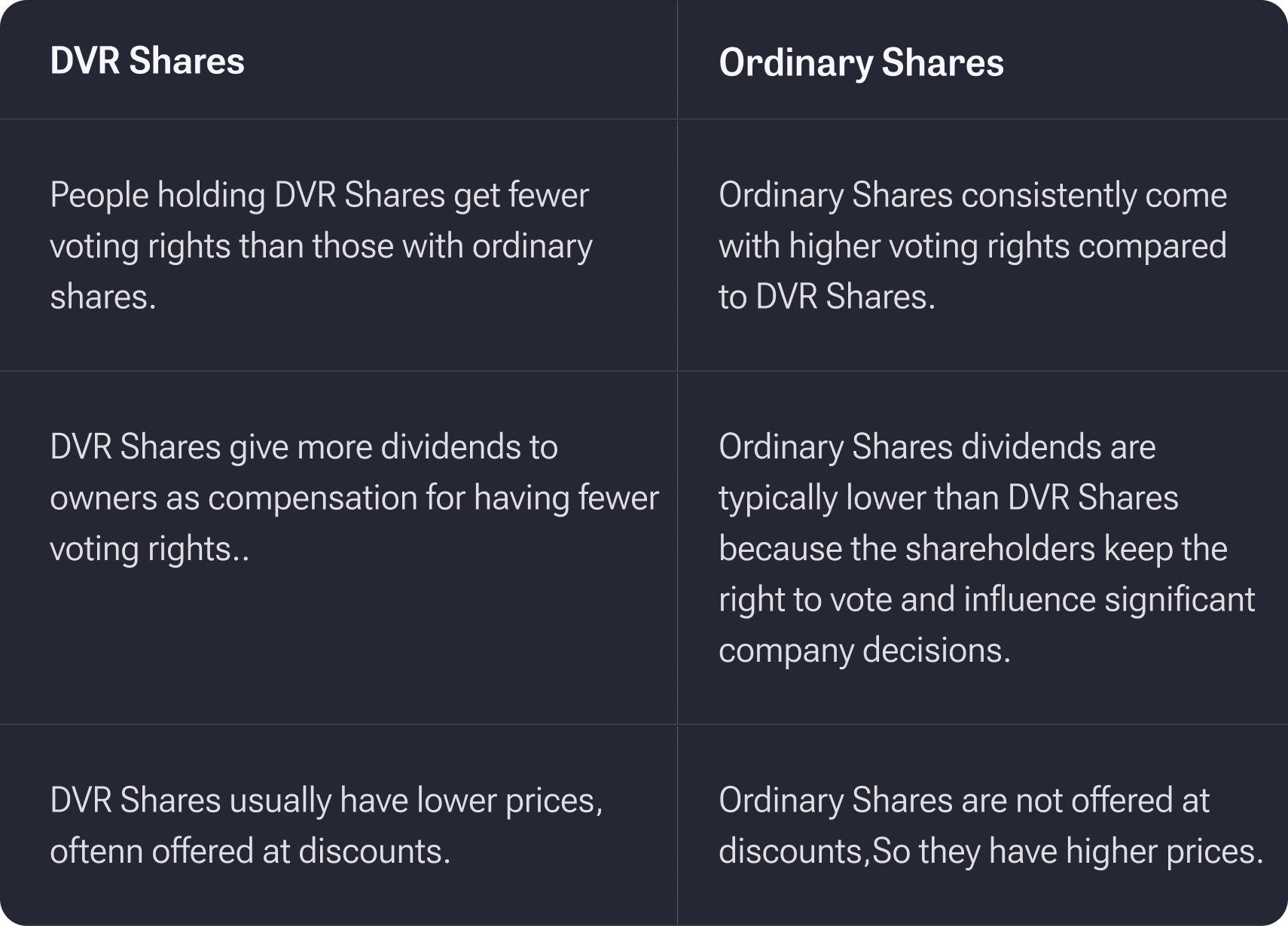
Let’s get a Reality check.
Let's explore companies that have issued both DVR Shares and ordinary shares and find out what's happening with these companies today.
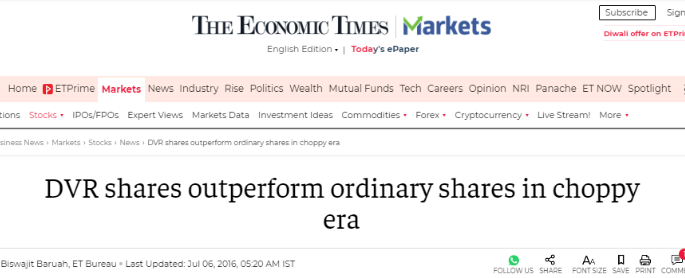
As reported by the Economic Times on July 6, 2015-2016, DVR (differential voting rights) shares had outperformed ordinary shares in that fiscal year. Several companies, including Tata Motors, Jain Irrigation, and Future Enterprise, had issued DVR shares.
DVR shares demonstrated significant outperformance during that period, registering up to 450% gains. For instance, Tata Motors' DVR shares saw an 18.8% increase, surpassing the 8.5% rise in ordinary shares. Jain Irrigation's DVR shares gained 22.5%, and Future Enterprise's DVR shares surged by 81%, outperforming their ordinary shares, which saw increases of 3.9% and 65%, respectively.
Fast Forward to 2023: DVR Share situation in Tata Motors

According to this article posted by Mint on 26 July 2023:Tata Motors DVR shares surged nearly 18% to reach a new 52-week high of ₹440 on the Bombay Stock Exchange (BSE) in opening trades on Wednesday, July 26. This increase occurred a day after Tata Motors announced its plan to convert DVR shares into ordinary ones. According to Mint's report, Tata Motors revealed that, upon the scheme's effectiveness, the company will issue 7 fully paid-up new ordinary shares with a face value of ₹2 for every 10 'A' ordinary shares with a face value of ₹2. This issuance is intended as a consideration for reducing and canceling the 'A' ordinary shares.
In conclusion
The journey of DVR shares has been marked by a departure from conventional ownership structures, offering companies and investors innovative choices. The performance trends observed in the past, coupled with current market dynamics, indicate that DVR shares play a distinctive role in shaping the future of corporate ownership.