Why OYO Is Back in Investor Focus
OYO is getting renewed attention because several things have changed at the same time: the IPO process appears to have moved forward, the travel sector has recovered, and the company has focused more on profitability than aggressive expansion.
1. IPO Visibility Has Improved
The reported SEBI approval gives OYO's public-market plan more visibility than it had during earlier attempts. For unlisted-share investors, this matters because a credible IPO path can improve price discovery and potential liquidity.
However, IPO visibility is not the same as IPO certainty. Investors should wait for the updated DRHP and final price band before making conclusions about valuation or listing gains.
2. OYO Has Shifted Toward Operating Discipline
OYO's earlier story was built around fast expansion across India and international markets. That helped the company build brand recognition, but it also created questions around losses, partner quality, and sustainability.
The current narrative is different. OYO has focused on cost control, stronger unit economics, premiumization, and exiting or reducing exposure to weaker markets. Public-market investors will want proof that these improvements can continue after listing.
3. Travel and Hospitality Demand Has Recovered
India's travel and hospitality market has benefited from domestic tourism, business travel, religious tourism, weddings, and short-stay demand. This recovery supports companies that can bring supply, demand, and pricing tools together.
For OYO, the opportunity is to use technology, brand recall, and distribution to help smaller hotels and property owners fill rooms more efficiently.
4. The Valuation Reset Has Changed the Debate
At its peak, OYO was valued at a much higher level in private markets. Later funding rounds and broader startup valuation corrections reset investor expectations.
That reset may make the opportunity look more reasonable to some pre-IPO investors. But lower pricing alone does not make an investment attractive. The final judgement depends on revenue quality, profitability, governance, IPO valuation, and post-listing demand.
OYO Business Model Explained
OYO operates a hospitality and travel-tech platform that connects travellers with hotels, homestays, vacation rentals, and other accommodation partners. Its model is largely asset-light, meaning it does not need to own most of the properties listed under its network.
The company typically works with property owners and hotel partners by offering:
Branding and visibility: OYO helps smaller properties get discovered by customers who already recognise the brand.
Technology tools: The platform can support pricing, booking, inventory, and property management.
Demand aggregation: OYO brings bookings through its app, website, partner channels, and travel distribution network.
Operational support: Depending on the partnership model, OYO may help with service standards, customer experience, and property performance.
Revenue can come from commissions, franchise fees, platform services, and other hospitality-related income. The company has also expanded into vacation rentals and international operations, although investors should check the updated DRHP to understand the current revenue mix.
The core attraction is scale. If OYO can bring more demand to partner properties while keeping costs under control, the platform can become more efficient over time. The core risk is execution. Hospitality is operationally complex, and customer experience can vary widely across properties.
OYO Valuation Outlook for 2026
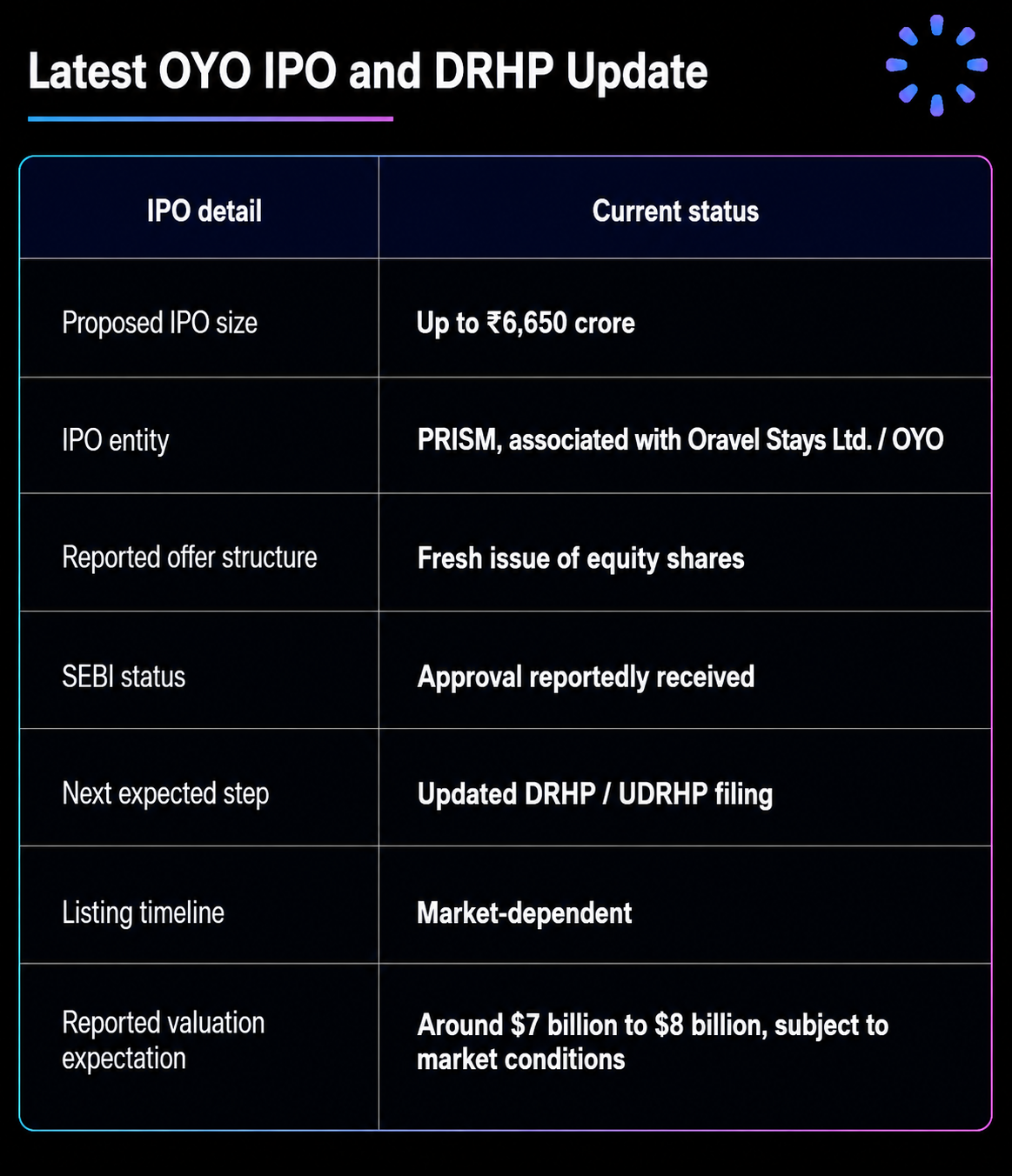
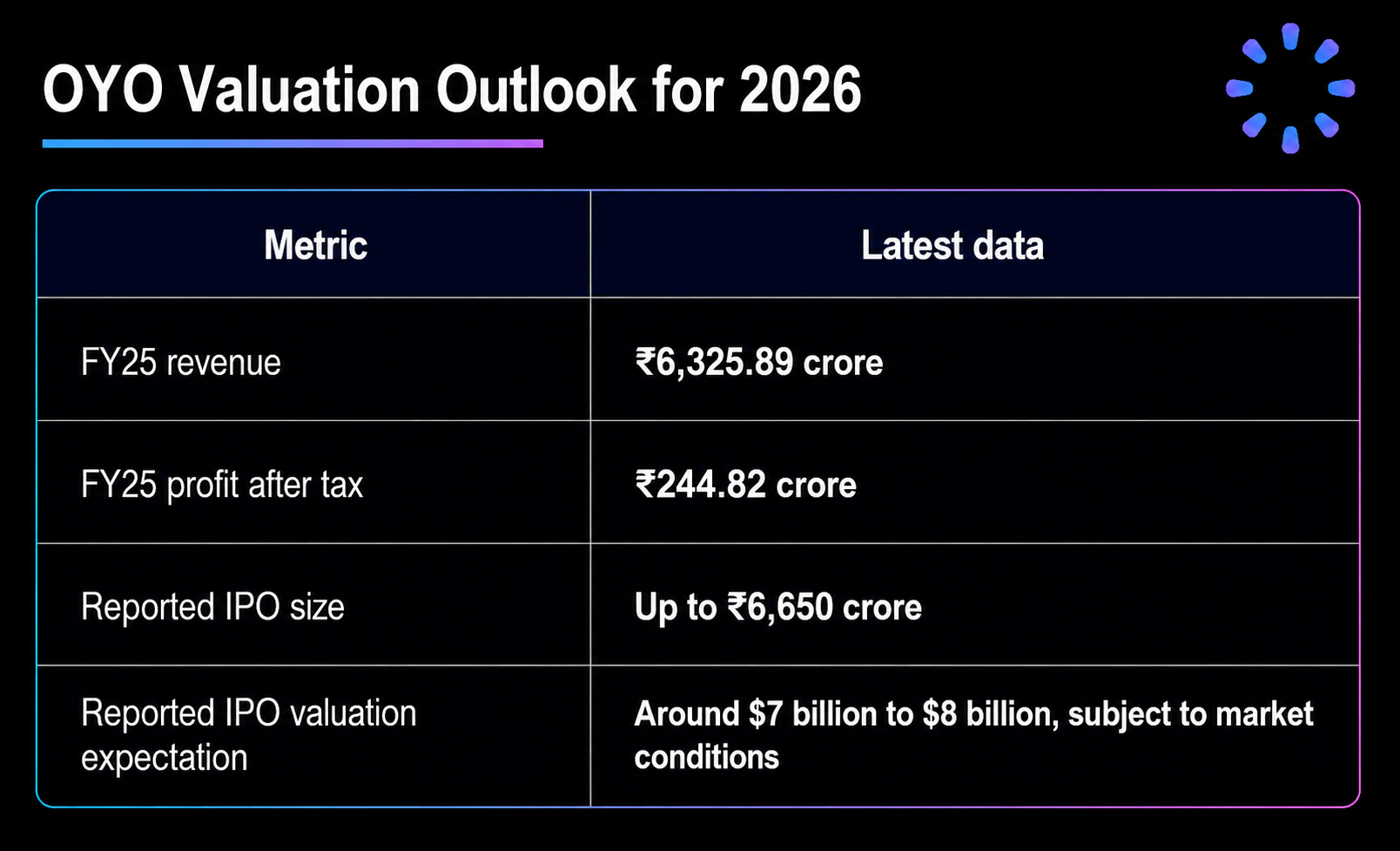
The OYO valuation story has changed sharply from the company's earlier peak years. Reports suggest the proposed IPO could target a valuation in the $7 billion to $8 billion range, although some reports also mention market-dependent valuation bands. Final valuation will depend on the updated filing, institutional feedback, market conditions, and IPO pricing.
Pre-IPO investors should compare any unlisted price with four valuation anchors.
1. Recent Private-Market Valuation
Private funding rounds can provide context, but they are not a guaranteed floor. They may include different terms, rights, preferences, and market conditions from a public IPO.
2. Expected IPO Valuation
If OYO lists at a meaningfully higher valuation than the current implied unlisted-market price, pre-IPO investors may see upside. If the IPO is priced conservatively, delayed, or received weakly, that upside can shrink.
3. Profitability and Cash Flow
Public-market investors usually reward companies that show a clear path to sustainable profits. For OYO, investors should focus on margins, cash flow, revenue quality, and whether profitability is driven by recurring business strength rather than one-off cost cuts.
4. Peer and Sector Sentiment
OYO sits at the intersection of travel, hospitality, technology, and startup IPO sentiment. Its valuation will be affected not only by its own numbers but also by market appetite for consumer-tech and platform businesses.
For investors comparing OYO with other private-market opportunities, the Precize screener tool can help organise company research and compare available unlisted shares.
What Investors Should Check in OYO's Updated DRHP
The updated DRHP will be the most important document for anyone tracking OYO IPO 2026. It should give a clearer view of the business than private-market commentary or media reports.
When the document is available, focus on these sections first:
Risk factors: Check risks linked to competition, regulation, hotel partner relationships, customer complaints, international operations, and profitability.
Financial statements: Study revenue growth, EBITDA, profit after tax, cash flow, debt, and working capital.
Use of proceeds: Since the IPO is reportedly a fresh issue, understand where the capital will go.
Revenue mix: Review how much revenue comes from India, international markets, platform services, hotels, vacation rentals, and other segments.
Promoter and investor holdings: Check founder shareholding, investor exits, employee stock options, and dilution.
Related-party transactions: Review any material transactions that may affect governance or margins.
Legal and regulatory matters: Hospitality platforms can face disputes with partners, customers, landlords, and regulators.
If you are new to private-market investing, the Precize FAQs explain common questions around unlisted shares, demat transfers, and investor process.
Risks of Investing in OYO Unlisted Shares
OYO unlisted shares offer exposure to a well-known pre-IPO company, but the risks are significant. Investors should be comfortable with uncertainty before committing capital.
IPO Timeline Can Still Change
SEBI approval is a positive regulatory step, but it does not fix the listing date. OYO may still wait for stronger market conditions, update its documents, change its issue timing, or adjust the final offer structure.
Valuation May Not Match Expectations
Media-reported valuation targets are not final IPO valuations. The final price band may change after institutional feedback, market volatility, peer performance, and investor demand.
Profitability Must Be Sustainable
OYO has worked to improve its cost structure and profitability profile. The key question is whether these improvements can continue while the company grows.
Investors should watch whether profitability comes from stronger operations, better pricing, and repeat demand, not only from cost reductions.
Hospitality Is Competitive
OYO competes with independent hotels, branded hotel chains, online travel aggregators, vacation-rental platforms, and regional hospitality networks. Customers can compare prices easily, and hotel partners can list across multiple platforms.
Unlisted Shares Have Liquidity Risk
Unlisted shares are harder to sell than listed shares. They may have wider bid-ask spreads, fewer buyers, longer settlement timelines, and limited price transparency.
This matters if you need money quickly or if the IPO gets delayed. Before buying OYO pre-IPO shares, confirm the exit process, transfer restrictions, and costs with the platform or intermediary.
How to Verify OYO Unlisted Shares Before Buying
Before buying OYO pre-IPO shares, verify the basics yourself instead of relying only on a headline price.
Use this checklist:
Live price: Check the latest quote on the platform and compare it with recent private-market indications.
Lot size and minimum investment: Confirm how many shares you need to buy and the total payable amount.
Seller and transfer process: Ask how shares will move to your demat account and how long settlement usually takes.
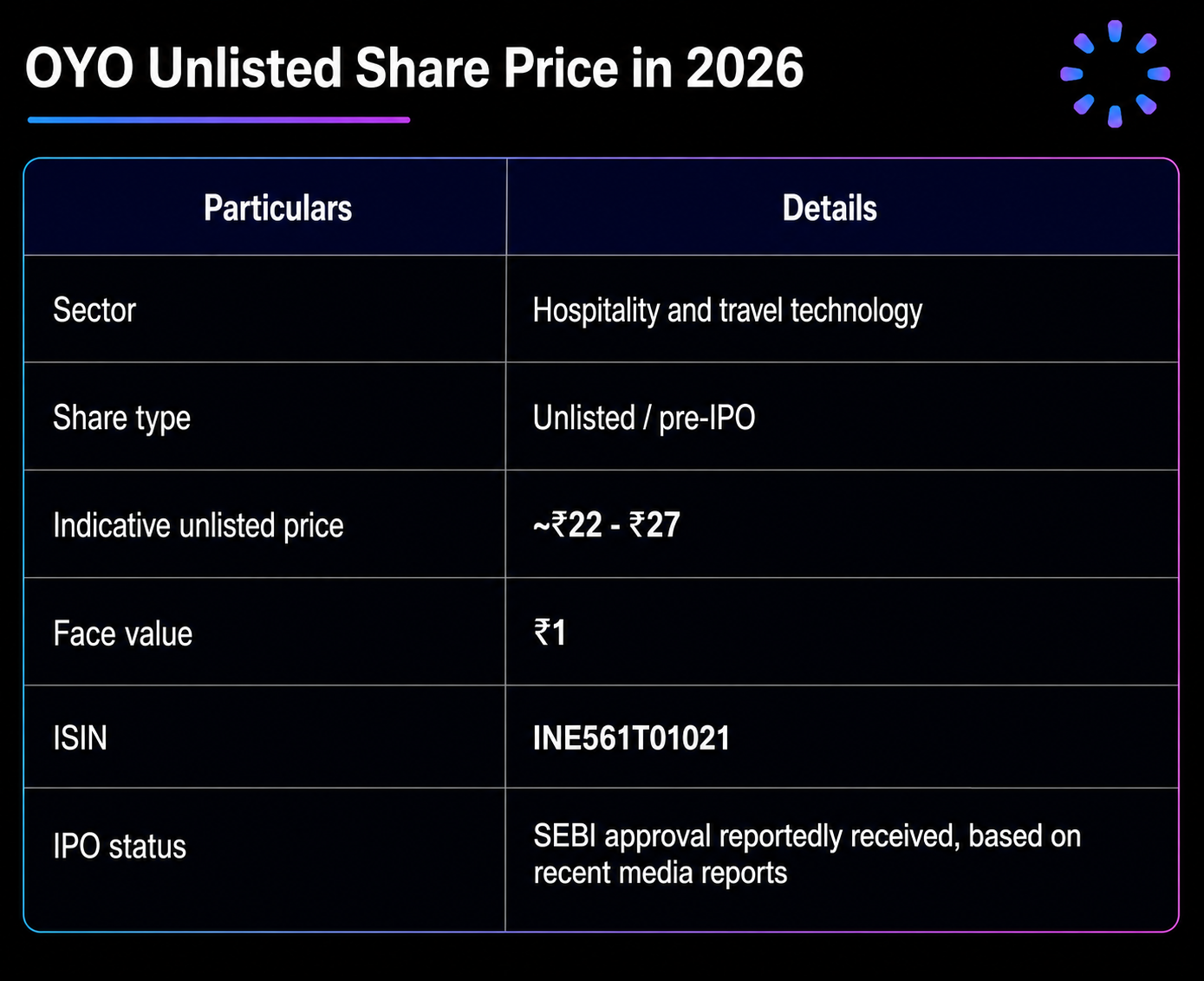
ISIN and company name: Match the ISIN INE561T01021 and understand whether the documentation refers to Oravel Stays unlisted shares, PRISM, or OYO.
Fees and taxes: Check platform charges, stamp duty, transfer charges, and tax implications.
Exit options: Understand whether you can sell before the IPO and what liquidity may look like if the IPO is delayed.
Latest DRHP status: Verify the updated filing on SEBI once it is available.
This step matters because unlisted shares are not as easy to exit as listed shares. A careful verification process can help you avoid buying only because of IPO excitement.
OYO Listing Outlook for 2026
The OYO listing outlook has improved after the reported SEBI approval. If PRISM files the updated DRHP on schedule and market conditions stay supportive, OYO could become one of India's most watched startup IPO candidates.
The listing case will likely depend on five things:
The final IPO valuation and price band.
The strength of reported profitability and cash flow.
The quality of risk disclosures in the updated DRHP.
Institutional demand during the roadshow.
Broader market appetite for technology-led consumer businesses.
For pre-IPO investors, the best approach is to track the updated DRHP, compare the unlisted price with the eventual IPO valuation, and avoid making decisions only on headlines. You can also follow broader private-market updates on the Precize blog.
Final Thoughts
OYO's renewed IPO push has brought OYO unlisted shares back into focus. The reported SEBI approval for a proposed ₹6,650 crore IPO is a major step, and the latest referenced price around ~₹22 - ₹27 gives private-market investors a clearer starting point for comparison.
Still, the investment case needs evidence. Investors should wait for updated filings, review financials carefully, and compare the final IPO valuation with the current unlisted price. OYO's brand and travel-sector exposure are strengths, but IPO timing, liquidity, competition, and profitability remain important risks.
In short, OYO is one of the more important pre-IPO stories to track in 2026. It is also one where discipline matters. Treat the unlisted price as a starting point for research, not a reason to rush.
FAQs on OYO Unlisted Shares
What is the current OYO unlisted share price?
OYO unlisted shares are trading around ~₹22 - ₹27. The live price can change based on platform availability, lot size, demand, and seller terms.
Has OYO received SEBI approval for its IPO?
Recent media reports say PRISM, OYO's parent entity, has received SEBI approval for a proposed ₹6,650 crore IPO. Investors should verify final IPO documents on SEBI's website and exchange platforms before making any decision.
What is the latest OYO DRHP update?
OYO's parent entity is expected to file an updated DRHP or UDRHP after the reported SEBI approval. This document should provide fuller details on financials, risk factors, use of proceeds, shareholding, and IPO structure.
What are the main risks in OYO pre-IPO shares?
The main risks are IPO delay, valuation reset, limited liquidity, competition, public-market volatility, and uncertainty around long-term profitability. Unlisted shares can also be harder to sell than listed shares.
Stay updated with OYO and other unlisted companies through our Precize Community. If this article was useful, you can share it with other investors through the Precize Referral Program.
Disclaimer: This article is for informational purposes only and should not be considered as investment advice. Investing in unlisted shares carries risks including illiquidity and potential loss of capital. Please consult with a qualified financial advisor before making investment decisions. Precize is not a stock exchange and is not authorized by any capital markets regulator.