
When evaluating a company's financial health, one of the key metrics investors often rely on is its book value. Understanding book value is especially important in the context of private equity shares, as it helps investors assess the true worth of a company. Unlike market value, which fluctuates based on stock prices, book value reflects a company's value based on its financial statements—specifically its assets and liabilities. In this blog, we will explore what book value is, how it is calculated, and why it is a crucial metric for private equity investors when making informed decisions.
What is Book Value?
Book value represents the worth of a company based on its balance sheet. It shows how much a company is valued after subtracting its liabilities from its total assets. In simpler terms, it's the value of what the company owns (assets) minus what it owes (liabilities).
For example, if a company's property is valued at Rs. 10 crore but has depreciated by Rs. 2 crore over time, the book value of the property would be Rs. 8 crore.
When looking at a company's overall book value, it is the total value of its assets after subtracting liabilities and intangible assets (like patents or goodwill). This is often referred to as the company's net worth or shareholders' equity.
Book value is important for investors because it gives a sense of how much a company would be worth if it were to sell off its assets and pay off its debts. In case of liquidation, common shareholders are the last to be paid, so understanding the book value helps investors know how much they could potentially receive if things went south.
How to Calculate Book Value?
Book value is a simple way to figure out how much a company is worth based on its financial statements. To calculate it, you take the total value of all the assets the company owns and subtract all its liabilities (what it owes).
The formula to calculate book value is:
Assets include things the company owns, like cash, inventory, property, and equipment. Liabilities are what the company owes, such as debts and bills.
Sometimes, analysts exclude intangible assets like patents or goodwill from the calculation, since they cannot be sold for cash in case the company is liquidated. If you do this, the formula becomes:
123_v1762003444445.png "Book Value = Total Assets – (Intangible Assets + Total Liabilities)")
Example:
Let's look at a simplified example. Here's the balance sheet of Company XYZ as of 31st March 2023:
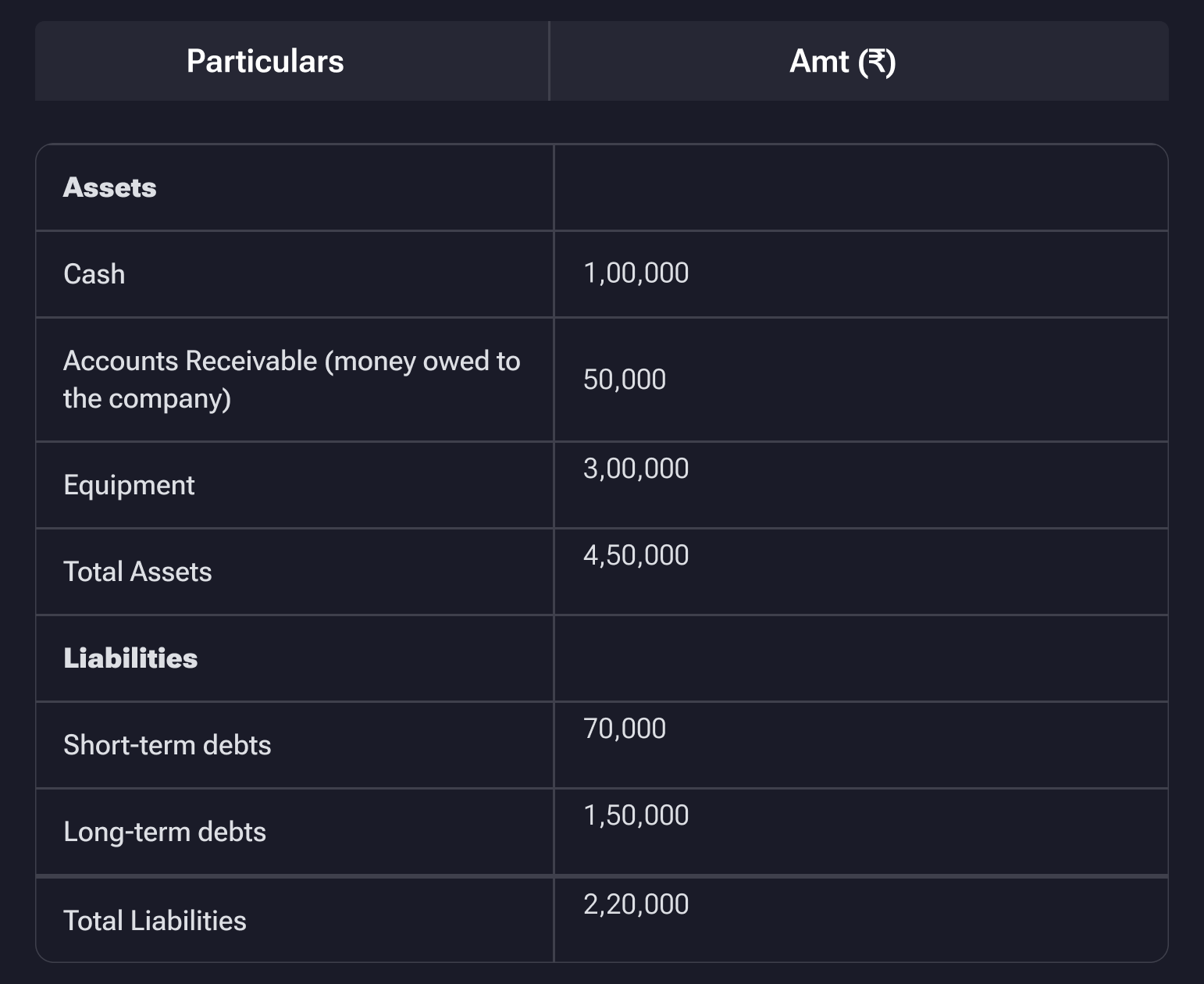
To find the book value, we subtract the total liabilities from the total assets:

So, if Company XYZ were to liquidate (sell off everything and pay off its debts), its shareholders would receive a total of ₹2,30,000 based on their share of ownership in the company. This amount reflects what the company is worth after settling all debts.
How Does Book Value Relate to Private Equity Shares?
Private companies, in contrast to public companies, are not obligated to disclose their financial performance on a quarterly basis. Private companies are typically owned by their founders or a small group of investors, while public companies are traded on stock exchanges and owned by shareholders.
Because private companies do not list their shares on the stock exchange, they may choose to sell shares in the unlisted market to raise funds. Even though they are not required to release quarterly reports, private companies do publish annual reports. These reports include key financial statements such as the balance sheet, cash flow statement, and profit and loss statement. For investors looking to explore private companies and diversify their portfolios, book value can be a helpful metric. By looking at a private company’s book value, investors can get a clearer picture of the company’s financial health and its true worth. This helps them make more informed decisions about whether the company is a good investment.
Conclusion:
In conclusion, book value is a key metric for assessing a company's financial health, particularly when evaluating private equity shares. It offers a clear understanding of a company’s worth by comparing its assets to liabilities. While private companies may not provide regular financial updates like public companies, book value remains a reliable indicator of their financial stability. However, it's important to note that relying solely on book value is not sufficient. Investors should conduct both qualitative and quantitative analyses to gain a comprehensive understanding of a company’s overall financial performance before making any investment decisions. This holistic approach ensures a more informed and balanced investment strategy.