When selling shares or securities, traders often face the time-consuming process of TPIN-CDSL verification, which can lead to costly delays, especially when market conditions are volatile. In such situations, acting quickly is essential to avoid potential losses. This is where Demat Debit and Pledge Instruction (DDPI) steps in as a game changer. By allowing traders to sell shares and pledge securities without the lengthy TPIN OTP verification, DDPI helps to speed up the process and enhance efficiency.
In this blog, we’ll dive into what DDPI is, why it's so important, and how it can simplify trading by eliminating unnecessary delays, ultimately making trading operations more seamless for investors.
What is Demat Debit and Pledge Instruction (DDPI)?
Demat Debit and Pledge Instruction (DDPI) is a document that allows a broker to debit securities from a client’s demat account and deliver them to the exchange when a trade is made. Once the DDPI is submitted, the client no longer needs to enter the CDSL T-PIN and OTP to sell shares, making the process faster and more convenient.
The Securities and Exchange Board of India (SEBI) introduced DDPI through a circular to simplify and secure the trading process. Under DDPI, shares can only be debited from a client’s account when a sell trade is placed, ensuring enhanced security. Additionally, SEBI replaced the earlier Power of Attorney (PoA) provisions with DDPI for authorized clients, effective July 1, 2022.
What Is a Power of Attorney (POA)?
A Power of Attorney (POA) is a legal document that allows one person, known as the agent or attorney-in-fact, to act on behalf of another person, referred to as the principal. The agent can be given broad or limited authority to manage the principal’s property, finances, investments, or medical care.
POAs can cover financial matters or healthcare decisions, and they may grant either general or restricted powers to the agent.
How Does Power of Attorney (POA) Differ from Demat Debit and Pledge Instruction (DDPI)?
POA and DDPI serve different purposes and vary in terms of authority, control, and security. Here's a simple comparison: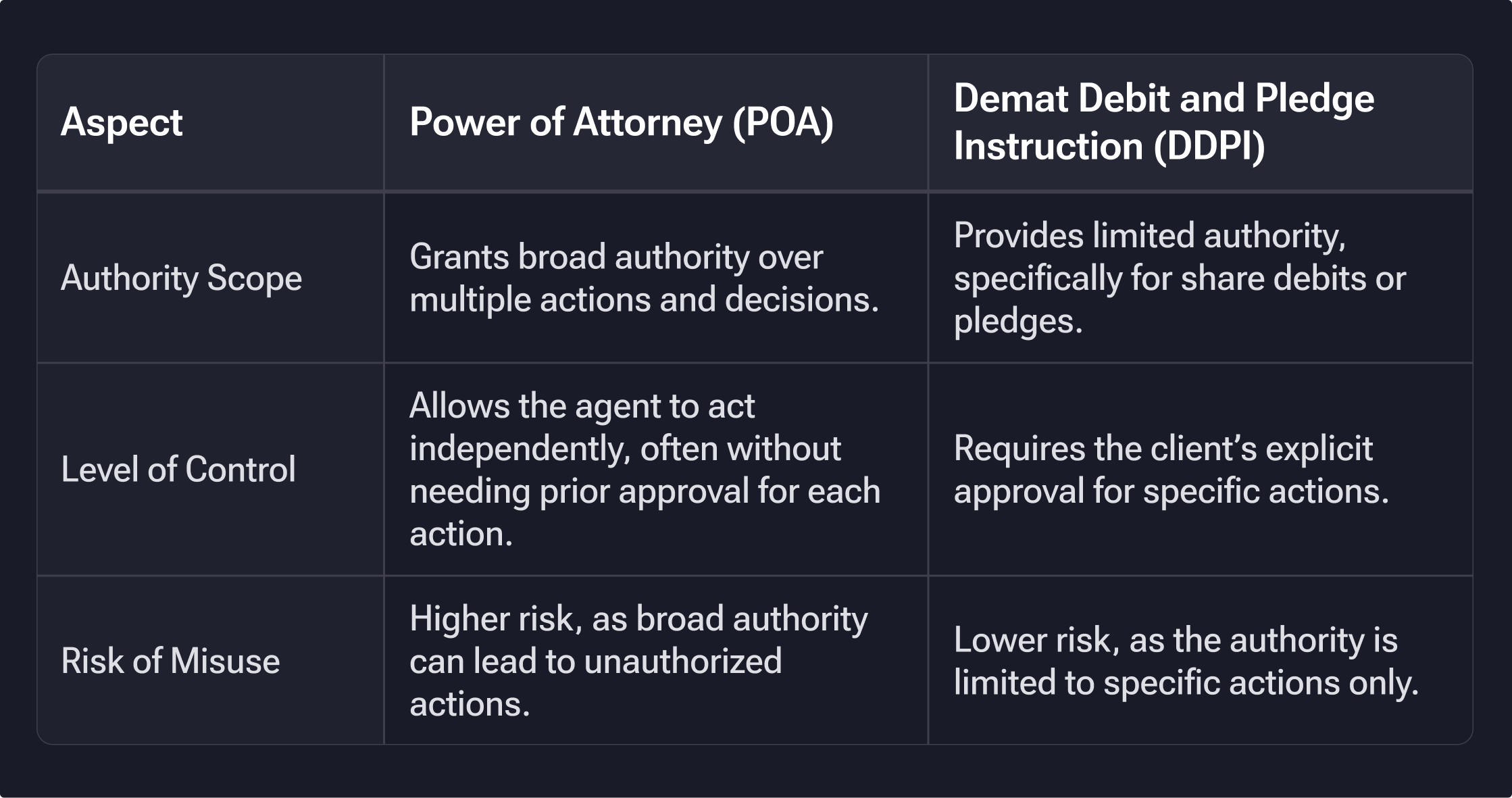 In summary, while a POA grants wide-ranging powers that can sometimes carry higher risks, DDPI is more focused and secure, designed specifically for seamless and controlled trading and pledging of securities.
What Transactions Can Be Facilitated Via DDPI?
The Securities and Exchange Board of India (SEBI) defines specific transactions that can be facilitated through the Demat Debit and Pledge Instruction (DDPI). These include:
Settlement of Trades:
DDPI allows the transfer of securities from a demat account to settle trades executed on the Stock Exchange through a broker. This ensures a smoother and more transparent process for buying or selling shares.Pledging Securities for Margins:
It enables clients to pledge shares to a trading member (TM) or clearing member (CM) to meet margin requirements. This makes using shares as collateral for trading simpler and more convenient.Participation in Stock Exchange Transactions:
DDPI facilitates transactions conducted on Stock Exchange platforms in compliance with SEBI regulations.Open Offers or Buybacks:
It ensures a secure and transparent process for transferring shares during public offers or buybacks, such as open offers where companies invite shareholders to sell their shares.
Why Choose DDPI Over PoA?
DDPI provides the same functionality as a Power of Attorney (PoA) but with tighter controls, reducing the risk of misuse or fraudulent transactions. It’s a more secure and streamlined way to manage trading and related activities.
Common Questions About Demat Debit and Pledge Instruction (DDPI)
Is setting up DDPI mandatory?
No, setting up DDPI is optional. It's entirely your choice to activate it or not, and no broker can force you to enable it.Will my existing Power of Attorney (PoA) work if I activate DDPI?
Yes, your existing PoA will remain valid unless you revoke it. Once revoked, the PoA becomes invalid, and you can use DDPI instead.
Why DDPI is Better Than PoA
Improved Security: Limits authorization to specific actions, reducing the risk of misuse.
Transparency: Provides better oversight compared to PoA.
Convenience: Streamlines transactions without compromising safety.
Conclusion
DDPI offers a secure, transparent, and efficient way to manage transactions directly from your demat account. It replaces outdated methods like PoA, reducing the risk of misuse and ensuring smoother operations. Activating DDPI is quick and easy, giving you better control over your investments.