
In the world of stock market trading, having the right tools is essential for making well-informed investment decisions. Two of the most commonly used tools by traders are the Order Book and Trade Book. While both provide valuable data, they serve different purposes in the trading process. In this blog, we’ll explain what these tools are, how they work, and the key differences between them.
What is an Order Book?
An Order Book is a real-time list of buy and sell orders for a specific security or stock on a trading platform. It reflects the interest of traders in the market by showing the number of shares available at different prices. The order book provides insight into supply and demand, helping traders understand current market conditions.
Components of an Order Book:
Bid Side: This section shows buyers’ orders, with the highest bid price displayed at the top. The bid price is the maximum amount a buyer is willing to pay for the stock.
Ask Side: This section lists sellers’ orders, with the lowest ask price at the top. The ask price represents the minimum amount a seller is willing to accept for the stock.
For example, if a stock’s highest bid price is ₹100 and its lowest ask price is ₹102, the trading platform shows this ₹2 difference as the "spread." A smaller spread usually indicates higher liquidity, while a larger spread may suggest limited market activity.
Why is the Order Book Important?
The order book helps traders:
Understand market depth (available shares at different prices).
Identify buying and selling pressure.
Spot potential entry and exit points.
For instance, if there are several large buy orders at a specific price, it could indicate a strong support level, suggesting that prices may not fall below this point easily.
What is a Trade Book?
A Trade Book is a record of all completed trades for a particular security. Unlike the order book, which shows pending buy and sell orders, the trade book lists past transactions. It includes trade details such as the execution price, volume, and time of each trade.
Why is the Trade Book Important?
The trade book helps traders:
Analyze historical trading patterns.
Study market reactions to major events.
Evaluate how large trades influence stock prices.
For example, if a stock’s price rises sharply after a company’s earnings announcement, reviewing the trade book can reveal whether the price increase was driven by a few large trades or numerous smaller transactions. This insight can be crucial for future trading decisions.
Key Differences Between Order Book and Trade Book
While both tools are essential in online trading, they serve distinct purposes. Here’s a closer look at their differences:
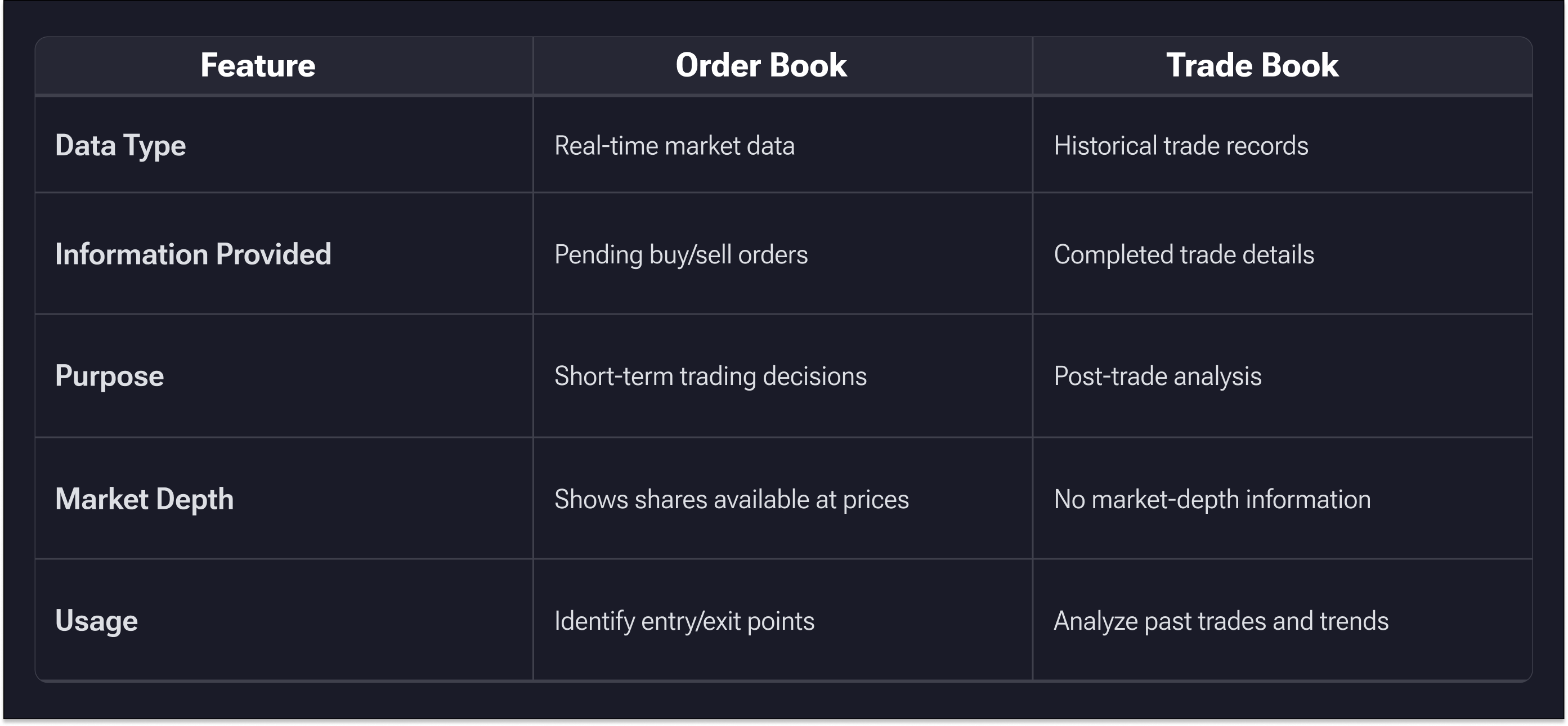
Practical Use in Online Trading
If you use an online trading platform, both the order book and trade book are easily accessible through your account. Here’s how traders can benefit from these tools:
Using the Order Book:
Spot Trading Opportunities: Monitor large buy or sell orders to find potential entry or exit points.
Assess Market Sentiment: Check if more traders are buying or selling the stock.
Identify Support and Resistance Levels: A large number of buy orders at a specific price might suggest a support level, while many sell orders could indicate resistance.
For example, if a stock’s current price is ₹500 and the order book shows several buy orders at ₹495, it could indicate a potential buying opportunity near ₹495.
Using the Trade Book:
Analyze Past Performance: Review historical trades to identify price trends and patterns.
Evaluate Market Impact: Study large trades to see how they affect stock prices.
Develop Trading Strategies: Use trade book data to refine trading strategies for future transactions.
For instance, if a stock shows high trading volumes during market opening hours, traders might adjust their strategies to trade during that time for better liquidity.
Why Understanding These Tools Matters
Mastering the use of both the order book and trade book can give traders an edge in the stock market. The order book provides real-time insights into market conditions, while the trade book helps with historical analysis and strategy development. Together, they form a comprehensive trading toolkit.
Conclusion
Understanding the difference between the order book and trade book is essential for anyone involved in stock market trading. These tools offer unique perspectives on market activity, helping traders make better-informed decisions.
If you’re someone interested in diversifying your portfolio beyond traditional investments, private platforms like Precize provide access to private equity and private credit opportunities, offering a chance to expand your investment options. Reserving access might help you discover new possibilities in the private market.