
What is the Share Market?
People often wonder about the difference between the stock market and the share market, often using the terms interchangeably.
A stock market and share market are similar, but there is a key difference. The share market is where shares are issued or traded. In contrast, the stock market allows trading in a wider range of securities, including bonds, mutual funds, derivatives, and shares.
What is the Stock Market, and How Does it Work?
Companies often raise money on the stock market by selling ownership shares to investors. These shares represent a portion of the company. These shares represent a piece of the company. By listing shares on stock exchanges, companies can get the funds they need to run and grow their businesses without borrowing money.
Investors use their money to buy these shares, hoping the company's success will increase the value of their shares over time, leading to profit. Additionally, companies often pay dividends to shareholders as they make more money.
How to Invest in the Stock Market in India?
If you are looking for guidance on how to invest in the share market for beginners or even as an experienced investor, you are in the right place.
Here’s a simple guide to buying stocks online:
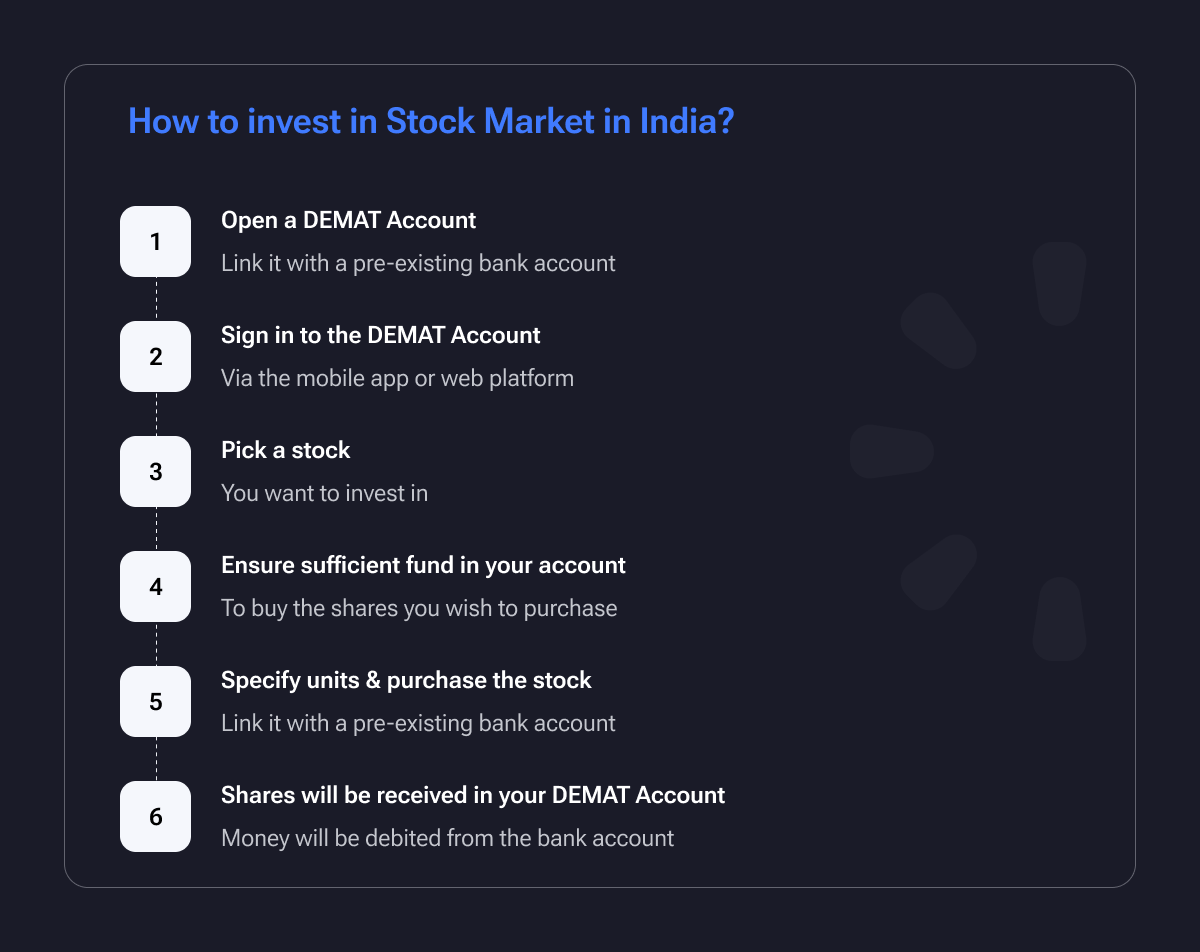
Open a DEMAT Account: Create a DEMAT account and link it to your active bank account to simplify transactions.
Log In: Access your DEMAT account through a mobile app or website.
Choose Your Stock: Select the stock you want to invest in.
Check Your Funds: Add funds to your bank account to cover the purchase.
Buy the Stock: Purchase the stock at its current price and enter the number of shares you want.
Complete the Purchase: Once your order is matched with a seller, the transaction will go through. The particular amount will be deducted from your bank account, and the shares will be deposited into your DEMAT account.
Note: When opening a DEMAT account, you will need to provide the following:
Bank Account details
Proof of Address
Proof of Identity
PAN Card
Cancelled Cheque
A Stockbroker
For anyone looking to invest in the stock market, it's important to be aware of these requirements.
Considerations before investing in the stock market:
Here are some important things to think about before you start investing:
Investment Goals: First, figure out what you want to achieve with your investments. Your goals will help you choose the right stocks. Also, decide how long you plan to invest.
Risk Tolerance: Think about how much risk you’re comfortable with. If you prefer safer investments, choose stocks that provide steady returns and are less influenced by market fluctuations.
Diversification: Distributing your investments across different sectors and asset classes helps to lower risk. This way, if one investment does poorly, it won't hurt your overall portfolio as much.
Understanding Portfolio Diversification:
Diversification includes spreading your investments across various asset types to minimize the risk associated with any single asset. This approach helps smooth out the ups and downs of your portfolio over time.
A key to successful investing is finding the right balance between your comfort with risk and your investment timeline. If you invest too conservatively when you're young, you might not keep up with inflation or build enough savings for retirement. On the other hand, if you invest too aggressively when you're older, you might face significant losses due to market fluctuations at a time when recovering from those losses is harder.
A way to balance risk and reward is by diversifying your investments. This means spreading your money across different asset types, such as bonds, stocks, private equity, private credit, etc, to lessen the impact of any single investment’s performance. While diversification can help lower risk and volatility, it doesn't guarantee profits or prevent losses.
Understanding Private Equity:
In addition to listed shares, there are unlisted shares, also known as private equity or pre-IPO shares, which represent ownership in private companies not traded on public exchanges. These shares are usually held by a selected group of individuals or entities, such as founders, employees, venture capitalists, or angel investors. Unlike publicly traded shares, which are bought and sold on stock markets, unlisted shares lack the liquidity and transparent pricing mechanisms of public markets. Instead, their valuation and transfer are typically done through private negotiations between buyers and sellers. This distinction makes unlisted shares less accessible to the general public. However, with Precize, both institutional and retail investors can invest in these unlisted shares with a minimum investment amount of just Rs 10,000/-.
Conclusion:
Investing in the stock market requires knowledge, preparation, and a strategic approach. Understanding market fundamentals, opening a DEMAT account, and selecting the right stocks are key steps. Setting clear investment goals, assessing risk tolerance, and diversifying portfolios help manage risks effectively. Diversifying investment across various sectors and asset classes can reduce the impact of market fluctuations. Balancing risk and reward, along with continuous education and informed decisions, can help in navigating the challenges of the stock market and achieving financial goals.