Is the SBI Mutual Fund IPO confirmed?
Confirmed in the sense that a formal listing process has started: the DRHP filing is the regulated starting gun, not a rumor. What is not confirmed yet in public markets is the final issue size, price band, timetable, allocation split, or post-issue promoter holdings, because those items typically shift during SEBI review and book-building.
If you are new to IPO vocabulary, treat milestones in this order:
DRHP (draft offer document for SEBI review)
SEBI observations and issuer responses
RHP (near-final offer document with more pricing detail)
Bid period, basis of allotment, listing
For mechanics straight from the regulator's education stack, see SEBI's investor learning hub and the SEBI legal regulations index.
What is SBI Funds Management (SBI Mutual Fund)?
SBI Mutual Fund is the customer-facing brand. The legal entity driving the IPO is SBI Funds Management Private Limited, a joint venture historically anchored by SBI with a significant minority stake held by Amundi (via the entities named in the DRHP).
The fund house runs the product shelf you would expect from a top-tier Indian AMC:
Active equity and tax-saving schemes
Debt and money market strategies
Hybrid and solution-oriented offerings
Index, ETF, and passive building blocks
Distribution is a structural advantage: SBI's banking footprint plus independent advisors and digital platforms create repeat touchpoints with retail investors. That distribution depth is one reason IPO narratives for large AMCs often emphasize sticky flows, SIP culture, and brand recall, then test those claims against real redemption and fee data in the prospectus.
What we know from early DRHP reporting (and what to verify)
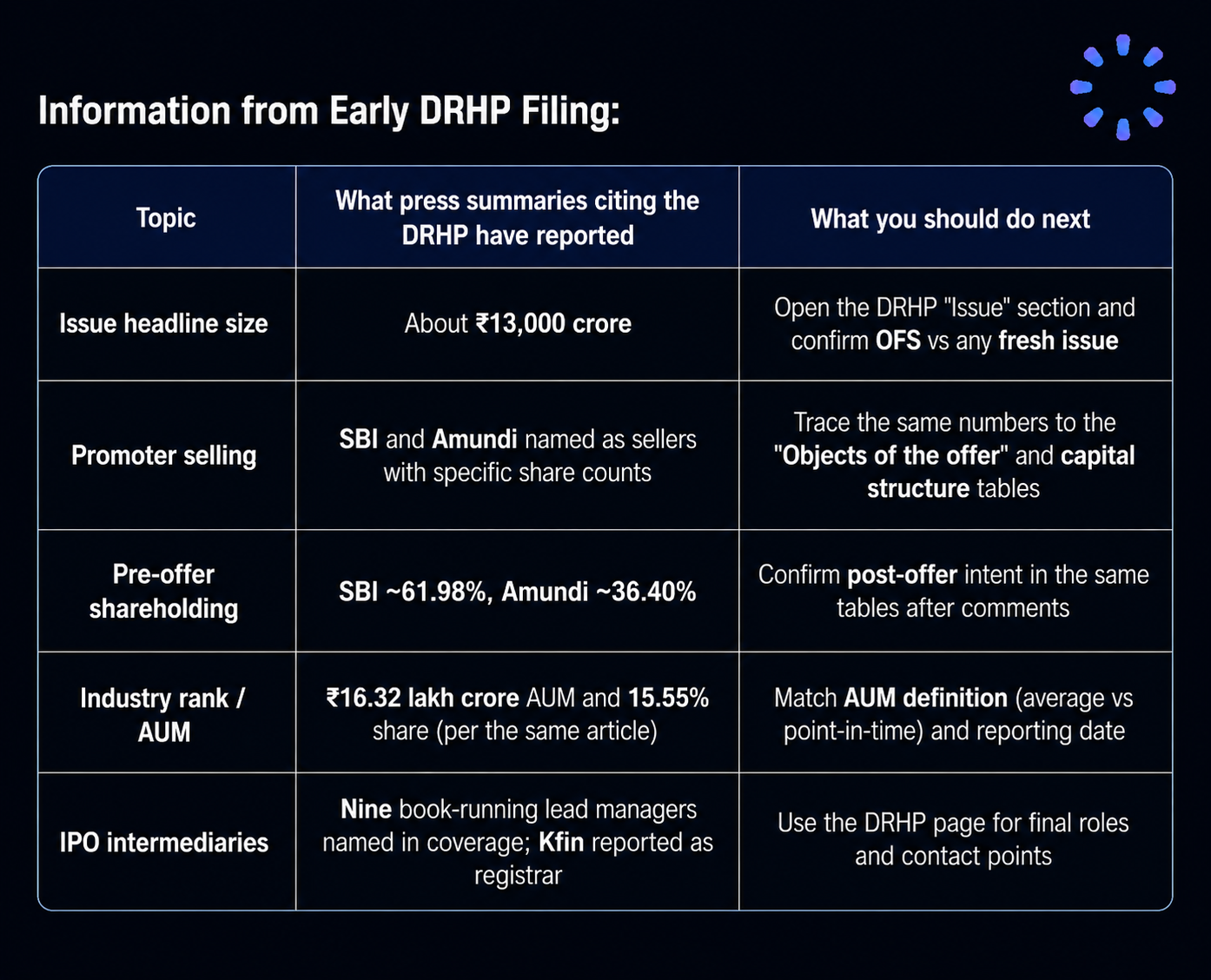
Media summaries of the DRHP (including The Hindu BusinessLine, Financial Express, and wire-style desks) converge on a few headline facts you should still re-check in the PDF DRHP when you invest serious time or capital:
Why investors care about an SBI Mutual Fund listing
1. A liquid proxy for India's mutual fund growth story
A listed AMC is not the same thing as buying mutual fund units, but it can become a listed equity way to express a view on industry AUM growth, fee pools, and operating leverage in asset management, subject to all the usual stock risks.
2. Fee economics and market cycles
AMCs earn from management fees and related revenue lines that move with AUM and product mix. That creates a simple bull story in rising markets and a simple stress story in prolonged corrections, which is why DRHPs spend pages on sensitivity and flow data.
3. Regulation as a first-class risk
SEBI rules on total expense ratio, direct plans, disclosure, distribution, and product structure can change economics faster than a brand can offset with marketing. Read the "Risk factors" and "Regulations" chapters carefully, not only the marketing chapter.
4. Competitive intensity
India's AMC leaderboard is crowded at the top. Names like HDFC AMC, ICICI Prudential AMC, Nippon India AMC, and others compete for shelf space, talent, and distributor attention. A listing does not remove competition; it surfaces it in quarterly results and peer multiples.
Risks to weigh before you chase the IPO headline
Market and flow risk: If equity and debt markets weaken together, net flows can tighten and AUM mix can skew in ways that pressure revenue quality, even for a large house.
Concentration and key-person risk: Active franchises depend on investment teams, risk processes, and stewardship. The DRHP's sections on key managerial personnel, related party transactions, and operational controls matter as much as the growth charts.
Valuation risk: Media sometimes prints implied market cap chatter or unlisted market price talk. Treat those as noisy inputs until you see earnings, margins, cash conversion, and listed peer multiples on a like-for-like basis.
OFS-heavy structure: If the issue is predominantly OFS, ask what you are funding as a buyer of shares in the secondary market sense: you are buying from sellers at a discovered price, not automatically "fueling" capex in the way some fresh issues are framed.
How to prepare practically (retail checklist)
Open the DRHP PDF on SEBI's offer document workflow and read Risk factors, Financial information, Legal, and Outstanding litigation before you read blogs (including this one).
Compare listed AMCs you can already buy today: revenue mix, PAT margins, cost-to-income, equity vs debt AUM, and ETF share. That homework makes the SBI issue easier to contextualize.
Decide your process, not your FOMO: max price, margin of safety, portfolio weight cap, and whether you prefer listing-day liquidity over IPO allocation complexity.
Track updates on SEBI and the issuer's investor relations pages once live.
If you are also exploring private-market access and want a structured way to browse companies outside traditional mutual funds, the Precize Screener is built for discovery and research workflows (not a recommendation to buy any specific security). For broader context on how we write about markets, see the Precize blog and FAQs.
Bottom Line
SBI Mutual Fund's DRHP is a meaningful milestone for India's capital markets because it packages a household name, a huge AUM base, and a long distribution history into a potential listed equity story. The hard part for investors is unchanged: read the filing, price the business, and size the risk like any other large financials listing.
If you want help navigating pre-IPO and unlisted research alongside your listed portfolio, start on Precize, use the screener for structured discovery, and reach Precize Care when you need platform support.
Frequently asked questions (FAQs)
1. What is a DRHP in simple terms?
A DRHP is the draft offer document an issuer files with SEBI so regulators and the market can review disclosures before a final RHP and IPO launch. It is meant to be comprehensive, but it is still a draft.
2. Is SBI Mutual Fund already listed?
Not yet. Media coverage positions the company as on path to become the seventh listed AMC in India if the issue completes.
3. Will SBI Mutual Fund receive IPO money for growth?
In an OFS-only structure, primary proceeds go to selling shareholders, not the company, unless a fresh issue component is included. Read the final prospectus tables to confirm the mix for this issue.
4. Where should I read the primary facts?
Start with SEBI filings for this issuer and the official DRHP / RHP PDFs, not screenshots on social media.
5. Does buying the IPO equal investing in SBI Mutual Fund schemes?
No. Mutual fund units and AMC equity are different instruments with different risks, liquidity, and return drivers.
Disclaimer: This article is for informational purposes only and should not be considered investment advice. Securities carry risks including loss of capital and volatility. Precize is not a stock exchange and is not authorized by any capital markets regulator as a stock exchange. Consult a qualified financial advisor before making investment decisions.