

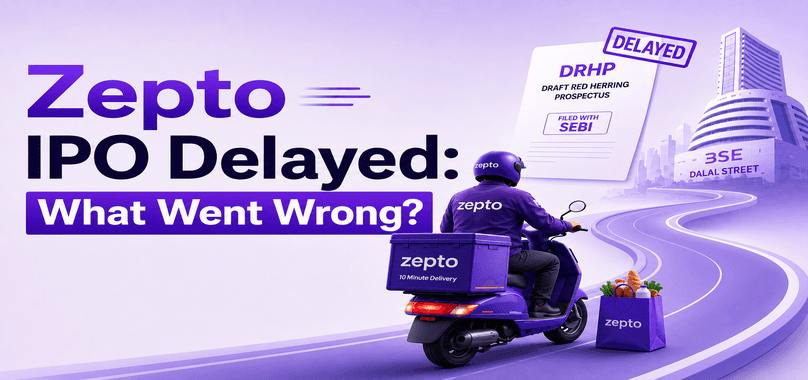
Zepto IPO Delay: When Speed Was No Longer Enough
For years, speed was Zepto’s biggest selling point. The company built its identity around the promise of delivering groceries and everyday essentials in minutes, turning speed from a logistical advantage into a powerful brand proposition.
But as Zepto prepares for its eventual public-market debut, investors appear to be asking a different question: Can the company turn rapid growth into sustainable profits?
Zepto has now paused its much-anticipated IPO after facing resistance from public-market investors over valuation and business fundamentals. Instead of proceeding with the listing, the company is looking to raise around ₹1,000 crore through a pre-IPO placement and use the additional time to improve its financial and operating metrics.
The development raises an important question for India’s quick-commerce industry: Was Zepto’s biggest strength speed also the foundation of a business model that is becoming harder to justify at a premium valuation?
Own Zepto unlisted shares before IPO
Get early access to Zepto unlisted shares before the IPO

The Zepto Story Was Built Around Speed
Zepto’s name itself comes from “zeptosecond”, an extremely small unit of time. From its early days, the startup positioned itself around one simple proposition: getting products to customers extremely quickly.
That proposition helped Zepto stand out in a crowded market alongside Blinkit and Swiggy Instamart. Its dark-store network, dense delivery infrastructure and aggressive customer acquisition strategy were designed around reducing delivery times.
The strategy worked in terms of scale.
According to its FY26 IPO disclosures, Zepto processed more than 640 million orders during the year and expanded its network to 1,139 dark stores. Revenue from operations more than doubled to around ₹22,624 crore in FY26.
However, the other side of the equation is equally important.
Zepto’s net loss widened to approximately ₹5,905 crore in FY26 from about ₹4,700 crore the previous year.
That is where the company's IPO story becomes more complicated.
What Changed for Zepto?
One of the key developments highlighted in recent analysis was the regulatory restriction on quick-commerce companies advertising guaranteed “10-minute delivery” claims.
For Zepto, the impact could be more significant than simply changing a marketing tagline.
The company's brand had been closely associated with speed. Meanwhile, competitors such as Blinkit had already been expanding their proposition beyond delivery times into areas such as product variety. Swiggy Instamart, meanwhile, had the advantage of operating under the broader Swiggy ecosystem.
This potentially left Zepto with a more difficult differentiation problem.
Deccan Herald's analysis argues that the removal of the explicit speed promise coincided with changes in Zepto's growth trajectory, including slower store expansion and weaker user-acquisition indicators. However, it is important to note that this does not establish a direct causal link between the advertising restriction and Zepto's IPO delay.
The bigger takeaway is that a quick-commerce company ultimately needs more than speed to build a durable competitive advantage.
The Bigger Problem: Growth vs Profitability
Zepto has demonstrated that consumers are willing to use quick-commerce platforms at enormous scale.
But public-market investors typically evaluate more than topline growth.
They want to know:
How much does each order contribute to profitability?
How quickly can a dark store become profitable?
How much cash is required to open additional stores?
Can customer acquisition remain efficient?
How sustainable is the company's cash burn?
When can the business generate positive free cash flow?
These questions have become increasingly important for Zepto.
In Q4 FY26, the company reportedly recorded an adjusted EBITDA loss of around ₹59 per order, although its cost per order had improved from earlier quarters. Its free cash flow also remained negative.
This creates a difficult balancing act: Zepto is growing rapidly, but it is also spending heavily to sustain that growth.

Why Did Zepto Delay Its IPO?
The immediate issue appears to be a valuation gap between what Zepto and its existing investors expected and what public-market investors were willing to pay.
Zepto had previously been valued at around $7 billion in its private-market funding round. Reports surrounding the IPO indicated that institutional investors were pushing for a significantly lower valuation.
Rather than accept a sharp valuation reduction, Zepto chose to postpone the listing and pursue additional private funding.
The company has indicated that it intends to focus on execution, update its financial and operating information and return to the public markets within the permitted timeline.
In other words, the IPO delay does not necessarily mean the public listing is cancelled.
It could instead be a strategic decision to buy time to improve the story before asking public investors to value it.
Zepto vs the Quick-Commerce Competition
The competitive environment makes the challenge even more significant.
Blinkit has the backing of Eternal, while Swiggy Instamart benefits from Swiggy's wider ecosystem. Amazon and Flipkart have also been increasing their presence in India's rapidly expanding quick-commerce market.
Zepto, on the other hand, is a standalone quick-commerce company.
That means investors may demand greater evidence that Zepto can independently achieve:
Scale → Better unit economics → Lower cash burn → Profitability → Sustainable growth
The company has made progress on some operating metrics, including store productivity and cost per order. But investors are likely to want to see those improvements translate into a much stronger bottom line before assigning the business a premium valuation.
What Zepto Needs to Prove Before Its IPO
The IPO delay gives Zepto an opportunity to strengthen its public-market narrative.
1. Reduce Cash Burn
The most immediate priority is improving cash efficiency. Rapid expansion is valuable only if each new store and customer ultimately contributes to sustainable economics.
2. Improve Profitability
Revenue growth alone may not be enough. Investors will closely track EBITDA losses, contribution margins and profitability at the store and order level.
3. Build a Broader Brand Proposition
Speed helped Zepto create its identity. But as quick commerce becomes mainstream, the company may need to compete on selection, convenience, availability, pricing, private labels and customer experience, rather than delivery time alone.
4. Demonstrate Sustainable Growth
A strong IPO story needs to show that growth can continue without disproportionately increasing losses.
5. Close the Valuation Gap
Ultimately, Zepto needs public investors to believe that its future growth justifies its valuation. The recent IPO pause suggests that this confidence has not yet been established.
What Does the Zepto IPO Delay Mean for Investors?
The Zepto story offers a broader lesson for investors evaluating high-growth startups.
Growth can attract private capital. Profitability and sustainable unit economics attract public-market capital.
Zepto has already demonstrated that it can build a large quick-commerce operation at remarkable speed. Its next challenge is proving that the same business can generate attractive returns without relying indefinitely on external funding.
The company's IPO delay therefore isn't necessarily the end of the story. It could be the beginning of a more important phase—one where execution matters more than hype, and economics matter more than speed.
Conclusion
Zepto changed the way urban India thinks about grocery delivery. Its speed-first strategy helped accelerate the growth of quick commerce and forced competitors to rethink delivery expectations.
But the public markets are asking for a different promise now.
The question is no longer simply “How fast can Zepto deliver?”
It is:
“How sustainably can Zepto grow, and when can that growth translate into profits?”
The answer could determine not only the timing of the Zepto IPO, but also the valuation investors are willing to assign to one of India's most closely watched quick-commerce startups.
For investors, Zepto's next chapter will be less about delivering in minutes—and more about delivering profitable growth.
To compare companies, documents, and availability explore unlisted companies on Precize. For ongoing IPO and private-market updates, browse the Precize blog. Stay updated with unlisted companies through our Precize Community. If this article was useful, you can share it with other investors through the Precize Referral Program.
FAQs
Zepto postponed its IPO amid investor concerns around valuation, profitability, cash burn and the sustainability of its growth. The company is instead pursuing a pre-IPO funding round and plans to revisit the public listing.
Zepto was previously valued at around $7 billion in its private-market funding round. Reports around the IPO indicated that public-market investors were seeking a substantially lower valuation.
No. Zepto reported a net loss of approximately ₹5,905 crore in FY26, despite revenue more than doubling during the year.
Zepto had approximately 1,139 dark stores at the end of FY26.
Zepto has indicated that it intends to proceed with its public listing after updating its financial and operating information and improving its business metrics.
Disclaimer: This article is for informational purposes only and should not be considered as investment advice. Investing in unlisted shares carries risks including illiquidity and potential loss of capital. Please consult with a qualified financial advisor before making investment decisions. Precize is not a stock exchange and is not authorized by any capital markets regulator.