What Does Zepto Do?
Zepto operates in India's quick-commerce segment. The company delivers groceries, packaged foods, household essentials, beauty products, electronics, and other daily-use items through a network of dark stores.
A dark store is a small fulfilment centre designed for online orders rather than walk-in customers. The model works best when demand is dense, inventory moves quickly, and delivery routes stay short.
Zepto competes with:
The appeal of quick commerce is simple. Customers increasingly want convenience for repeat purchases, not only for planned monthly grocery shopping. The challenge is also clear: delivery speed, inventory availability, discounts, and fulfilment infrastructure all cost money.
That is why Zepto's IPO story is not just about revenue growth. Investors need to study whether the company can make each order more profitable as it scales.
Zepto Unlisted Share Price
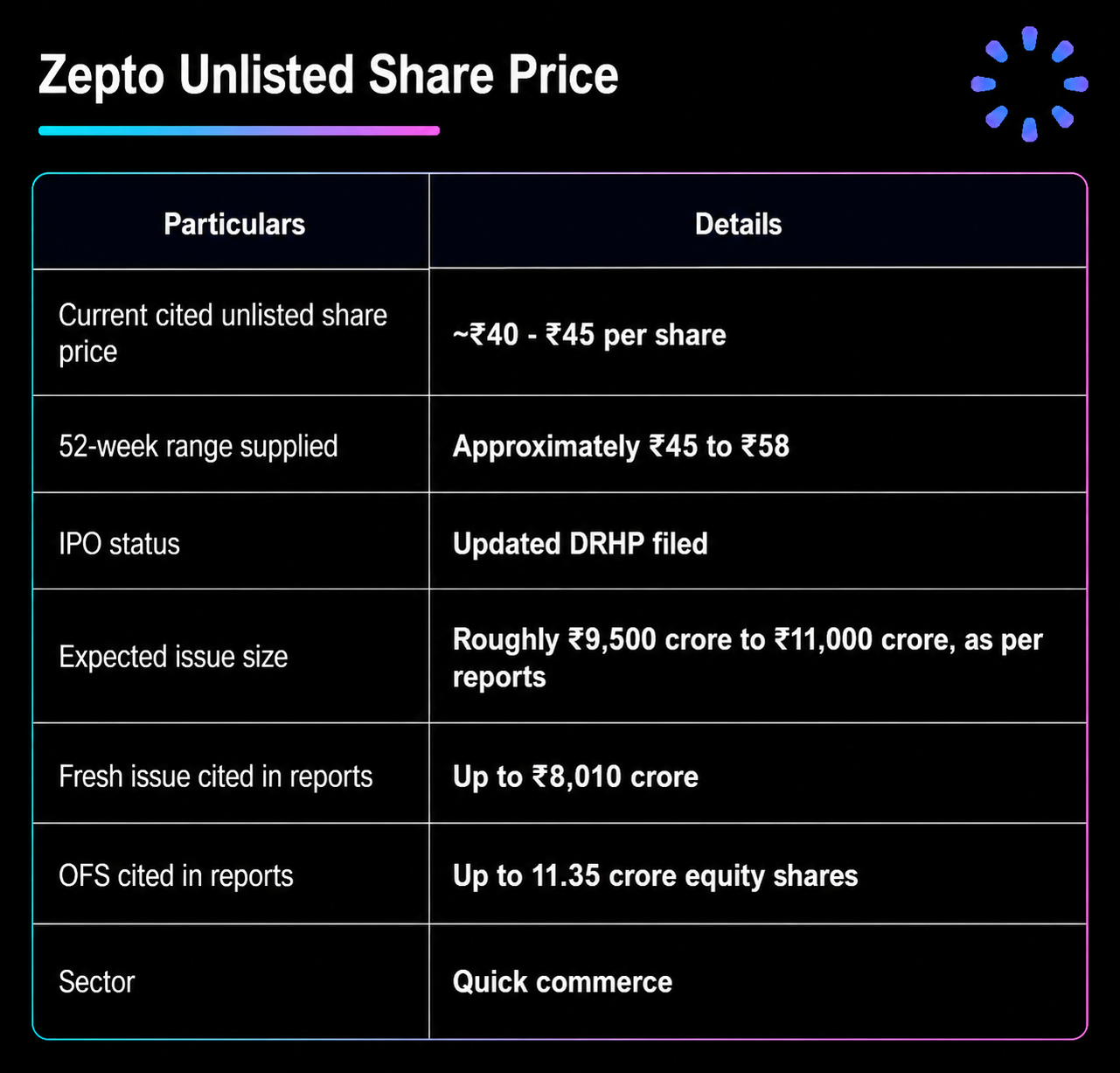
The Zepto unlisted share price is cited at ~₹40 -₹45 per share, with a 52-week range of approximately ₹45 to ₹58.
The Precize screener can also help compare Zepto with other pre-IPO opportunities by sector, pricing, and available information.
Zepto Financials and Growth Snapshot
The updated DRHP has brought Zepto's growth and losses back into focus. According to media coverage of the updated draft papers, Zepto's operating revenue more than doubled in FY26, while losses also increased because of expansion and infrastructure spending.
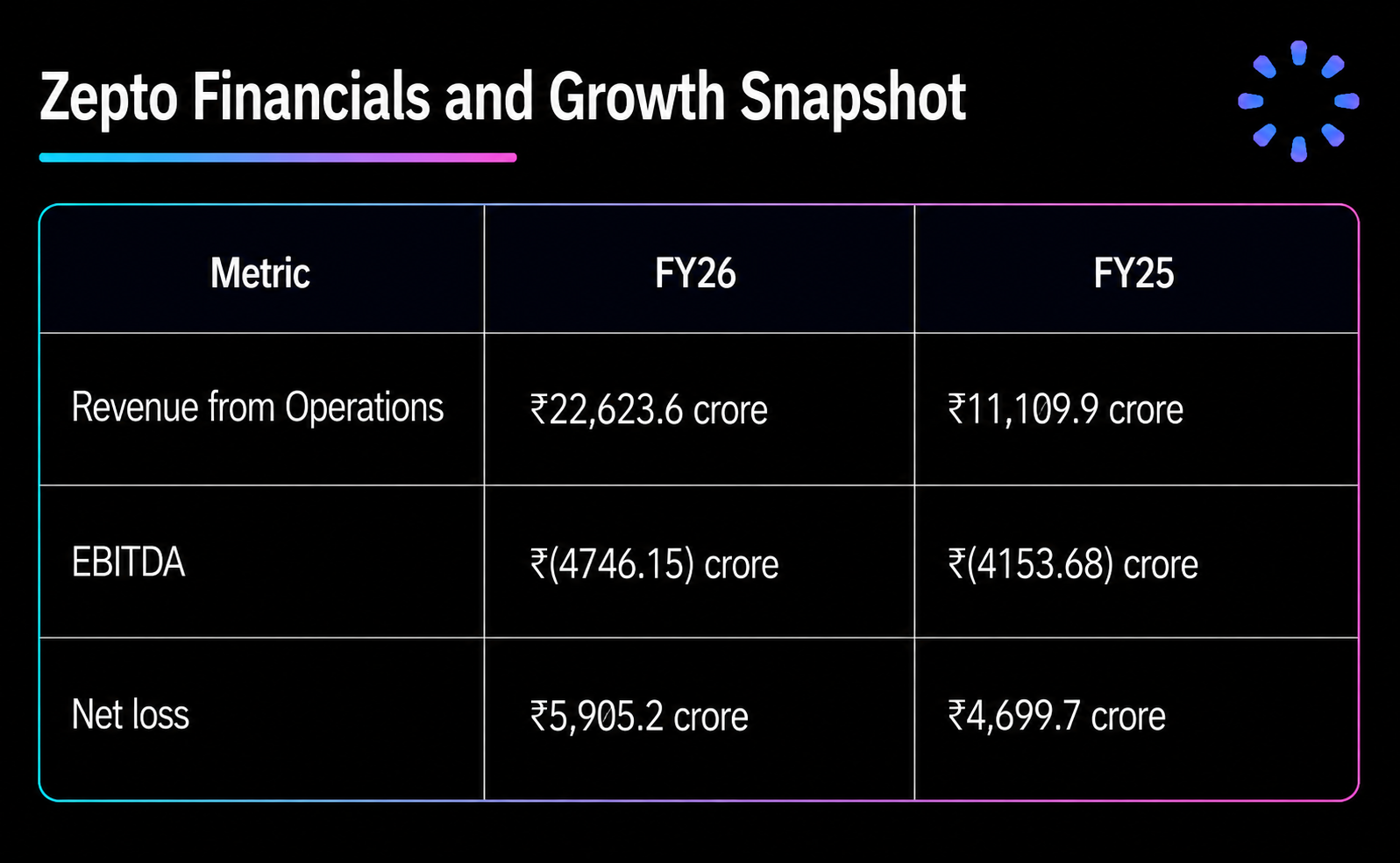
That combination is common in fast-scaling internet businesses. It is still important to separate healthy growth from expensive growth.
Investors should track four areas closely:
Revenue growth: Is growth driven by higher order frequency, wider city coverage, better product mix, or discounts?
Gross margins: Are category mix, private labels, delivery fees, and advertising helping improve margins?
Operating losses: Are losses rising slower than revenue, or is expansion consuming more capital each year?
Cash burn: How long can the company fund growth without returning to markets for more capital?
The IPO proceeds may be used for dark-store expansion, technology infrastructure, marketing, working capital, and strategic acquisitions. These uses can support growth, but investors should check whether they also improve operating discipline over time.
Why Investors Are Interested in Zepto Pre-IPO Shares
Zepto has become one of the most tracked pre-IPO names because it sits at the intersection of consumer internet, urban convenience, and India's growing private-market participation.
1. Exposure to India's Quick-Commerce Boom
Quick commerce has moved from novelty to habit in many urban households. Consumers now use fast-delivery apps for snacks, fresh foods, personal care products, cleaning supplies, small electronics, and urgent top-up purchases.
Zepto is one of the strongest standalone brands in this category. If quick commerce keeps expanding across dense Indian cities, Zepto could benefit from higher order frequency and stronger customer retention.
2. IPO Visibility Has Improved
The updated DRHP gives investors a clearer event to track. It does not guarantee a successful IPO or listing gains, but it reduces uncertainty around Zepto's intent to list.
Pre-IPO demand often rises when a company moves closer to public-market entry. However, investors should avoid assuming that IPO proximity automatically makes an unlisted investment attractive.
3. Brand Recall Is Strong
Zepto has built strong recall among urban millennials and Gen Z consumers. In quick commerce, this matters because purchase decisions are often urgent and app-driven.
Strong recall can lower customer acquisition friction. Still, brand strength must translate into repeat orders, better margins, and lower churn for shareholders to benefit.
4. Multiple Margin Levers Are Possible
Zepto's long-term margin improvement could come from:
Higher order density in mature cities.
Better dark-store utilisation.
Advertising income from brands.
Improved delivery routing.
Private-label and higher-margin product categories.
Lower discounts as customer habits mature.
These levers are promising, but they need evidence. Investors should look for proof in the DRHP, not only in management commentary.
Key Risks in Zepto Unlisted Shares
Zepto's growth story is attractive, but the risk profile is significant. Pre-IPO investors should be comfortable with uncertainty, delayed liquidity, and valuation swings.
Profitability Remains the Main Question
Zepto is still loss-making. That is not unusual for a high-growth company, but it means investors are underwriting future profitability rather than current earnings.
The company will need to show that scale reduces losses meaningfully. If delivery costs, rent, discounts, and inventory costs stay high, public-market investors may apply a lower valuation multiple.
Competition Is Intense
Quick commerce is one of India's most competitive internet sectors. Zepto competes with Blinkit, Swiggy Instamart, BigBasket Now, Flipkart Minutes, and Amazon-backed delivery initiatives.
Many of these rivals have deep pockets, strong ecosystems, and large customer bases. Competition can pressure prices, marketing spends, delivery fees, and customer loyalty.
Valuation Risk Is Real
Pre-IPO interest can push prices ahead of fundamentals. If the IPO price band is lower than expected, or if market sentiment weakens, unlisted investors may not get the re-rating they expect.
Investors should compare the current unlisted share price with the implied IPO valuation, latest financials, public-market peer multiples, and the company's path to profitability.
Liquidity Is Limited Before Listing
Unlisted shares do not trade like listed shares on NSE or BSE. Exits depend on buyer availability, transfer restrictions, demand, and platform processes.
If Zepto's IPO is delayed, investors may need to hold longer than planned. This is why unlisted shares should usually be sized conservatively within a diversified portfolio.
Public Disclosures May Change the Narrative
As more details emerge through the DRHP, red herring prospectus, and final prospectus, investors may reassess the business. Risk factors, related-party transactions, cash burn, outstanding litigation, and use of proceeds can all affect sentiment.
For basic process questions around unlisted shares, demat transfers, and investor eligibility, you can review common questions about buying unlisted shares or contact Precize Care.
Should You Buy Zepto Unlisted Shares Before the IPO?
Zepto unlisted shares may suit investors who understand startup risk, want exposure to India's quick-commerce growth, and can hold through IPO timing uncertainty. They may not suit investors who need liquidity, predictable earnings, or low volatility.
A practical way to decide is to ask five questions:
Do I understand the business model? Quick commerce depends on dense demand, reliable fulfilment, and improving unit economics.
Am I comfortable with losses? Zepto's growth comes with high spending, and profitability may take time.
Is the valuation reasonable? The current unlisted price should be compared with likely IPO valuation and financial performance.
Can I handle illiquidity? Exiting unlisted shares may not be immediate.
Is my portfolio diversified? A high-growth pre-IPO investment should not dominate your portfolio.
If you are investing only for possible listing gains, the risk may be higher than it looks. Listing gains depend on the IPO price band, market sentiment, subscription demand, and company disclosures. None of these are guaranteed.
If you are a long-term investor and believe Zepto can turn quick-commerce scale into durable margins, the company may be worth tracking closely. But the decision should be based on valuation and risk appetite, not only IPO excitement.
What to Check Before Investing
Before buying Zepto pre-IPO shares, review these items:
Latest unlisted price: Check the current quote, not only older market commentary.
Lot size and total investment: Understand the minimum order value and settlement terms.
Transfer process: Confirm demat transfer timelines, documentation, and lock-in rules if applicable.
Zepto DRHP: Read the risk factors, financial statements, use of proceeds, and shareholding pattern.
IPO valuation: Compare the final price band with current unlisted pricing.
Exit plan: Decide whether you are investing for listing, long-term holding, or portfolio diversification.
You can also follow the Precize blog for more IPO and private-market updates.
Final Take
Zepto's updated DRHP is a meaningful milestone. It moves the company closer to a public listing and gives investors a clearer timeline to watch.
The investment case is exciting but not simple. Zepto has a strong brand, a large addressable market, and exposure to one of India's fastest-growing consumer categories. At the same time, losses, competition, valuation, and liquidity risk remain important.
For investors exploring Zepto unlisted shares, the sensible approach is to stay disciplined. Study the Zepto DRHP, compare valuation carefully, check live pricing, and invest only if the risk fits your portfolio.
Stay updated with Zepto and other unlisted companies through our Precize Community. If this article was useful, you can share it with other investors through the Precize Referral Program.
Frequently Asked Questions
1. Has Zepto Filed Its DRHP for IPO?
Yes. Zepto has filed updated DRHP papers with SEBI for its upcoming IPO, according to market reports and the supplied source draft. Investors should verify the latest filing status on SEBI before making investment decisions.
2. When Is the Zepto IPO Expected?
Market reports suggest Zepto may target a listing around July 2026. The final IPO date will depend on regulatory approvals, market conditions, investor demand, and company decisions.
3. Is Zepto Profitable?
No. Zepto is currently loss-making as it continues to spend on expansion, dark stores, technology, inventory, and customer acquisition. Investors should track whether losses reduce as revenue scales.
4. Can Retail Investors Buy Zepto Shares Before IPO?
Yes, retail investors may be able to buy Zepto unlisted shares through pre-IPO marketplaces, subject to availability, KYC, minimum lot size, transfer terms, and applicable regulations.
Disclaimer: This article is for informational purposes only and should not be considered investment advice. Investing in unlisted shares carries risks including illiquidity and potential loss of capital. This is not a recommendation to buy or sell shares of Zepto. Please consult with a qualified financial advisor before making investment decisions. Precize is not a stock exchange and is not authorized by any capital markets regulator.