
Garuda Aerospace FY26 Financial Performance: What the Numbers Reveal
Garuda Aerospace, an Indian drone technology company, delivered strong growth in FY26, with revenue rising 66.8% year-on-year to ₹205.93 crore and profit after tax (PAT) increasing 41.1% to ₹25.91 crore.
The financial performance comes as the company moves closer to the public markets, following SEBI approval for its proposed ₹750 crore IPO. While the topline and capital efficiency numbers show positive momentum, declining EBITDA margins and negative cash-flow metrics remain important watchpoints for investors.
Revenue Jumps 66.8% in FY26
Garuda Aerospace's strongest financial highlight was its topline growth.
The company reported FY26 revenue of ₹205.93 crore, compared with approximately ₹123.44 crore in FY25, implying a 66.8% YoY increase.
This growth indicates a significant expansion in the company's business during the year. The company's operations span drone manufacturing as well as services, including Drone-as-a-Service, pilot training and maintenance support.
FY26 Financial Snapshot
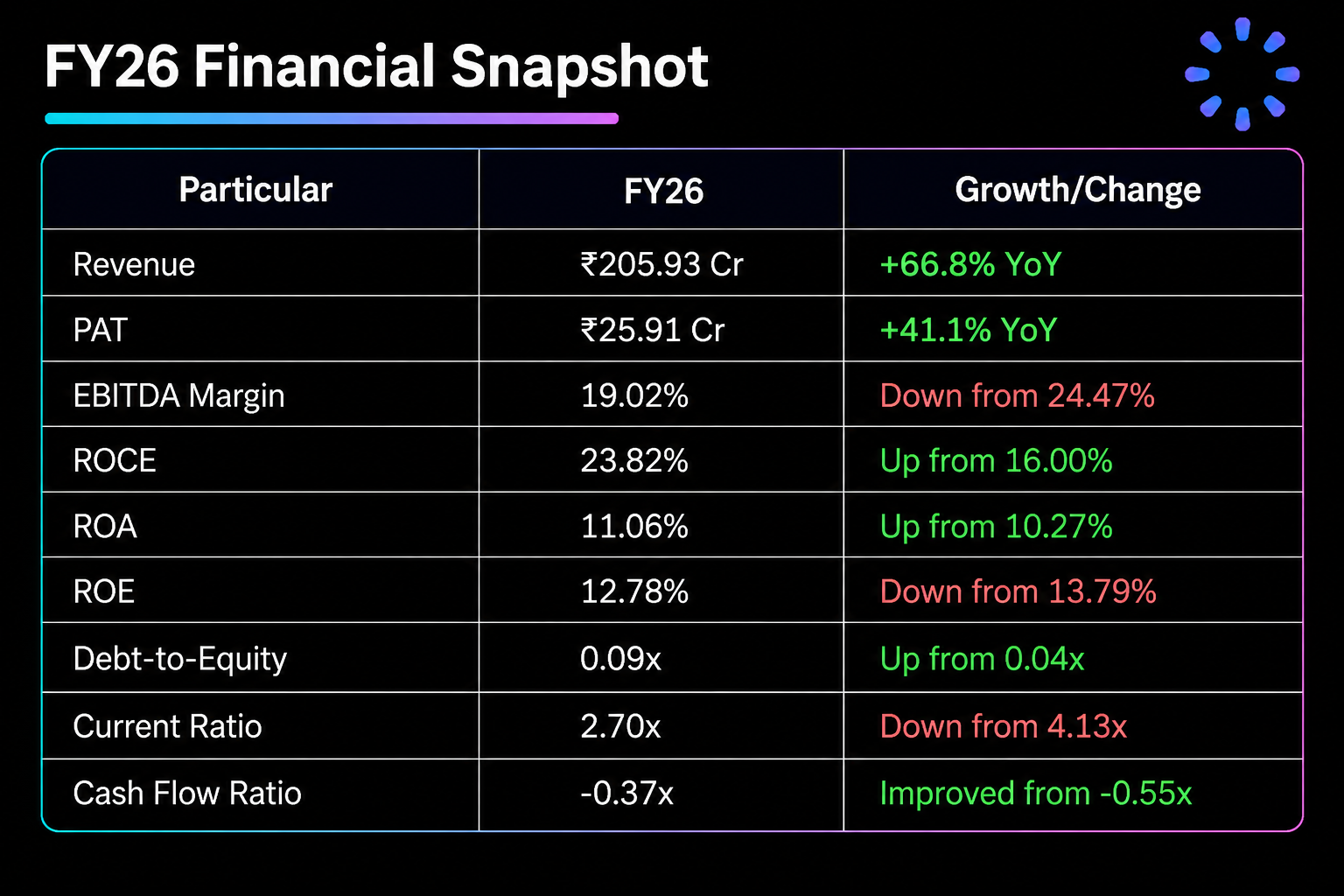
The numbers present a mixed but largely growth-oriented picture: topline growth and ROCE improved substantially, while margins, ROE and liquidity metrics require closer monitoring.
PAT Grows 41.1% to ₹25.91 Crore
Garuda Aerospace's PAT increased 41.1% YoY to ₹25.91 crore in FY26.
The growth in profit was lower than the 66.8% increase in revenue, which is consistent with the pressure visible in operating margins. Nevertheless, the company remained profitable while significantly expanding its revenue base.
The difference between revenue growth and PAT growth makes profitability and margin trajectory particularly important areas to track in future financial periods.
EBITDA Margin Falls to 19.02%
One of the key financial watchpoints is the decline in EBITDA margin.
Garuda Aerospace's EBITDA margin fell from 24.47% in FY25 to 19.02% in FY26, representing a 545 basis-point decline.
This means that despite the strong increase in revenue, operating profitability as a percentage of revenue weakened.
For investors assessing the company's financial trajectory, the ability to sustain revenue growth while recovering or stabilising EBITDA margins could be an important factor going forward.
ROCE Improves Sharply to 23.82%
A major positive from the FY26 financials is the improvement in Return on Capital Employed (ROCE).
ROCE increased from 16.00% in FY25 to 23.82% in FY26. This represents a significant improvement and indicates stronger returns generated on the capital employed in the business.
At the same time, Return on Assets improved from 10.27% to 11.06%, suggesting an improvement in asset-level profitability.
However, ROE moved in the opposite direction, declining from 13.79% to 12.78%.