India’s GDP Growth Outlook: Trillion-Dollar Targets Ahead 

Explore the GDP of India in trillion, current snapshot, future projections, growth drivers, global importance, and challenges shaping India’s economy.
6 min read
gdp of india in trillion

Every time you hear about the GDP of India in trillions, it’s more than just figures on paper; it’s a reflection of how the nation is moving forward and how that progress impacts your daily life, from jobs to prices to opportunities. 

India’s economy has become a key player on the global stage, and in this blog, you’ll see why it matters worldwide. We’ll explore the current snapshot of India’s economy in 2025, the projected GDP milestones for 2030, 2040, and beyond, the major drivers behind this growth, the challenges that stand in the way, and the strategic initiatives and government reforms shaping the future. 

Let’s get into it!

Overview

  • As of 2025, India’s GDP is around $4.19 trillion, making it the 4th largest economy globally.

  • Key growth drivers include urbanization, the rising middle class, technology adoption, infrastructure, and government reforms.

  • Major challenges are slow manufacturing growth, high food inflation, youth unemployment, trade pressures, and structural barriers.

  • Platforms like Precize provide access to private growth companies and global trade finance opportunities, offering ways to stay connected with India’s economic growth.

Key Drivers of Indian Economic Growth
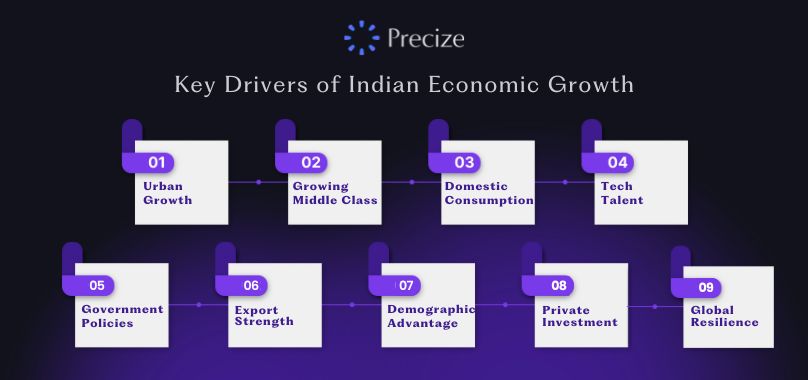
When you look at the GDP of India in trillions, there are several key factors that explain why the economy is growing so strongly.

1. Urbanization and Infrastructure Expansion

As more people move to cities, you can see new opportunities opening up.

  • Investments in roads, transport, housing, and digital networks are not just improving daily life but also creating jobs and boosting productivity. 

  • With more than half of India’s population expected to live in cities in the future, urbanization will continue to drive growth.

2. Growing Middle Class

You are also part of a country where the middle class is growing rapidly. 

  • In the coming decades, hundreds of millions will join this group, which means more demand for products, services, and lifestyle upgrades. 

  • This steady rise in consumption is a strong pillar of India’s economic progress.

3. Domestic Consumption

Household spending is already the largest contributor to India’s GDP. As incomes rise and purchasing power improves, you’ll notice stronger consumer demand across almost every sector, which keeps the economy moving forward.

4. Technology and Skilled Workforce

India’s growth is also powered by its skilled workforce and fast adoption of technology. With more people learning digital skills and industries embracing new technologies, the economy is shifting towards advanced services and high-value industries.

5. Government Reforms and Policies

You can see the impact of government initiatives like infrastructure projects, production-linked incentives, and financial inclusion schemes. 

  • These reforms create a supportive environment for businesses and encourage more economic activities.

6. Export Strength

Exports play a big role, too. Goods like petroleum products, engineering items, and electronics are helping India strengthen its global trade position, while improved international ties continue to support this growth.

7. Demographic Advantage

With one of the world’s youngest populations, India has a strong labor force that contributes to productivity. As more young people gain skills, this advantage will only grow stronger.

8. Rising Private Investment

Private companies are also exploring more in industries, manufacturing, and services. This flow of investment supports innovation, job creation, and overall economic expansion.

9. Resilience to Global Challenges

Finally, India has shown the ability to withstand global economic pressures. With stable financial systems, controlled debt, and healthy foreign exchange reserves, the country is better placed to manage global uncertainties without slowing down too much.

With these key drivers in place, India’s economy continues to gain momentum, setting the stage for its current performance and future growth.


India’s Current Economic Snapshot (2025)

As of 2025, India’s nominal GDP stands at about $4.19 trillion, placing the country as the fourth-largest economy in the world, ahead of Japan and close to Germany.

  • Strong Growth Rate: In the fiscal year 2024–25, India’s GDP grew at an estimated 6.5%. Over the next few years, the growth rate is expected to stay between 6.3% and 6.8% (2025-26), showing India’s ability to maintain steady momentum despite global challenges.

  • Rapid Expansion: The Indian economy is currently adding close to $1 trillion every 12 to 18 months. This rapid expansion highlights the scale at which the country is growing and how quickly it is moving closer to the world’s largest economies.

Building on the current economic snapshot, the next few decades could bring remarkable milestones for India’s GDP.

Projected GDP Milestones (2030, 2040 & Beyond)

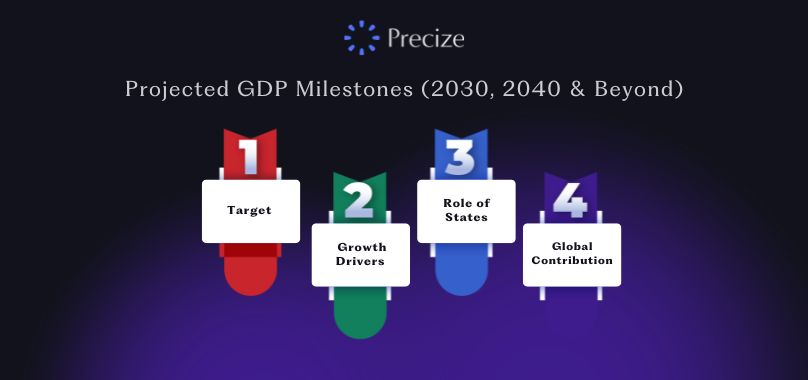
When you look ahead, the GDP of India in trillions shows some remarkable milestones that highlight how fast the economy is set to grow in the coming decades. Below are the key projections.

1. Target by 2030

India’s GDP is projected to touch $7.3 trillion, moving past Japan and Germany to become the world’s third-largest economy.

2. Growth Drivers Till 2030

Aiming for an 8.5% to 9% annual growth rate, India’s progress will be powered by technology, a young workforce, and stable economic policies.

3. Role of States

Leading states like Maharashtra, Gujarat, and Tamil Nadu are likely to achieve trillion-dollar GDP levels by 2035, adding significant strength to the national economy.

4. Global Contribution

By 2040, India’s share in the global GDP could expand to 8–10%, supported by emerging industries, structural reforms, and rising domestic demand.

Although India is on track for significant GDP growth, certain hurdles could influence how smoothly this progress continues.

Challenges to Sustained Growth

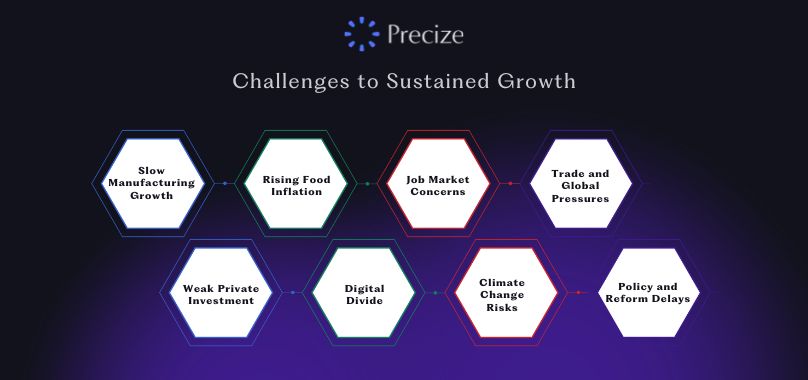
Even though the GDP of India in trillions is rising steadily, there are several challenges that could slow down progress if not addressed.

  • Slow Manufacturing Growth: The manufacturing sector is not expanding as fast as needed, which limits the country’s ability to reach higher GDP levels.

  • Rising Food Inflation: With food inflation staying above 8%, the cost of living increases, reducing people’s capacity to spend and save.

  • Job Market Concerns: Job creation is not keeping pace with demand, and youth unemployment around 15% remains a serious concern for economic stability.

  • Trade and Global Pressures: Geopolitical tensions and rising trade deficits increase business costs and make global competitiveness harder.

  • Weak Private Investment: Cautious business sentiment and limited private investment slow down industrial growth and capital formation.

  • Digital Divide: Unequal access to digital infrastructure, especially in rural areas, prevents many from benefiting from technology and skill-building opportunities.

  • Climate Change Risks: Agriculture is highly vulnerable to droughts, floods, and water shortages, directly impacting rural incomes and food security.

  • Policy and Reform Delays: Delays in major reforms around land, labor, and energy hold back the structural changes needed for long-term growth.

Conclusion

Looking at the GDP of India in trillions, it’s clear that India’s economy is on a strong growth path, with significant milestones expected by 2030, 2040, and beyond. Urbanization, a growing middle class, technology adoption, and government reforms are all driving this progress, while challenges like manufacturing slowdown, inflation, and structural barriers remain important to address. 

For those interested in opportunities linked to India’s growth story, platforms like Precize are facilitating access to private companies, allowing investors to buy and sell unlisted shares and pre-IPO shares. They also provide unique global trade finance opportunities, enabling portfolio diversification with alternative fixed-income options

Reserve your access with Precize to explore these opportunities!

FAQs

1. What factors contribute to India’s GDP growth?

India’s GDP growth is driven by several key factors, including strong domestic consumption, a young and growing workforce, widespread adoption of technology, and ongoing economic reforms that support business and industry.

2. How does India’s economic growth compare to that of other countries?

India is one of the fastest-growing major economies in the world. It has already surpassed the UK and Japan in total GDP and is expected to become the third-largest economy globally within the next decade.

3. What challenges could affect India’s GDP growth projections?

Although India’s growth outlook is positive, it could be influenced by global economic conditions, inflation, currency fluctuations, and domestic issues such as income inequality and uneven access to resources.

Disclaimer 

The content shared here is for general knowledge only and is not intended as professional advice on legal, finance, or investment matters. Any references to platforms, shares, or investment opportunities are not recommendations to buy or sell. Readers are encouraged to do their own research & seek advice from qualified professionals before making any financial or investment decisions.

Precize
Precize
Content Strategy and Research Analyst

Stay in the Loop

Join our newsletter for exclusive access to thoughtfully curated content and we promise, no spam

The next generation of asset classes in India

Resources

Our Office

Office No. 1219, The Summit Business Park, Andheri Kurla Road, Andheri East, Mumbai, Maharashtra - 400093

Find us on Google

support@precize.in

+91 7738336457

All trademarks and logos or registered trademarks and logos found on this Site or mentioned herein belong to their respective owners and are solely used for informational and educational purposes.

The material presented in this advertisement is for informational purposes only and should not be construed as investment advice or investment availability. It is not a recommendation of, or an offer to sell or solicitation of an offer to buy, any particular unlisted share, security, strategy, or investment product. Investing in the private market and securities involves risks, including the potential loss of money, and past performance does not guarantee future results. Market trends, data interpretations, graph projections are provided for informational and illustrative purposes and may not reflect actual future performance. Nothing on this website should be construed as personalized investment advice or should not be treated as legal, financial, or any other form of advice. Precize is not liable for financial or any other form of loss incurred by the user or any affiliated party based on information provided herein.

Precize is neither a stock exchange nor does it intend to get recognized as a stock exchange under the Securities Contracts Regulation Act, 1956. Precize is not authorized by the capital markets regulator to solicit investments. The securities traded on these platforms are not traded on any regulated exchange.

The website will be updated regularly.

Copyright © 2026 - Precize - All Rights Reserved