
Hero FinCorp, one of India’s prominent non-banking financial companies (NBFCs), is looking to sell a ₹258 crore stressed unsecured loan pool, in a move that highlights its ongoing strategy to reduce exposure to unsecured lending and strengthen asset quality.
According to a recent report, the company has invited bids for the stressed loan portfolio and is seeking a haircut of around 95%, meaning the pool could potentially be sold at a significant discount to its stated value.
Hero FinCorp’s ₹258 Crore Loan Sale: What Happened?
The loan pool comprises stressed unsecured exposures, with Hero FinCorp looking to monetise these assets through a sale to eligible buyers. The company has retained the flexibility to sell the assets as a whole or in multiple pools and can add or withdraw accounts during the process.
The proposed transaction is part of Hero FinCorp’s broader effort to run down its unsecured loan portfolio. The company’s FY26 annual report described this as an “intentional rundown” of its unsecured portfolio.
A 95% haircut would imply that the recoverable value expected from the pool is substantially below its face value. In financial markets, a haircut represents a reduction applied to an asset's value.
Hero FinCorp’s Unsecured Loan Book Is Shrinking
The latest development comes against the backdrop of a gradual reduction in Hero FinCorp’s unsecured exposure.
As of March 31, 2026, unsecured loans on the standalone balance sheet stood at ₹21,644.44 crore, compared with ₹22,562.53 crore a year earlier.
The company’s personal loan exposure also declined by around 13.5% YoY, falling to ₹14,158.84 crore from ₹16,362.12 crore.
Personal loans remain an important area to watch from an asset-quality perspective. Gross NPAs in this segment stood at 6.55% of exposure as of FY26, although this was lower than 7.55% a year earlier.
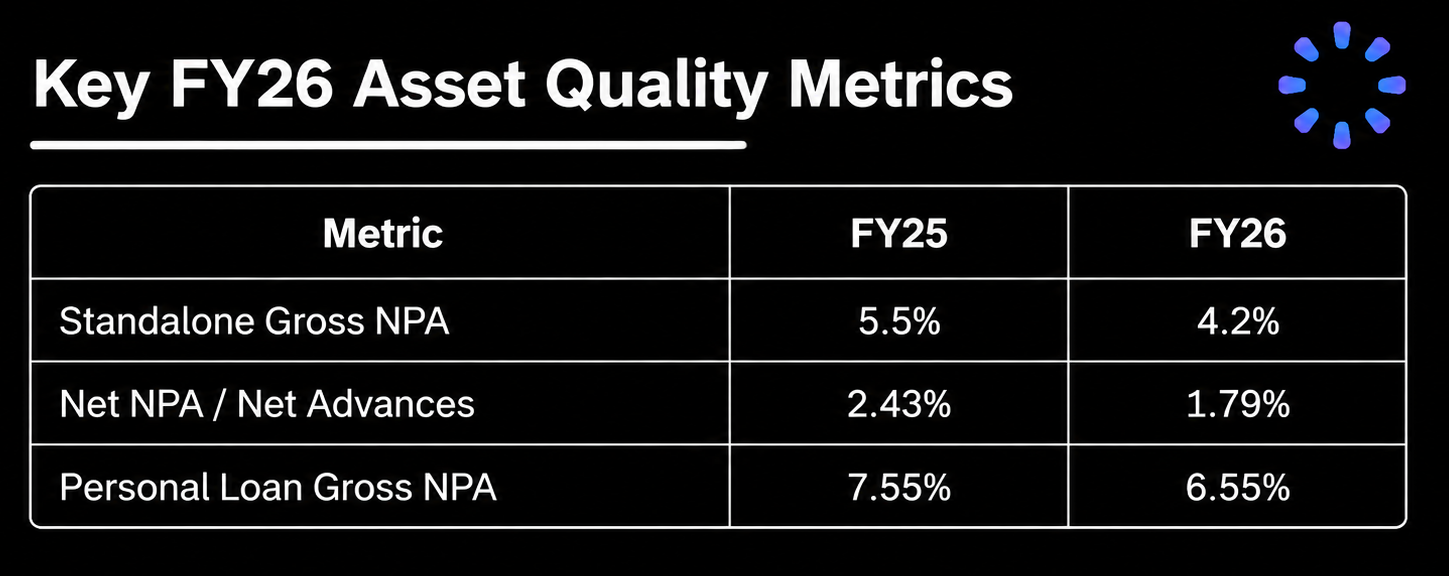
Despite the improvement in headline asset-quality ratios, the company also reported higher write-offs. Settlement losses and bad debts written off increased to ₹2,970.12 crore in FY26, from ₹2,276.79 crore in FY25.
Why Is Hero FinCorp Reducing Unsecured Lending?
Unsecured loans do not have specific collateral backing them. As a result, recoveries can become more challenging when borrowers default, particularly during periods of stress.
For an NBFC, reducing stressed unsecured exposures can therefore help contain future credit costs and allow greater focus on segments with more predictable risk-return characteristics.
Hero FinCorp's latest loan-sale process can be viewed in this broader context: rather than continuing to carry stressed exposures on its books, the company is exploring an upfront monetisation route.
However, the proposed sale also highlights the potential gap between the face value of a loan and its recoverable economic value when the underlying portfolio is severely stressed.
FY26 Financial Performance Under Pressure
Hero FinCorp's asset-quality improvement came alongside a challenging financial year.
The company reported a standalone net loss of ₹306.56 crore in FY26, compared with a profit of ₹57.84 crore in FY25. On a consolidated basis, the company reported a net loss of ₹226.01 crore.
Hero FinCorp has attributed the reported loss largely to accounting treatment related to its compulsorily convertible preference shares (CCPS), which are carried as a liability at fair value. The company stated that treating these instruments as equity would have resulted in a standalone profit of ₹230.65 crore.
This makes the distinction between reported accounting earnings and underlying operating performance particularly relevant when evaluating the company.
Hero FinCorp IPO: Another Key Development to Watch
The stressed-loan sale also comes at an important point in Hero FinCorp's proposed IPO journey.
Hero FinCorp filed its Draft Red Herring Prospectus (DRHP) with SEBI in August 2024 and received SEBI observations in May 2025. A one-time SEBI relaxation subsequently extended certain observation letters expiring between April and September 2026 until September 30, 2026.
The company's annual report states that it is taking steps to complete the proposed IPO within the applicable timeline.
Therefore, developments around asset quality, unsecured loan exposure, credit costs and the IPO process could remain important areas for investors tracking Hero FinCorp.
What This Means for Hero FinCorp
The ₹258 crore stressed loan sale is more than just an isolated portfolio transaction. It provides an indication of the company's changing approach toward unsecured lending.
Three developments stand out:
Unsecured exposure is being reduced: The company has explicitly indicated an intentional rundown of its unsecured portfolio.
Asset quality has improved: Gross and net NPA ratios declined in FY26, although write-offs remained elevated.
Credit costs remain important: The significant level of bad-debt write-offs and the proposed stressed-asset sale show that legacy unsecured exposures continue to require attention.
The eventual outcome of the loan sale including the final consideration received and the impact on recoveries will provide further insight into the quality of the underlying portfolio.
Conclusion
Hero FinCorp's decision to put a ₹258 crore stressed unsecured loan pool on the block, while seeking a potential 95% haircut, highlights the challenges associated with legacy unsecured exposures.
At the same time, the company's declining unsecured loan book and improving headline NPA ratios point toward an ongoing effort to strengthen asset quality. For those tracking Hero FinCorp unlisted shares, the key factors to monitor will include the company's ability to reduce stressed assets, manage credit costs, improve profitability and progress with its proposed IPO.
The loan sale is therefore an important development to watch as Hero FinCorp continues to reshape its lending portfolio and financial profile.
To compare companies, documents, and availability explore unlisted companies on Precize. For ongoing IPO and private-market updates, browse the Precize blog. Stay updated with unlisted companies through our Precize Community. If this article was useful, you can share it with other investors through the Precize Referral Program.