What is MSEI and what does it do?
The Metropolitan Stock Exchange of India (MSEI) is a SEBI-recognised stock exchange set up to bring more competition and choice to India’s capital markets. Like other exchanges, its role is to provide a regulated marketplace where participants can trade financial instruments, supported by rules, surveillance, and market infrastructure.
MSEI has historically been present but not meaningfully active at scale, largely because trading activity in India has remained concentrated on two dominant exchanges.
In India, NSE and BSE have become the primary venues for trading and listings over the decades. Their scale, participant base, technology, and product depth create strong network effects, which make it difficult for a third exchange to gain traction.
What happened: MSEI’s comeback plan
MSEI is set to begin its operations and trading is expected to begin on the new exchange within the next two weeks, reviving as a potential rival to NSE and BSE.
The exchange has completed its capital raise (~₹1,240 crore) and technology overhaul, including a new latency-trading stack and enhanced real-time surveillance
MSE is also developing liquidity-enhancement programs for over 130 stocks, enabling better price discovery and tighter spreads.
NSE holds approximately 90-92 percent share, while BSE holds 8-10 percent share in the cash segment. In stock futures and options (F&O), NSE holds around 95 percent share, while BSE holds around 5 percent share.
Its aim: create a multi-asset platform targeting retail, SME, and mid-market participants. But a new stock exchange on the market may face competition and the risk of low liquidity as a result of this.
Why MSEI was not a major exchange until now, and why the timing may be changing
MSEI’s limited activity historically can be explained by three structural reasons:
1) Liquidity concentration
Trading venues are winner-takes-most businesses. Liquidity tends to concentrate where most participants already trade. That concentration creates a cycle where:
Brokers route orders to the most liquid venue
Traders prefer the venue with the best execution
Issuers' list where the investor base is deepest
2) Participant incentives and operating scale
Exchanges need active brokers, market makers, and member participation to build meaningful volumes. Without early critical mass, even good technology struggles to translate into sustained trading.
3) Recognition renewals and confidence
MSEI’s recognition has been renewed by SEBI for defined periods, which is normal from a regulatory standpoint, but can affect long-term confidence when an exchange is not operating at high scale.
So why does MSEI appear in the news now? The reported plan focuses on the one lever that can change outcomes: building liquidity deliberately, rather than expecting it to arrive organically.
Why is a third stock exchange difficult in India?
India is not unique here. Globally, exchanges tend to consolidate because of network effects. In India, the challenge is sharper due to:
Strong network effects -
The more liquidity a venue has, the more attractive it becomes. A new or smaller venue must overcome a large initial disadvantage.
Broker and participant behaviour -
Brokers and institutions naturally prioritise venues with:
Consistent depth
Low slippage
Stable infrastructure
Predictable settlement experience
Trust and market integrity expectations -
A recognised exchange must demonstrate robust:
Surveillance and compliance
System resilience
Fair access and transparency
These are not “one-time build” tasks. They require ongoing investment, governance, and operational maturity.
How stock exchanges make money
This section is important because many readers assume exchanges earn only from trading fees. In reality, major exchanges typically generate revenue through multiple streams:
Transaction charges
Fees on trades across segments (cash, derivatives, currency, debt).Listing and issuer services
Listing fees, annual listing charges, and services for issuers.Data and analytics
Market data products, terminals, index licensing, and enterprise feeds.Clearing and settlement-linked ecosystem income
Exchanges are closely tied to market infrastructure that supports settlement and risk management.Treasury and other income
Income from investments and other services depends on the exchange’s structure.
For a smaller exchange, the challenge is that most of these revenue lines require scale. Without sustained volumes, the model remains structurally disadvantaged.
What could change for investors and markets if MSEI scales up
A meaningful third exchange can have real implications, but they are not one-sided.
Potential advantages -
1) Better price competition
Competition can reduce transaction costs over time.
2) Innovation and product experimentation
New venues often innovate on technology, access, and market design to win participation.
3) Reduced concentration risk
Having more than two meaningful venues can improve market resilience.
4) More choice for intermediaries and issuers
Brokers and issuers may gain additional options for distribution and execution.
Potential disadvantages and risks -
1) Fragmented liquidity (especially early)
If volumes split across venues without depth, execution quality may not improve.
2) Incentive-driven activity can be temporary
Liquidity programs can create early volumes, but sustaining them is the real test.
3) Operational and surveillance expectations remain high
A smaller exchange must meet the same standards of market integrity and system stability.
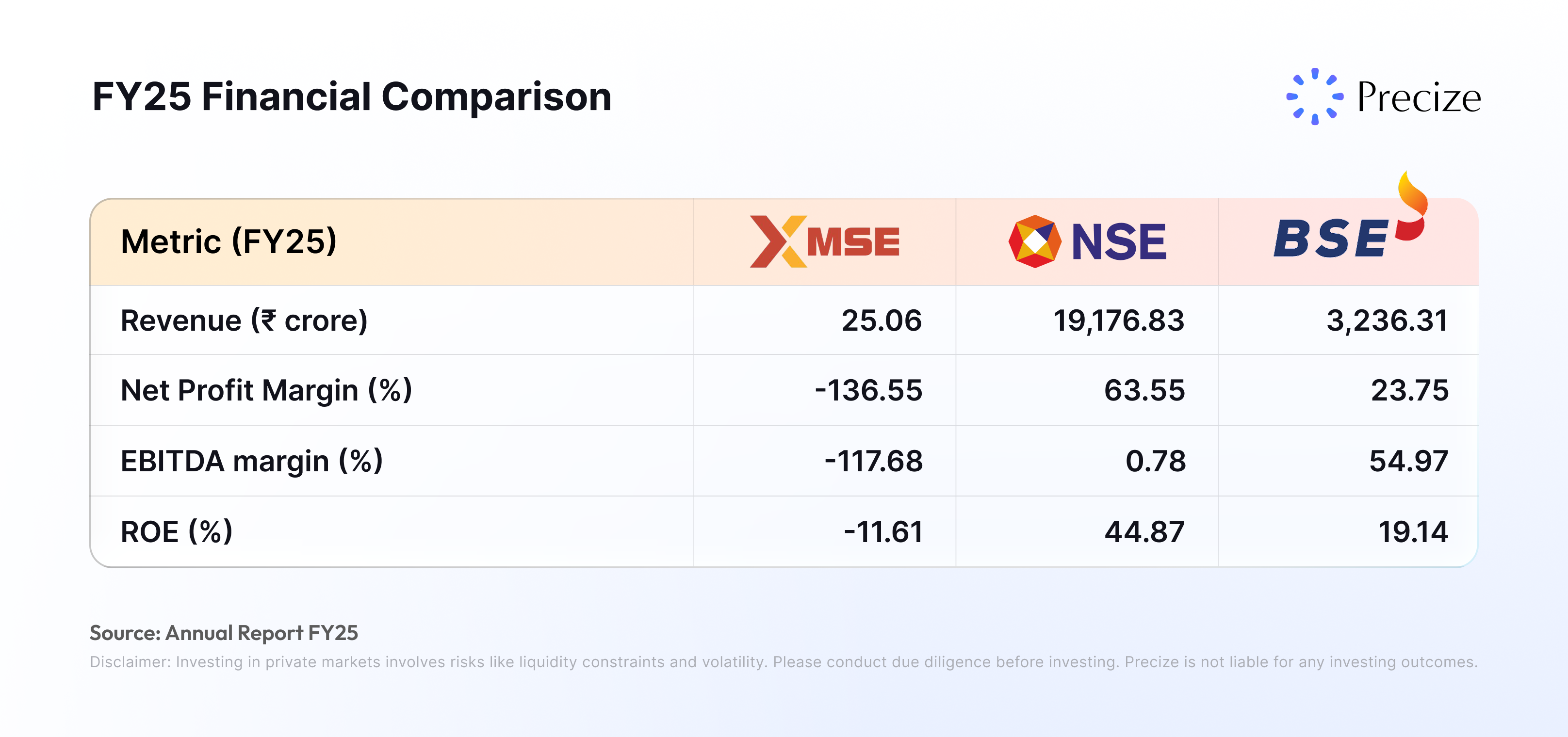
MSEI vs NSE vs BSE: FY25 financial comparison
How to Buy MSEI Unlisted Shares
Buying MSEI unlisted shares has become simple with the rise of trusted online platforms that specialize in private market investments. The process is fully digital and can be completed from your home in just a few steps. Here’s how it works:
Step 1: Create Your Account Online
Sign up on a reliable platform such as Precize.
Click on “Reserve Access” and enter your basic details.
Check your email for verification and choose a strong password to complete registration.
Step 2: Add Demat Details
Complete your profile by updating your PAN card, bank account details, and Demat account number (NSDL or CDSL).
This step is required for compliance and smooth share transfer.
Step 3: Decide and Place Your Order
Select the number of shares or lots you want to buy.
Note that most platforms set a minimum investment, usually starting around ₹10,000.
Add funds to your account UPI or net banking and confirm your order.
Step 4: Get Shares in Your Demat Account
Once your transaction is approved (generally within 24 to 48 business hours), the shares will be credited directly to your Demat account.
Ensure that your Demat details are correct to avoid any delays.