What Has Changed in the NSE IPO 2026 Timeline?
The NSE IPO timeline has become more active in 2026, with reported SEBI NOC progress, settlement-related developments, and DRHP preparation. However, investors should separate reported progress from confirmed approval because no final IPO date, price band, or issue size has been announced yet.
Recent public reports indicate that NSE received a SEBI No Objection Certificate (NOC) on 30 January 2026 for moving forward with IPO-related work and has been preparing for a Draft Red Herring Prospectus (DRHP). Business Standard reported that NSE had asked bankers to target a DRHP filing by 15 June 2026, while other reports have pointed to a June 5 to June 15 window.
Here is how pre-IPO investors should read the milestones:
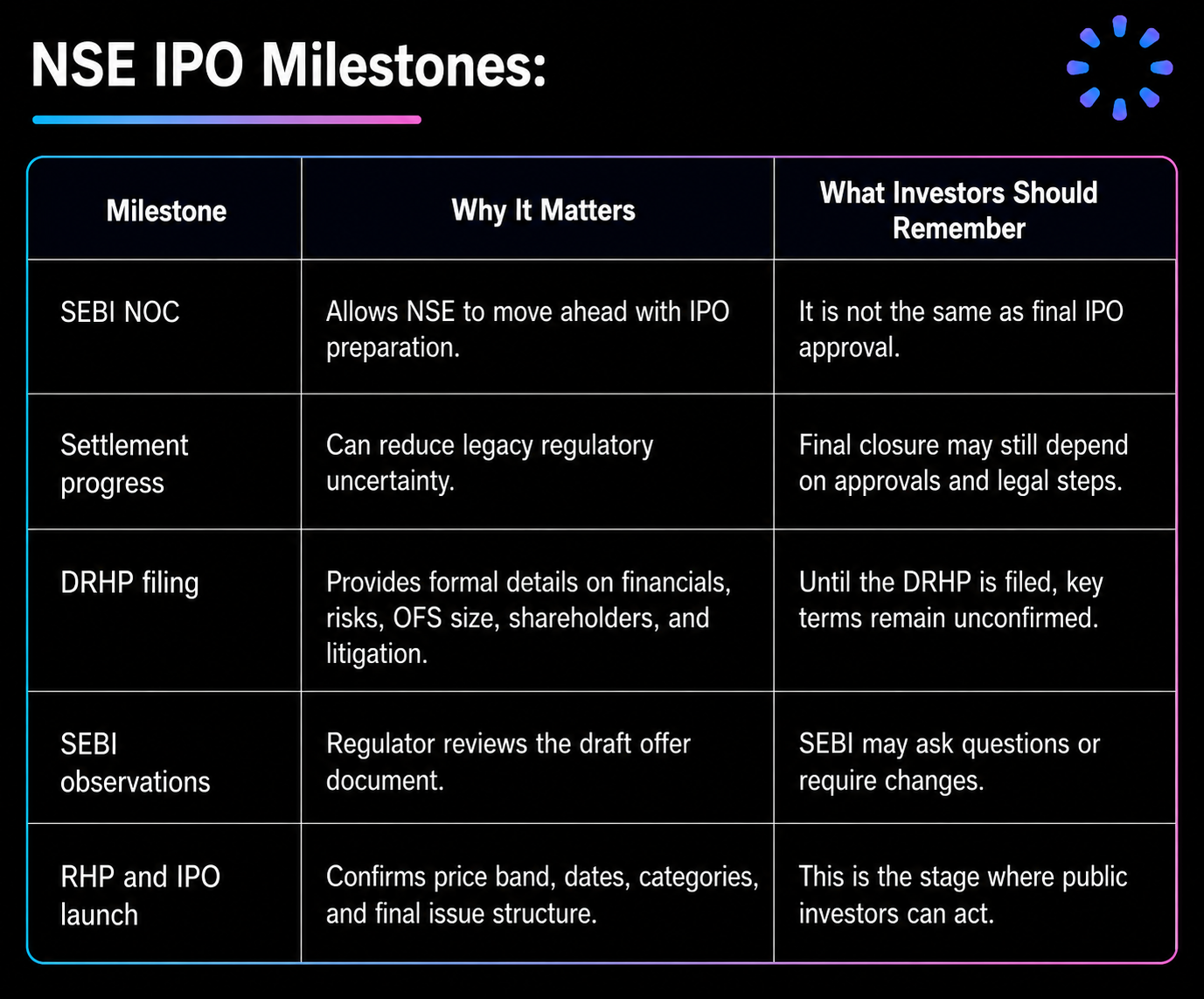
Media reports have also pointed to settlement progress in long-running co-location and dark fibre matters, with reported settlement amounts around ₹1,800 crore. These developments are positive for the IPO process, but they do not remove every regulatory, legal, or market-condition risk.
These are important milestones, but they do not mean the IPO is guaranteed on a specific date.
Why NSE Unlisted Shares Still Attract Investor Interest
Despite the long IPO delay, NSE unlisted shares remain among the most tracked pre-IPO opportunities in India. The reason is the quality of the underlying business.
NSE sits at the centre of India's capital-market activity. It earns revenue from transaction charges, listing fees, market data, clearing and settlement-related services, technology products, and other market infrastructure businesses.
1. Market Leadership
NSE is India's largest stock exchange by trading activity and a dominant player in equity derivatives. Its position creates powerful network effects: brokers, traders, institutions, companies, and retail investors all benefit from liquidity being concentrated on the same exchange.
That market leadership is difficult to replicate. For investors, it makes NSE a rare private-market asset with public-market scale.
2. Strong Profitability
NSE continues to generate strong margins and cash flows. For FY26, public results coverage said NSE's consolidated total income was about ₹18,713 crore, while consolidated PAT was about ₹10,302 crore. Q4 FY26 also showed recovery, with reported PAT of about ₹2,871 crore.
The full-year PAT decline shows that regulatory changes, settlement costs, and market-volume shifts can affect earnings. Our NSE FY26 results analysis covers the earnings context in more detail, but the absolute profit base remains large compared with most private companies available in the unlisted market.
3. IPO Re-Rating Potential
Many investors buy NSE unlisted shares because they expect a valuation re-rating if the company lists. A successful IPO could improve price discovery, broaden the investor base, and provide a formal exit route for existing shareholders.
However, this potential is not automatic. If unlisted-market valuations already price in a successful listing, future upside may be lower than investors expect.
4. India's Long-Term Market Participation Story
India's capital markets have expanded significantly over the past decade. More demat accounts, higher retail participation, systematic investment flows, and deeper derivatives activity have all supported exchange volumes.
If this trend continues, NSE could remain a major beneficiary. Investors interested in this broader theme can compare pre-IPO opportunities across sectors before committing capital.
Key Risks Before Buying NSE Unlisted Shares
NSE is a strong business, but NSE unlisted shares are not risk-free. The biggest mistake investors can make is treating the IPO as a certainty or assuming that business quality automatically protects against valuation risk.
IPO Timing Risk
There is still no final, SEBI-confirmed IPO launch date. Even if the DRHP is filed, the IPO can still be delayed due to regulatory queries, market conditions, litigation, shareholder decisions, or changes in offer structure.
If your investment thesis depends on a quick listing, NSE may not be the right fit.
Liquidity Risk
Unlisted shares are less liquid than listed shares. You may not be able to sell immediately, and exit prices can vary depending on buyer demand, transfer timelines, and available market supply.
This matters especially for investors who may need funds within the next 6-12 months.
Valuation Risk
NSE unlisted shares often trade at premium valuations because demand is high and the IPO story is well known. A premium price can reduce future returns even when the underlying company performs well.
Before investing, compare the implied valuation with NSE's earnings, growth rate, margins, dividend potential, and listed exchange peers where relevant.
Regulatory Risk
NSE operates in a heavily regulated environment. Changes in transaction charges, derivatives rules, market-participation norms, or settlement obligations can affect revenue and profitability.
The FY26 profit decline is a reminder that even market-leading infrastructure businesses are sensitive to regulatory decisions.
Information Risk
Listed companies publish frequent disclosures. Unlisted companies usually provide less frequent public information. Until NSE files a DRHP, investors must rely on available financial updates, public reports, and transaction-market data.
If you are new to private-market investing, review the unlisted share transfer and lock-in FAQs to understand transfer processes, lock-in considerations, and unlisted share basics.
How to Evaluate NSE Share Valuation Before Investing
Do not evaluate NSE unlisted shares only by asking, "Will the IPO happen?" A better approach is to ask, "What return am I likely to earn if the IPO takes one year, three years, or longer?" That framing is especially important for NSE pre-IPO shares because the listing catalyst and purchase valuation both matter.
Use this checklist before investing:
Check the implied market capitalisation. Multiply the latest unlisted share price by the total share count if available. Compare it with reported earnings.
Review earnings quality. Separate recurring operating profits from one-time settlement costs, exceptional gains, or discontinued operations.
Compare valuation multiples. Look at price-to-earnings and price-to-sales ratios against listed exchange peers and infrastructure businesses.
Assess dividend yield. NSE has a history of strong cash generation, but dividend policy can change.
Track IPO documents. The DRHP and RHP will provide the clearest view of risk factors, legal matters, shareholder selling, and financial disclosures.
Build a holding-period assumption. Assume the investment may remain unlisted longer than expected.
Avoid over-allocation. Even high-quality unlisted shares should be sized carefully within a diversified portfolio.
This is where research discipline matters. Investors can screen unlisted companies on Precize and compare NSE with other pre-IPO opportunities before committing capital.
Conclusion
The NSE IPO 2026 update is one of India's most closely watched market stories, but the investment case is more balanced than a simple "IPO coming soon" narrative. NSE is a strong, profitable, strategically important business, yet the NSE IPO timeline, valuation, and regulatory path still matter.
For pre-IPO investors, the best approach is to avoid hype and focus on evidence: official filings, valuation discipline, financial performance, liquidity terms, and portfolio fit. NSE may remain an attractive long-term private-market opportunity, but only at a price and allocation that reflect the risks.
As the NSE IPO 2026 process develops, keep comparing NSE with other private-market opportunities and review available company data before making an investment decision. If you need help understanding the process, you can contact Precize Care.
Stay updated with unlisted companies through our Precize Community. If this article was useful, you can share it with other investors through the Precize Referral Program.
FAQs on NSE IPO 2026 Delay and NSE Unlisted Shares
1. Why is the NSE IPO delayed?
The NSE IPO has been delayed mainly due to regulatory, governance, technology, and legal concerns, including issues linked to the NSE co-location case and fair access to exchange systems. Because NSE is a systemically important market infrastructure institution, SEBI has reviewed its listing more cautiously than a normal company IPO.
2. Is the NSE IPO confirmed for 2026?
The NSE IPO is not confirmed until formal offer documents and issue dates are announced. Public reports suggest NSE has moved closer to filing a DRHP after regulatory progress, but investors should wait for official documents before assuming a fixed IPO date.
3. Is NSE a profitable company?
Yes, NSE is a highly profitable exchange business. For FY26, public reports indicated consolidated total income of about ₹18,713 crore and consolidated PAT of about ₹10,302 crore, although full-year profit declined versus the previous year.
4. What should investors track before buying NSE unlisted shares?
Investors should track DRHP filing, SEBI observations, settlement closure, OFS structure, latest financials, NSE share valuation, transfer timelines, and liquidity conditions. The DRHP will be especially important because it will contain formal risk factors and offer details.
Disclaimer: This content is for informational purposes only and does not constitute investment advice. Investing in unlisted shares involves risks including illiquidity and potential loss of capital. Consult a qualified financial advisor before making investment decisions. Precize is not a stock exchange and is not regulated by SEBI.