
If you buy or sell listed stocks in India, you will almost always interact with two national exchanges: the Bombay Stock Exchange (BSE) and the National Stock Exchange (NSE). Both sit at the center of India’s equity market, yet they are not identical. This NSE and BSE comparison explains what each exchange does, where they overlap, where they differ, and how practical traders usually decide between them.
Who this guide is for: beginners mapping their first demat account, active traders who care about fills and liquidity, and long-term investors who want context on benchmarks such as Sensex versus Nifty. For more foundational reading across listed and private markets, browse the Precize blog.
The notes below are educational and not trading, tax, or investment advice. Rules, statistics, and product availability change; confirm details with your broker and with official exchange disclosures before you place orders.
Key takeaways
History and positioning: BSE traces back to 1875 and lists a very broad mix of companies, including many smaller names. NSE launched in the 1990s with a screen-based market and typically leads cash-market turnover for large, actively traded stocks.
Benchmarks: Sensex reflects 30 large stocks on BSE; Nifty 50 reflects 50 large stocks on NSE. They answer different sampling questions, so neither index is “better” in isolation.
Mechanics: Trading hours, clearing frameworks, and investor safeguards sit inside the same national regulatory perimeter supervised by SEBI. Both exchanges support electronic access through brokers.
Practical choice: For many liquid largecaps, you may trade on either venue; where only one listing exists, the exchange is chosen for you. When both quotes exist, liquidity, spreads, and your strategy usually steer the decision.
Beyond listed markets: If you later diversify into unlisted or pre-IPO opportunities, research workflows matter as much as picking an exchange. When that fits your plan, explore companies methodically with the Precize screener.
What is BSE?
The Bombay Stock Exchange (BSE) is Asia’s oldest bourse and operates under Indian securities law. It provides listing, trading, and market data services across equities, ETFs, mutual funds, debt, and derivatives, among other segments.
History and structure. Native share brokers formed what became the BSE in 1875. Trading migrated from open outcry to electronic rails; today’s cash-market orders route through BSE’s systems with infrastructure aimed at broad participation across listed names.
Benchmark. The Sensex tracks thirty large, representative securities on BSE and is widely cited as a pulse check for Indian blue-chip sentiment.
Why it matters to investors. BSE’s depth of listings can matter when you research smaller or less actively traded securities, because some names trade primarily on one venue. For core concepts before you go deeper, see our primer on the basics and benefits of investing in the stock market.
What is NSE?
The National Stock Exchange (NSE) is India’s largest exchange by many turnover measures and runs a fully electronic order book for its headline equity segment.
History and structure. NSE was established in 1992 and opened wholesale debt trading first; equity cash trading expanded after recognition by SEBI. Screen-based matching reduced friction for nationwide participation relative to physical floors.
Benchmark. The Nifty 50 tracks fifty large listed stocks across sectors and is a standard reference for portfolios and index products.
Products. Beyond cash equities, NSE hosts robust derivatives complexes used by hedgers and traders; many investors encounter NSE first through large-cap liquidity and index derivatives. For a readable introduction to pooled listed vehicles, see our piece on ETFs and how they sit alongside other instruments.
Similarities between BSE and NSE
Both are systemically important market infrastructures
BSE and NSE together handle the bulk of India’s organized secondary trading in listed securities. Retail and institutional participants route orders through brokers that connect to exchange matching engines.
Both operate under SEBI supervision
SEBI sets listing conditions, disclosure expectations, and trading conduct rules that exchanges must enforce. For investor-facing explainers straight from the regulator, start with the SEBI investor site. Precize educational articles supplement, but do not replace, official regulatory sources.
Electronic access and comparable trading hours
Cash-market sessions for the headline equity segment commonly run 9:15 a.m. to 3:30 p.m., Monday to Friday, excluding exchange holidays. Verify holiday calendars annually because timings can shift around festivals or special sessions.
Broad product menus beyond plain equities
You can access ETFs, derivatives, and debt-market segments subject to eligibility and broker membership. Always confirm whether your account is enabled for a given segment before placing trades.
Nationwide participation with standardized clearing
Both exchanges interoperate with Indian clearing corporations and depositories so that trades can settle in dematerialized form. Settlement timelines for cash equities have compressed over time; confirm the effective cycle with your broker at execution.
Investor-protection frameworks
Listing norms, surveillance, and complaint-handling pathways aim to keep markets orderly. If you are new to safeguards and dispute routes, pair this article with common questions on the Precize FAQs.
Key differences between BSE and NSE
Benchmark design differs
Sensex tracks thirty large listings on BSE, while Nifty 50 tracks fifty large listings on NSE. The indices are not interchangeable portraits of the same universe; use the benchmark that matches your portfolio or research question.
Listing breadth versus headline turnover patterns
BSE often lists a larger headcount of companies across market-cap tiers, which can matter if you study smaller issuers. NSE frequently concentrates higher rupee turnover in the most liquid cash-market names; exact rankings shift quarter to quarter, so treat turnover talk as directional unless you pull fresh statistics from each exchange’s market reports.
Technology legacies and user experience
Both exchanges run modern electronic stacks. Practitioners sometimes perceive differences in quote freshness, co-location ecosystems, and derivatives depth at NSE for certain contracts; your broker’s routing and interface shape day-to-day experience more than abstract brand labels.
Derivatives and product emphasis
NSE’s derivatives franchise is a global-scale complex by Indian standards; BSE also lists derivatives, but product-specific liquidity varies by contract. Check contract specs and margin rules before you trade.
At-a-glance comparison table
Figures such as listing counts and turnover shares change with market conditions. Use the table for orientation, then verify live data on each exchange’s website.
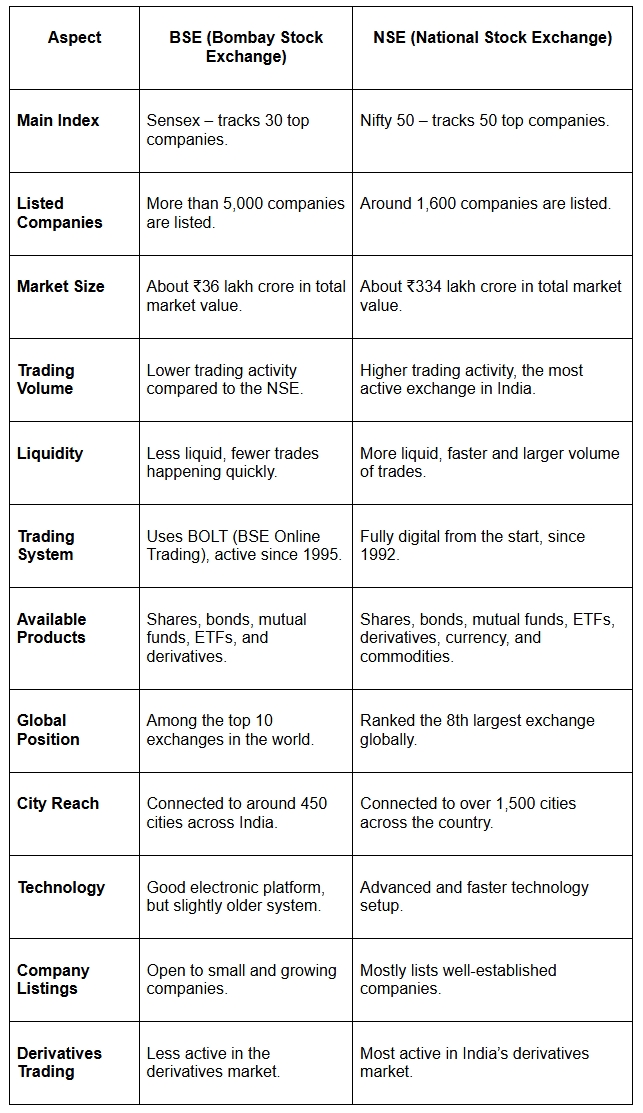
NSE or BSE: which one should you choose for trading?
When liquidity and tight spreads matter most
If you trade actively or work with large order sizes, you may prefer the venue showing narrower bid–ask spreads and higher visible depth for your symbol that day. Many liquid largecaps quote competitively on both exchanges; compare live Level-I or Level-II data before you send the order.
When only one listing exists
Some securities are listed on only the NSE or only the BSE. In that case, your exchange choice is determined by availability, not preference.
Investment style and research depth
Short-term traders often emphasize immediate liquidity and derivatives proximity; long-term investors may care more about corporate fundamentals than which tape prints their entry, provided settlement and pricing are acceptable. If your research extends to unlisted names, read how private-market transparency differs in our overview of unlisted companies.
Index tracking and product choices
Portfolios built to track Sensex versus Nifty should align execution and products with the index provider’s methodology. ETF and index-fund tickers spell out which exchange hosts primary liquidity; follow fund factsheets.
Brokerage and platform considerations
Exchanges do not set your brokerage; your broker does. Some pricing tiers reference segments or exchanges differently, so read the schedule that applies to your account. For operational questions, combine broker support with educational posts on how brokers connect you to exchange trading rails.
Conclusion
The comparison between NSE and BSE is less about picking a permanent “winner” and more about matching venue characteristics to your security, strategy, and execution quality on any given day. Both exchanges operate inside India’s regulatory framework, compete for listings and turnover, and coexist in most brokers’ order-entry screens.
If you want to move beyond listed equities into private markets, keep the same discipline: read primary materials, understand liquidity, and diversify thoughtfully. Precize offers research-led access to private equity and private credit opportunities alongside tools that mirror how institutional analysts review financial statements. Explore private equity and private credit when you are ready for that sleeve.
Deep dives into reporting lines help whether you trade listed or unlisted names. Refresh fundamentals with guides to balance sheets and cash flow statements, then pressure-test ideas against peers.