Why Polymatech Unlisted Shares Are Getting Attention
Investor interest in Polymatech unlisted shares has grown because semiconductor manufacturing is now a national priority for India. The government is supporting the sector through the Semiconductor India Programme, while demand from AI, data centers, electric vehicles, telecom, displays, and medical electronics keeps rising.
Several factors explain the attention:
India's semiconductor policy support: India wants to reduce dependence on imported chips and electronics components.
Rapid revenue growth: Polymatech has reported strong top-line expansion from FY23 to FY25.
Profitability: Unlike many high-growth private companies, Polymatech has reported positive PAT in recent years.
IPO expectations: The company filed draft IPO papers in 2023 and remains in listing conversations.
Global expansion: Singapore, France, Bahrain, and the United States have all appeared in the company's expansion narrative.
Sector scarcity: There are not many Indian unlisted companies that offer direct exposure to semiconductor manufacturing themes.
For investors scanning semiconductor unlisted shares in India or pre-IPO semiconductor stocks in India, Polymatech often appears because there are few private Indian companies with this kind of direct semiconductor-linked positioning.
That said, a strong story is not the same as a low-risk investment. Semiconductor manufacturing is capital-intensive, cyclical, and execution-heavy. For unlisted shares, investors must also deal with lower liquidity and less public disclosure than listed companies.
If you are comparing private companies, use the Precize unlisted shares screener to review availability, sector exposure, price data, and company details in one place.
Polymatech Unlisted Share Price Today
The Polymatech unlisted share price is indicative because the shares do not trade on NSE or BSE. Prices are discovered through private-market demand and supply, and quotes may differ across platforms.
Polymatech price showed around ~₹50 to ₹55 during this update, with a 52-week range of ₹52 to ₹109. Other private-market quotes around June 2026 have generally appeared in the low-to-mid ₹50s depending on counterparty, lot size, and liquidity.
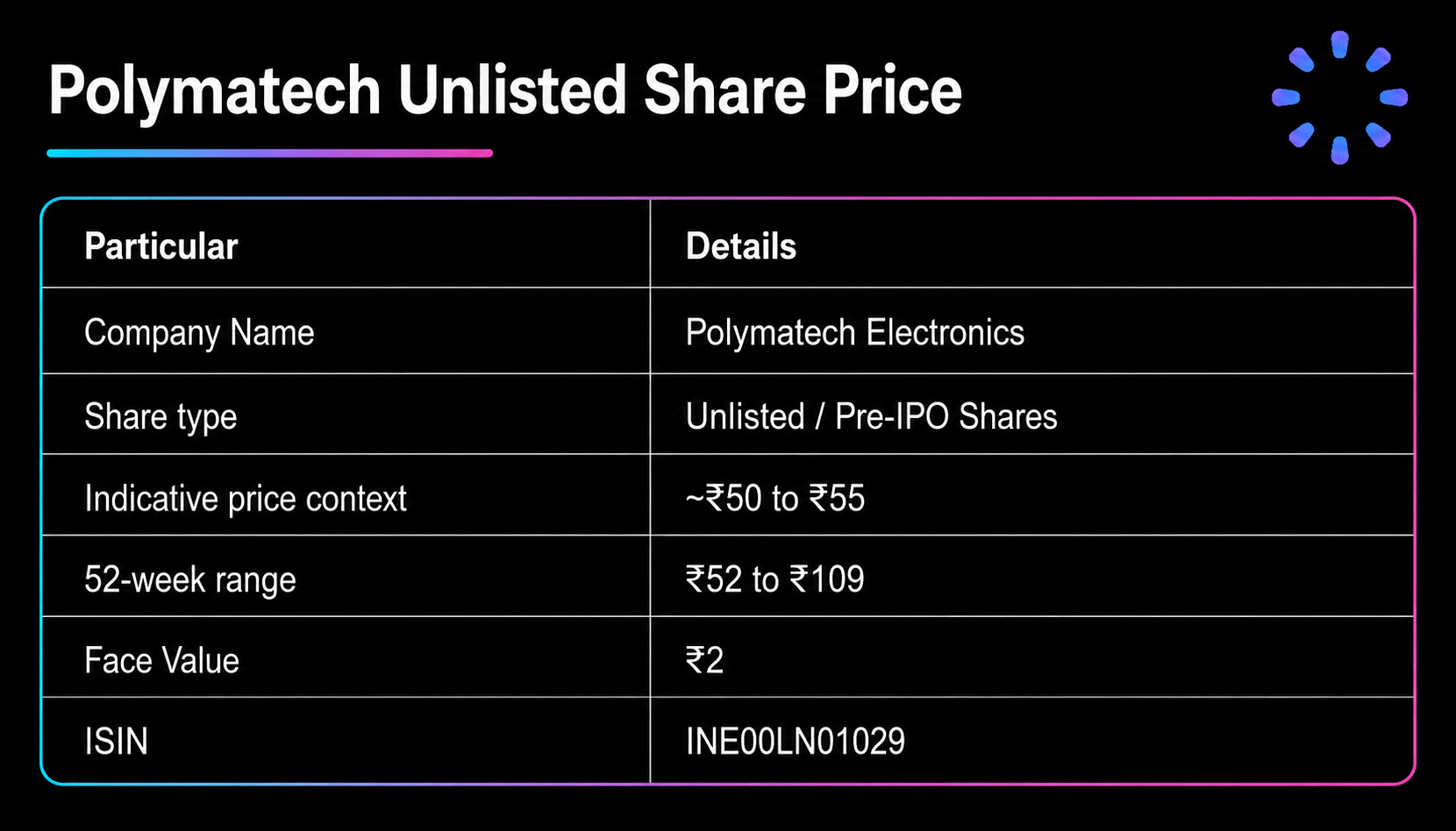
Unlisted prices can move sharply because there is no exchange order book. A single quote may reflect the seller's inventory, buyer demand, settlement timing, lot size, and market sentiment around IPO news. Always check the latest price, transfer process, and charges before transacting.
Polymatech Business Model
Polymatech's business model is built around manufacturing opto-semiconductors and advanced electronics components for industrial and commercial use cases.
Key end-use areas include:
Smartphones and display systems.
Automotive lighting and electronics.
Medical electronics.
Industrial laser systems.
Agriculture and horticulture lighting.
AI and machine vision applications.
Telecommunications and data infrastructure.
Advanced electronics manufacturing for global OEM customers.
The company's strategy appears to rest on five pillars:
Scale Indian manufacturing capacity for semiconductor-linked products.
Build advanced packaging and assembly capabilities that can serve export markets.
Expand globally through regional facilities and subsidiaries.
Move up the value chain from opto-electronics into broader advanced electronics.
Use future fundraising to support capacity expansion, machinery, working capital, and product diversification.
For investors, the key question is whether Polymatech can convert this expansion plan into repeatable revenue, healthy cash flows, and durable margins. Semiconductor and advanced electronics companies can grow fast, but they also need heavy capital investment and tight operational control.
Polymatech has reported strong financial growth in recent years. The latest available figures suggest that revenue increased sharply from FY23 to FY25 while profitability remained healthy.
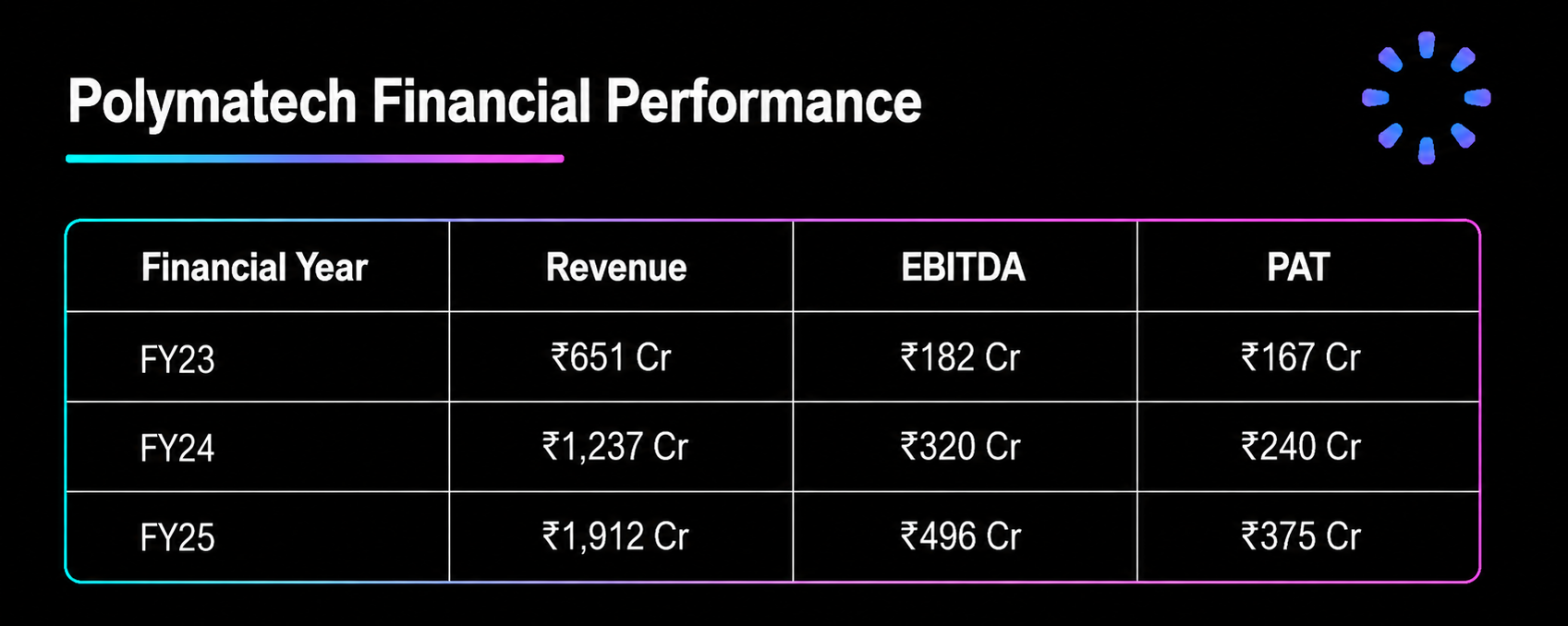
The headline numbers are strong. Revenue nearly doubled in FY24 and grew about 54% in FY25. EBITDA margins have reportedly stayed near the mid-20% range, while FY25 PAT reached about ₹376 crore.
What stands out:
Revenue scale has expanded quickly. The business moved from a few hundred crore in revenue to nearly ₹2,000 crore within a short period.
Profitability has remained positive. FY25 net profit was materially higher than FY24.
The growth story depends on execution. Expansion into new geographies, new products, and larger manufacturing capacity must translate into real orders and collections.
Working capital needs should be monitored. Fast-growing manufacturing businesses often need higher inventory, receivables, and equipment spend.
Investors should not look only at revenue growth. For a capital-heavy business, cash conversion, receivables, debt, customer concentration, and order quality matter just as much.
Singapore Manufacturing Hub: Why It Matters
One of Polymatech's biggest recent developments is its Singapore expansion.
On 10 June 2026, AEIM Pte Ltd, a wholly owned subsidiary of Polymatech Electronics, announced the opening of an advanced electronics manufacturing facility at Mapletree Hi-Tech Park, 163 Kallang Way, Singapore. The facility is backed by about US$25 million of committed investment.
The Singapore hub is expected to support:
LED Chip-on-Board (CoB) packaging.
Advanced memory module assembly.
Asia-Pacific regional operations.
Global customer servicing.
Supply-chain resilience.
Semiconductor and advanced electronics partnerships.
Singapore is already one of Asia's most important semiconductor and electronics hubs. For Polymatech, the facility helps position the company as a more international manufacturing player rather than a purely India-focused business.
The announcement also said Polymatech's broader supply chain spans multiple countries, including India, Singapore, France, Estonia, and the United States. That broader footprint may help with customer access and supply-chain diversification, but it also increases execution complexity.
Polymatech Global Expansion Plans
Polymatech has communicated several international expansion initiatives. These plans are important because they signal ambition, but investors should separate announced intent from fully operational commercial scale.
Singapore
The Singapore facility is the clearest recent update. It is positioned as Polymatech's Asia-Pacific hub for LED CoB packaging and advanced memory module assembly.
France
Polymatech has been linked to sapphire crystal growth, wafer-related activity, and semiconductor ecosystem collaborations in Grenoble, France. France can give the company access to European semiconductor talent, equipment partners, and customer networks.
Bahrain
The company has discussed semiconductor manufacturing and assembly operations in Bahrain, which could help serve Middle East markets and diversify its manufacturing base.
United States
Polymatech's U.S. presence has been linked to semiconductor testing, failure analysis, reliability engineering, and equipment capabilities. These functions can be important for global OEM customers that need quality assurance across the supply chain.
India
India remains the company's core manufacturing base. Polymatech continues to expand its semiconductor and opto-electronics capabilities from Tamil Nadu, including GaN-linked and advanced electronics manufacturing plans.
Together, these plans make Polymatech one of the more globally ambitious semiconductor-linked private companies from India. The investment case depends on whether the company can integrate these geographies without stretching capital, management bandwidth, or execution quality.
Polymatech DRHP Filing and IPO Timeline
Polymatech filed its Draft Red Herring Prospectus (DRHP) with SEBI in September 2023 for a proposed ₹750 crore IPO. Reports from The Economic Times and The Hindu BusinessLine said the issue was planned as a fresh issue with no offer-for-sale component.
The 2023 IPO plan was later postponed. More recent reporting from The Financial Express suggests the company may explore a much larger IPO in the future to fund capacity expansion and a broader electronics product push.
Potential IPO proceeds could support:
Semiconductor manufacturing expansion.
Machinery and equipment purchases.
International facility development.
Working capital requirements.
Product diversification.
Research and development.
Forward integration into electronics products.
As of now, there is no final IPO launch date. Investors should wait for fresh DRHP filing, SEBI observations, official price band, offer structure, and listing timeline before treating any IPO expectation as confirmed.
Opportunities for Investors
Polymatech gives investors a way to study India's semiconductor manufacturing opportunity before a possible public listing. The opportunity is tied to several long-term themes.
Key growth drivers include:
India's semiconductor mission and electronics manufacturing incentives.
Rising AI and data-center infrastructure demand.
Electric vehicle growth.
Display, smartphone, and consumer electronics demand.
Medical electronics and machine vision applications.
Global customers looking for diversified semiconductor supply chains.
Increasing demand for advanced packaging and opto-electronics.
If India builds a deeper semiconductor manufacturing ecosystem, companies with proven capacity, customer relationships, and export demand could benefit. Polymatech is one of the companies investors are watching in that context.
However, opportunity does not remove risk. The right question is not just "Is semiconductor demand growing?" It is "Can Polymatech capture that demand at a valuation that leaves enough room for investors?"
Risks of Investing in Polymatech Unlisted Shares
Investors should evaluate these risks before buying Polymatech unlisted shares.
1. Liquidity Risk
Unlisted shares are harder to sell than listed equities. You may not find a buyer when you want to exit, and the available exit price may differ from the last quoted price. If you are new to the category, compare the mechanics in our guide to unlisted shares vs listed shares.
2. Valuation Risk
Private-market prices can rise because of IPO speculation, sector excitement, or limited supply. If expectations cool, prices can fall even if the business continues to grow.
3. Semiconductor Cyclicality
The semiconductor industry moves in cycles. Demand, pricing, inventories, and capital expenditure can change quickly across global markets.
4. Execution Risk
Polymatech's expansion plans span multiple countries and product categories. Large manufacturing projects require capital, equipment, talent, quality control, and customer onboarding.
5. Disclosure Risk
Unlisted companies do not offer the same level of public disclosure as listed companies. Investors may have fewer updates on cash flows, debt, receivables, related-party transactions, and customer concentration.
6. IPO Uncertainty
A DRHP filing does not guarantee a listing. IPO timing depends on company readiness, SEBI review, market conditions, valuation expectations, and investor appetite.
7. Disclosure and Governance Review
For any fast-growing unlisted company, investors should review the latest audited financials, statutory filings, board disclosures, auditor notes, and platform research before making any decision. This matters even more when the company is expanding across countries and raising capital for large manufacturing projects.
How to Evaluate Polymatech Before Investing
Before investing in Polymatech unlisted shares, review the company through both business and private-market lenses.
Key checks include:
Latest audited financials: Revenue growth is important, but cash flow and receivables matter too.
Valuation: Compare implied valuation with listed and global peers, but adjust for differences in scale and business model.
Order quality: Check whether order book numbers translate into executed revenue and collections.
Debt and capex: Understand how expansion is being funded.
IPO visibility: Look for fresh DRHP filing and SEBI updates, not only market chatter.
Liquidity: Confirm likely exit options before buying.
Holding period: Be prepared for a longer wait if the IPO timeline shifts.
For process questions on demat transfer, settlement, and platform support, review the Precize FAQs. For help with a specific transaction, you can reach Precize Care. Stay updated with unlisted companies through our Precize Community. If this article was useful, you can share it with other investors through the Precize Referral Program.
Final Takeaway
Polymatech has emerged as one of India’s most talked-about semiconductor companies in the unlisted market, backed by strong FY24 and FY25 growth, global expansion plans, and its 2023 DRHP filing. With rising demand for semiconductors and India’s manufacturing push, the company is well positioned for long-term growth.
However, investors should also consider risks such as valuation volatility, execution challenges, and IPO uncertainty. For long-term investors seeking exposure to India’s semiconductor opportunity before a potential IPO, Polymatech remains a key company to watch.
FAQs on Polymatech Unlisted Shares
1. What does Polymatech Electronics do?
Polymatech Electronics manufactures opto-semiconductors, LED chips, and advanced electronics components used in sectors such as automotive, healthcare, industrial lighting, machine vision, and telecommunications.
2. Is Polymatech listed on NSE or BSE?
No. Polymatech is currently an unlisted company, so its shares do not trade on NSE or BSE.
3. What is the Polymatech unlisted share price?
The indicative Polymatech unlisted share price is currently around ~₹50 to ₹55 per share and a 52-week range of ₹52 to ₹109.
4. Has Polymatech filed for an IPO?
Yes. Polymatech filed a DRHP with SEBI in October 2023 for a proposed ₹750 crore IPO. That plan was later postponed, and recent reports suggest the company may explore a larger IPO in the future.
Disclaimer:This article is for informational purposes only and should not be considered investment advice. Investing in unlisted shares carries risks including illiquidity and potential loss of capital. Please consult with a qualified financial advisor before making investment decisions. Precize is not a stock exchange and is not authorized by any capital markets regulator.