If you’ve ever taken a home loan, used a credit card, or heard about banks passing on their loans to other financial players, you’ve already brushed past the impact of securitization in everyday life. It’s a process that works quietly in the background but plays a huge role in keeping India’s financial system running smoothly.
In fact, the Indian securitization market has seen a sharp rise recently. As per ICRA Limited, the overall volume of securitization of standard assets in Q3 FY2025 is estimated at around ₹68,000 crore, an impressive year-on-year growth of nearly 80% compared to Q3 FY2024.
For the first nine months of FY2025, total securitization volumes have reached approximately ₹1.8 trillion, up from ₹1.4 trillion during the same period in FY2024. This growth shows how important securitization has become in today’s financial landscape.
In this blog, you’ll get a simple and clear look at the different types of securitization, the step-by-step process behind it, and the main benefits and drawbacks. We’ll also explain the key legal and regulatory issues specific to India and close with what the future might hold for securitization as markets evolve.
Let’s get started!
What does Securitization mean?
Securitization means turning financial assets, like loans or receivables, into tradable securities. These assets usually generate future cash flows, such as monthly loan repayments. Instead of holding these assets, a lender converts them into financial instruments that can be sold to investors.
Got the meaning? Great. Now let’s explore how securitization works in action, right from pooling assets to final payout.
8 Steps Process of Securitization
Securitization might sound complicated, but it’s easier to understand when you look at it step by step. Here are 8 simple steps on how the whole process usually works:
Step 1: Selecting and Pooling Assets
It begins with a financial institution or bank, called the originator.
The originator picks a group of similar assets, such as home loans, auto loans, or receivables, considering their maturity, risk, and interest rates.
This collection is known as the asset pool.
Step 2: Transferring to Special Purpose Vehicle (SPV)
The originator then transfers these pooled assets to a Special Purpose Vehicle (SPV), which is a separate legal entity like a trust or subsidiary.
This transfer is a true sale, meaning the assets are legally removed from the originator’s books and moved to the SPV.
Step 3: Creating and Issuing Securities
The SPV packages these assets into securities based on their type and risk level.
These securities, often called Pass-Through Certificates (PTCs) or Security Receipts (SRs), are then issued to investors.
In India, these investors are usually Qualified Institutional Buyers (QIBs), such as banks, insurance companies, and mutual funds.
Step 4: Adding Credit Support and Getting Ratings
To make these securities safer and more attractive, credit enhancement methods are added.
This can include guarantees, extra collateral, or third-party support.
Credit rating agencies evaluate and rate these securities to help investors understand the risks.
Step 5: Selling Securities and Raising Funds
The SPV sells these securities to investors. The money collected is then paid to the originator for the asset pool.
Step 6: Managing Payments and Collections
After the sale, the originator usually continues collecting repayments from borrowers, such as EMIs on loans.
These payments are transferred to the SPV, which then distributes the principal and interest to investors according to the terms.
Step 7: Administration and Handling Defaults
The SPV oversees the flow of funds and ensures investors receive their payments on time.
Depending on the agreement in place, the originator may need to step in if borrowers default.
Having seen the process, you may wonder about the various forms securitization can take. Let’s explore those next.
Types of Securitization
Different types of securitization serve different purposes and have their own structures. Here are the main types you should know:
Pass-Through Securitization
In this type, a group of similar financial assets, such as home loans or car loans, is bundled together.
The payments received from these loans, including both principal and interest, are collected by a servicing company and then passed directly to the investors.
After deducting service fees, each investor gets their share based on how much they’ve invested.
A common example is mortgage-backed securities (MBS), where investors receive payments made by homeowners.
Pay-Through Debt Instruments
These instruments work differently from pass-through structures.
Instead of directly passing payments to investors, the cash flows are used to support structured debt instruments.
The securities are split into multiple layers or “tranches,” each with different risk levels, payment order, and maturity.
Investors in senior tranches get paid first, while junior tranches carry higher risk and get paid later.
Collateralized mortgage obligations (CMOs) are a good example of this type.
Collateralized Debt Obligations (CDOs)
CDOs are formed by pooling together various types of debt, such as company loans, corporate bonds, or even other securitized assets.
These are then divided into tranches with varying levels of risk and return.
Investors choose the tranche that matches their risk appetite; senior tranches are safer with lower returns, while junior ones are riskier but offer higher returns.
Asset-Backed Securities (ABS)
ABS are backed by a collection of loans like car loans, personal loans, or credit card receivables.
The repayments from these loans are used to pay investors.
ABS allows lenders to move loans off their balance sheets, reduce risk, and raise funds to issue more loans.
Mortgage-Backed Securities (MBS)
This is a specific type of ABS that is backed by home loans or other real estate loans.
The payments made by borrowers, usually monthly EMIs, are passed on to the investors.
MBS can be further classified into Residential Mortgage-Backed Securities (RMBS) and commercial Mortgage-Backed Securities (CMBS), depending on the type of property.
Collateralized Loan Obligations (CLOs)
CLOs are similar to CDOs but are made up specifically of corporate loans, often high-yield or leveraged loans.
These are also structured in tranches based on risk and are sold to investors.
CLOs help financial institutions manage exposure to business lending.
Other Types of Securitization
Collateralized Bond Obligations (CBOs): These are backed by corporate bonds and structured similarly to CDOs.
Future Cash Flow Securitization: This type is based on expected future income, such as toll collections, lease payments, or utility bills. It’s often used in infrastructure or public sector projects.
Understanding the different types helps you appreciate the advantages securitization brings.
Key Advantages of Securitization
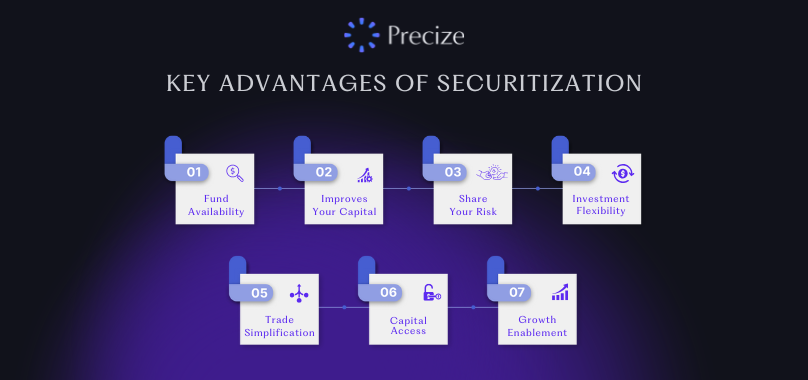
Securitization offers many benefits that you should know about, especially in India’s financial system.
Frees Up Your Funds
Securitization helps you, as a bank or financial institution, turn loans or receivables that are hard to sell into securities you can trade. This frees up money that was tied down, so you can use it to give more loans or grow your business.
Improves Your Capital
By moving these assets off your balance sheet, you can improve your capital ratios. This makes it easier for you to meet regulatory rules and lend more to customers.
Share Your Risk
Instead of holding all the risk yourself, securitization spreads it among many investors. This helps you manage your risk better and keeps the financial system more stable.
Gives You More Investment Choices
If you are an investor, securitization gives you access to different investment options with varying risks and returns. This lets you build a portfolio that suits your comfort level.
Makes Trading Easier
Securitized assets can be sold and bought more easily in the market compared to regular loans. This liquidity makes it simpler for you to trade when needed.
Helps You Raise Funds
If you are a business, you can get extra capital by turning your receivables or other assets into securities. This is especially useful if you want to raise money without borrowing more.
Supports Your Growth
When banks and financial companies like yours can lend more, it boosts the overall economy. More lending means more opportunities for people and businesses to grow, which is important in India’s developing market.
While securitization offers many benefits, it’s important you also understand the potential downsides.
Common Disadvantages of Securitization
While securitization has many benefits, it’s also important to be aware of its drawbacks. Here are some key disadvantages you should keep in mind:
Complex Process
Securitization involves many different parties, legal documents, and complicated financial structures. This can make it hard for you to fully understand the risks or the true quality of the underlying assets.
Lack of Transparency
As an investor, you might not get clear or complete information about the loans or assets backing the securities. When assets from many borrowers are combined, it becomes difficult to assess their credit quality, which may lead to incorrect pricing of risk.
Default Risk
There is always a chance that the borrowers behind the securitized loans might fail to repay. If defaults increase, the value of these securities can fall sharply, causing losses for investors. This risk became very clear during the 2008 global financial crisis.
System-Wide Risk
If a large number of borrowers default at the same time, it can create a chain reaction affecting not just investors but the entire financial system. This may lead to a broader financial crisis.
High Costs
The process of securitization involves several expenses like legal fees, administrative costs, and charges for credit ratings. These costs can lower the returns you get from these investments.
Accountability Issues
Since many parties are involved, it can be hard to figure out who is responsible if problems arise. This lack of clear accountability can make resolving issues more difficult.
Moral Hazard
Sometimes, banks might not carefully check borrowers’ ability to repay loans because they plan to sell these loans through securitization. This can result in poor lending decisions and higher chances of defaults.
Early Repayment Risk
If borrowers repay their loans earlier than expected, your returns may be reduced, making the investment less profitable.
Low Secondary Market Liquidity
In India, some securitized products may not have an active market for resale. This can make it hard for you to sell these securities quickly when you need cash.
Since securitization has its challenges, knowing the legal and regulatory rules becomes even more crucial for you.
Key Legal and Regulatory Issues of Securitization
When you explore securitization in India, you can’t ignore the legal and regulatory challenges that come with it. These rules shape how deals are structured, who can invest, and what risks you need to watch out for.
Who Regulates You
In India, securitization is mainly regulated by the Reserve Bank of India (RBI) and the Securities and Exchange Board of India (SEBI).
If you're a bank, NBFC, or housing finance company, the RBI sets the rules for your securitization transactions.
SEBI, on the other hand, regulates how securitized instruments and security receipts are listed and traded, especially when offered to the public or listed on exchanges.
Laws You Need to Follow
The SARFAESI Act, 2002, plays a major role if you're dealing with stressed assets. It helps enforce security interests tied to non-performing loans.
RBI issues detailed directions like the Securitisation of Standard Assets and Transfer of Loan Exposures.
These set out key rules, such as how long you must hold assets and how much risk you must retain before you can securitize.
SEBI also has specific rules for listing securitized products, and these are gradually being updated to stay in line with RBI guidelines.
Stamp Duty and Tax Rules
Stamp duty can be a costly issue.
When you transfer loans or receivables to an SPV, you may face high stamp duties depending on the state, which can sometimes make the deal too expensive to pursue.
However, tax reforms have helped. SPVs set up as trusts now enjoy pass-through tax treatment, making the structure more tax-efficient.
Compliance and Structure Rules
You’re required to hold on to a portion of the securitized assets, this is called the Minimum Retention Requirement (MRR).
There’s also a Minimum Holding Period (MHP), which means you must keep assets for a certain time before you can securitize them.
Overcollateralization (adding extra assets to secure the deal) doesn’t count toward your MRR.
Also, if you plan to offer securities to more than 50 people, you must list them, as per SEBI’s rules.
Legal Gaps and Foreclosure Issues
Foreclosure rules have improved with SARFAESI, making it easier to enforce rights over defaulted assets.
But challenges remain, especially when it comes to understanding the legal meaning and rights of different classes of security receipts.
This can cause confusion for investors and delay decision-making.
Accounting vs Regulatory Gaps
If you’re a large institution, you may notice differences between what RBI rules require and how Indian accounting standards treat securitization.
This mismatch can make your reporting more complicated and sometimes even discourage you from using securitization.
Instead, you might lean toward direct loan sales for simplicity.
With the legal and regulatory landscape clear, it’s time to look ahead at the future of securitization.
Future Outlook of Securitization
India’s securitisation market is expected to stay strong and grow even more in the coming years.
In FY2025, total volumes hit a record ₹2.35 lakh crore, and they’re expected to rise further to around ₹2.4-2.5 lakh crore in FY2026.
This growth is mainly being driven by more active participation from private banks and NBFCs, who are turning to securitisation to manage their liquidity needs and balance sheet pressures.
Conclusion
Now that you’ve understood what securitization means, its types, how it works, and the pros, cons, and legal aspects, it’s clear that securitization plays a big role in shaping financial markets. It helps lenders manage risk, improves liquidity, and supports wider credit access.
At Precize, we make it easier for you to tap into such evolving financial trends.
Our platform facilitates access to investments in top private companies by allowing you to buy and sell unlisted and pre-IPO shares.
We also bring unique global trade finance opportunities through Private Credit Investments, helping you diversify your portfolio with alternative fixed-income options.
So, to get started, reserve your access to Precize today!
Disclaimer
The information shared in this blog is for educational and informational purposes only. It should not be considered financial, legal, or investment advice. You are advised to do your own research or consult with a qualified professional before making any financial decisions. Precize does not guarantee returns or endorse any specific investment mentioned. All investments carry risk, and past performance is not a guarantee of future results.