Filing taxes can feel confusing, especially when it comes to understanding what allowances you can actually claim. One such allowance that often creates doubt is the Entertainment Allowance. You might have seen this term on your salary slip or heard about it during tax season, but what does it really mean, and who can claim it?
In this blog, you’ll understand what entertainment allowance is and how the entertainment allowance is applicable to different employees, especially those in government jobs. We’ll cover conditions for claiming it, and a simple calculation example. The blog also explains its applicability to private sector employees, key benefits of the deduction, and common mistakes to avoid while filing.
Let’s get into it to learn!
The entertainment allowance is applicable only to Central and State Government employees under the old tax regime.
Private sector employees, PSUs, and autonomous bodies cannot claim this deduction; it's fully taxable for them.
Dedication is allowed under Section 16(ii) and is limited to the lowest of ₹5,000, 20% of basic salary, or the actual allowance received.
The allowance must be included in gross salary first, and then the deduction is applied.
An entertainment allowance is a part of your salary given by your employer to cover expenses related to official entertainment duties, such as hosting clients or attending formal events on behalf of your organisation.
This allowance is commonly provided to government employees, though some private sector companies may also include it in the salary structure. However, for tax purposes, the entertainment allowance is applicable only to government employees under Section 16(ii) of the Income Tax Act.
The structure of an entertainment allowance can differ from one organization to another. Some companies provide a fixed annual allowance upfront, while others distribute a set amount each month. In many cases, employees are required to cover the expense first and then seek reimbursement, based on the company’s internal guidelines.
These allowances often come with specific usage conditions. For instance, spending may be limited to particular types of entertainment or approved locations. Employers might also enforce caps on how much can be spent per occasion or within a monthly cycle.
In addition, companies generally have a defined approval process. Some may require advance approval from reporting managers or finance teams, while others review and clear expenses after the fact. Understanding the approval workflow and documentation requirements is essential to avoid reimbursement delays or policy violations.
Once you’re clear about what entertainment allowance covers, the next step is checking if you qualify for the deduction.

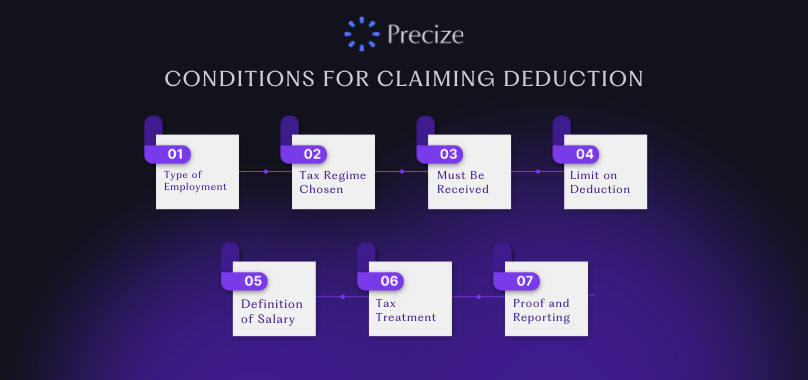
To claim a deduction for entertainment allowance under Section 16(ii) of the Income Tax Act, certain rules must be followed. These are clearly defined and apply only if you meet all the conditions listed below:
Type of Employment: This deduction is available only to Central or State Government employees. If you work for a PSU, local authority, autonomous body, or in the private sector, you're not eligible to claim it.
Tax Regime Chosen: You can claim the deduction only if you’ve opted for the old tax regime. Under the new regime, this benefit is not allowed.
Allowance Must Be Received: You must have actually received the entertainment allowance as part of your salary during the financial year. It’s not based on what you spend; only the amount received counts.
Limit on Deduction: The maximum amount you can claim is the lowest of these three:
20% of your basic salary (excluding any extra allowances or perks).
The actual entertainment allowance received during the year.
Definition of Salary: For this purpose, only your basic salary is considered. Other components like HRA, bonuses, or any other benefits are not included in the calculation.
Tax Treatment: The full amount of the entertainment allowance is first added to your salary. Then, if you qualify, the deduction under Section 16(ii) is subtracted while calculating your taxable income.
Proof and Reporting: It’s important to keep records showing the entertainment allowance received. This must be correctly reported under the "Salary" section of your Income Tax Return (ITR).
Once the eligibility is clear, the next step is understanding how the deduction is actually calculated.
Let’s say you’re a Central Government employee, and here are your salary details for the financial year 2024–25:
Basic Salary: ₹3,00,000
Entertainment Allowance Received: ₹20,000
Now, let’s work out the deduction you can claim under Section 16(ii), step by step:
20% of Basic Salary: 20% of ₹3,00,000 = ₹60,000
Actual Entertainment Allowance Received: ₹20,000
Maximum Limit Allowed: ₹5,000
Now, compare all three amounts:
20% of basic salary = ₹60,000
Allowance received = ₹20,000
Capped limit = ₹5,000
Since the deduction is limited to the lowest of these three, the amount you can claim is ₹5,000.
So, for the financial year 2024–25, you’re allowed to deduct ₹5,000 from your salary income under Section 16(ii) of the Income Tax Act.
So, how does this deduction benefit you beyond just saving a few thousand? Let’s explore.
If you're eligible under the old tax regime, claiming a deduction for entertainment allowance can offer some useful advantages. The following are the key benefits you should know:
Lowers Your Taxable Salary: If you're a Central or State Government employee, claiming a deduction on the entertainment allowance can help reduce your taxable income, which may lower your overall tax liability.
Acknowledges Work-Related Spending: The allowance recognizes that government employees often incur expenses for official purposes, like hosting meetings or representing their department at events.
Not Meant for Private Employees: The benefit is only for government staff. Employees working in the private sector, PSUs, local bodies, or autonomous organisations are not eligible to claim it.
Supports Accurate Tax Filing: Claiming this deduction ensures that your tax return reflects the correct salary amount, helping you stay compliant without overpaying.
No Extra Proof Required: As long as the allowance is shown in your salary slip, there’s no need to submit additional documents or bills for this deduction.
While understanding the benefits is important, it’s equally crucial to know how to manage and utilise the allowance effectively.

To ensure your entertainment allowance is used efficiently, consider the following strategies:
Understand Usage Guidelines
Review your company’s policy to know exactly what types of expenses are permitted. This helps you plan better and prevents unexpected rejections during reimbursement.
Allocate Funds Strategically
Even with an allowance in place, it's smart to allocate a set amount for each outing or engagement. This ensures you stay within limits and manage expenses effectively.
Seek Cost-Saving Opportunities
Make your budget go further by looking for deals, early-bird offers, or corporate discounts. Many venues provide lower rates for group reservations or during less busy hours.
Set Aside for Bigger Events
If you’re anticipating a high-cost event, such as a business dinner, concert, or client entertainment, consider reserving part of your monthly allowance in advance. This helps avoid overspending or out-of-pocket costs.
While the strategies are clear, it’s just as important to be aware of the common pitfalls that can affect your claim.

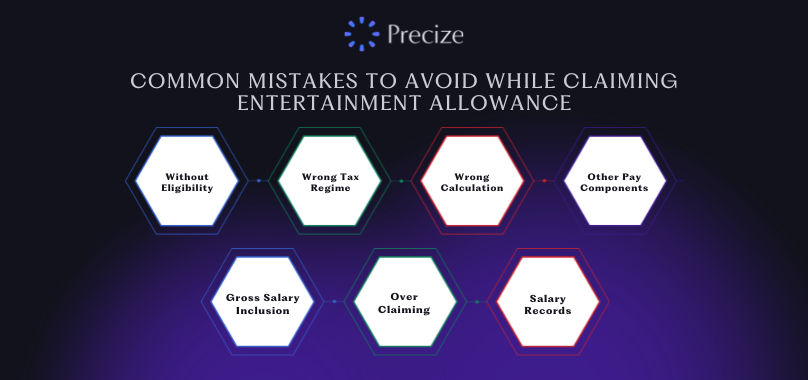
When claiming a deduction for entertainment allowance under Section 16(ii), it’s important to be accurate and follow the rules to avoid errors during tax filing. Here are some common mistakes you should watch out for:
Claiming Without Eligibility
This deduction is strictly for Central and State Government employees. If you’re working in a private company, PSU, local authority, or autonomous body, you are not eligible to claim it. In such cases, the full amount is taxable.
Choosing the Wrong Tax Regime
The deduction is allowed only under the old tax regime. If you’ve opted for the new tax regime, you won’t be able to claim it, even if the allowance is part of your salary.
Wrong Calculation Method
A common error is claiming the full amount received or miscalculating the 20% of basic salary. The deduction should be the lowest of ₹5,000, 20% of basic salary, or the actual allowance received. Make sure to use only the basic salary in your calculation; do not include any other components.
Adding Other Pay Components
Some people mistakenly include extra allowances, perks, or bonuses in their salary while calculating the 20% limit. Only your fixed basic pay should be considered.
Skipping Gross Salary Inclusion
Before claiming the deduction, the entertainment allowance must be added to your total (gross) salary. Missing this step can lead to mismatches in your income details.
Over-Claiming the Deduction
Claiming more than what’s allowed under the rules can result in a notice from the Income Tax Department or denial of your deduction during assessment.
Not Keeping Salary Records
Always maintain clear proof of the salary structure and allowance received. Incomplete or missing records can create problems if your return is selected for verification.
Now that you’ve understood how the entertainment allowance is applicable to different types of employees, it's clear that this tax benefit is strictly limited to Central and State Government employees under the old tax regime.
Throughout this blog, we covered its definition, tax treatment under Section 16(ii), eligibility conditions, calculation method, and common mistakes to avoid. If you fall under the eligible category, claiming this deduction can help reduce your taxable income in a straightforward and compliant way.
As you take steps to manage your salary and taxes better, it’s also a good time to think about diversifying your financial portfolio. Precize, an alternative investment platform, offers access to pre-IPO shares and global trade finance opportunities, giving you new ways to strengthen your financial planning.
Reserve your access with Precize to explore unique investment options beyond traditional markets.
No, this deduction is available only under the old tax regime. If you’ve opted for the new tax regime, you cannot claim any deduction for entertainment allowance.
No, it’s not fully tax-free. The entire amount is first added to your salary income, and then the deduction is applied as per the allowed limits. Any remaining balance is taxable.
No, private sector employees are not eligible for this deduction. For them, the full amount received as an entertainment allowance is taxable.
The deduction is based strictly on the amount received as an entertainment allowance, not on how much is actually spent on official duties.
You need to include the entertainment allowance in your gross salary and then claim the deduction under Section 16(ii)in the "Salary Income" section when filing your Income Tax Return (ITR).
No, this deduction is only for active Central and State Government employees. Pensioners are not eligible.
You don’t need to provide any separate bills or expense records. Just keep a record of your salary slip or salary structure showing the entertainment allowance received.
The maximum deduction allowed is ₹5,000 per financial year, even if you’ve received a higher amount as an entertainment allowance.
The information provided in this blog is for general knowledge and educational purposes only. It should not be considered as professional tax or financial advice. Readers are advised to consult a qualified tax consultant or financial advisor to understand how the entertainment allowance rules apply to their specific situation, especially with respect to the latest Income Tax laws and applicable tax regimes.

Join our newsletter for exclusive access to thoughtfully curated content and we promise, no spam
Company
Our Office
Office No. 1219, The Summit Business Park, Andheri Kurla Road, Andheri East, Mumbai, Maharashtra - 400093
Find us on Googlesupport@precize.in
+91 7738336457
All trademarks and logos or registered trademarks and logos found on this Site or mentioned herein belong to their respective owners and are solely used for informational and educational purposes.
The material presented in this advertisement is for informational purposes only and should not be construed as investment advice or investment availability. It is not a recommendation of, or an offer to sell or solicitation of an offer to buy, any particular unlisted share, security, strategy, or investment product. Investing in the private market and securities involves risks, including the potential loss of money, and past performance does not guarantee future results. Market trends, data interpretations, graph projections are provided for informational and illustrative purposes and may not reflect actual future performance. Nothing on this website should be construed as personalized investment advice or should not be treated as legal, financial, or any other form of advice. Precize is not liable for financial or any other form of loss incurred by the user or any affiliated party based on information provided herein.
Precize is neither a stock exchange nor does it intend to get recognized as a stock exchange under the Securities Contracts Regulation Act, 1956. Precize is not authorized by the capital markets regulator to solicit investments. The securities traded on these platforms are not traded on any regulated exchange.
The website will be updated regularly.
Copyright © 2026 - Precize - All Rights Reserved