Employee Stock Option Plans (ESOPs) in India are schemes that let employees buy or receive shares in their employer over time, usually after a vesting schedule. In plain terms: your employer ties part of your wealth-building to the company’s equity so your upside grows if the business succeeds.
What Does ESOP Mean in India?
ESOP usually stands for Employee Stock Option Plan. In Indian startups and growth-stage firms, it describes a bundle of stock options granted to employees (and sometimes advisors). Each option is typically the right to buy one share at a fixed exercise price (also called strike price) within an exercise window, subject to vesting and plan rules.
In the United States, "ESOP" can also mean a qualified employee stock ownership plan that uses a trust to hold company stock. Some Indian companies use trust or pool structures, but most employees in the Indian tech and startup space simply receive options that convert to equity when exercised. Your grant letter and plan document are the final word on definitions, not the label in the job post.
Most Indian plans sit under Companies Act 2013 rules for employee stock options and related instruments. SEBI-listed companies face extra disclosure and pricing requirements. Related labels such as sweat equity or an ESPS (employee stock purchase plan) are not identical to a standard option grant, so check which structure you actually received.
If you are comparing how private market exposure fits your overall portfolio, the Precize screener helps you find and research unlisted companies in one place, separate from your employer’s stock.
Why Companies Offer ESOPs
Companies offer ESOPs to align incentives, conserve cash salary, and compete for talent against larger employers. For employees, ESOPs can be meaningful wealth creators when there is a liquidity event, but they are not guaranteed income and they add complexity.
How ESOP Works: From Grant to Sale
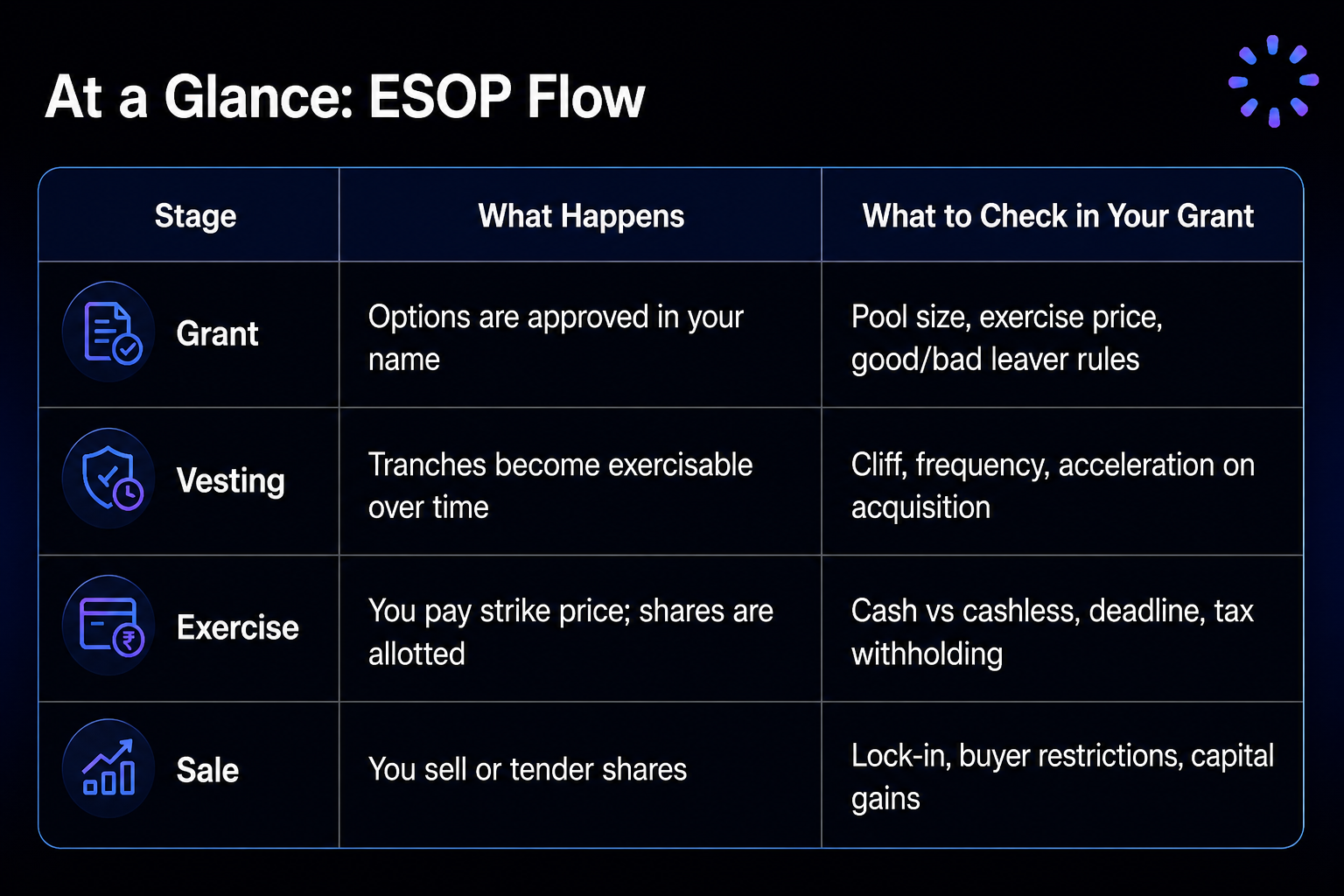
Think of the lifecycle in stages: grant, vesting, exercise, holding, and sale or tender. Not every plan uses identical timelines; always verify yours.
Step 1: Grant and Pool
The board or shareholders approve an ESOP pool (a slice of equity reserved for employees). You receive a grant letter stating number of options, exercise price, vesting schedule, and key conditions.
Step 2: Vesting Schedule and Cliff
Vesting is when options become exercisable in tranches, for example 25% per year over four years. Many plans use a one-year cliff: If you leave before 12 months, the first tranche may not vest at all. After the cliff, vesting is often monthly or quarterly.
Step 3: Exercise
Exercise is when you pay the exercise price and the company allots shares to you (or to a nominee holding structure, per plan). Some plans allow cashless exercise; others require you to fund the exercise. There may be an exercise window after you leave; if you miss it, unexercised options can lapse.
Step 4: Restrictions and Liquidity
After allotment, you might face lock-ins, ROFR/ROFO (right of first refusal) clauses, and blackout periods around funding or results. Liquidity may only arrive with an IPO, acquisition, ESOP buyback, or secondary transaction approved by the company.
Step 5: Sale and Taxes
When you sell, you may face capital gains tax. The holding period and listed vs unlisted status change whether gains are treated as short-term or long-term and which rates apply. Your tax return should reflect both perquisite at exercise and capital gains on sale, as applicable.
For process and account questions Precize FAQs cover common queries from investors in unlisted and pre-IPO markets.
At a Glance: ESOP Flow
Benefits of ESOPs for Employees
Ownership mindset. When compensation includes equity, many teams think longer-term about waste, customers, and capital efficiency.
Wealth upside. If the company’s valuation rises and you can sell or tender at a higher price than your combined exercise cost and taxes, the uplift can be substantial. This is scenario-dependent, not promised.
Retention incentive. Vesting rewards staying through messy phases of company-building.
Learning. Going through an exercise and sale cycle teaches cap tables, dilution, and tax timing, skills that help when you evaluate other investments.
Potential diversification later. Once you have liquidity, you can diversify into other asset classes, including private markets accessed through regulated routes such as Precize.
Benefits Employers See
Talent attraction: Startups compete with cash-rich employers by offering paper upside.
Cash efficiency: Fixed salary outlay can be lower if employees value options.
Culture and retention: Shared ownership can reinforce mission and retention if the plan is explained well.
Exit and succession options: In some structures, employee ownership can be part of long-term ownership transition, though this is more common in mature businesses than in early-stage ventures.
Costs and Administration
Running an ESOP is not free. Companies budget for:
Legal and secretarial work: Drafting the plan, amendments, board and shareholder resolutions, and compliance under the Companies Act and, where relevant, SEBI rules for listed issuers.
Valuations: FMV for grants and exercise often needs registered valuer or merchant banker inputs on a defined cadence.
Payroll, cap table, and treasury: Tracking grants, managing exercise notices, handling TDS, and updating cap tables on tools such as Carta, trica, or similar.
Communication: Employees need clear FAQs on vesting, bad leaver clauses, and tax, or ESOPs create resentment instead of motivation.
Dilution: Every new option pool dilutes existing shareholders. Founders should model dilution up front.
Tax Implications of ESOPs in India (Overview)
Tax law changes; use this section as a checklist for discussions with a chartered accountant, not as personal tax advice. Authoritative reference: the Income Tax Department website and your Form 16 / AIS.
At Allotment (Exercise)
When you exercise options, the benefit is often measured as the fair market value (FMV) of the shares minus the exercise price you pay. That spread is generally treated as a perquisite in the salary head and taxed at your slab rates. Your employer may withhold TDS at exercise where applicable.
Special Rules for Eligible Startups
For certain eligible startups as defined under Indian tax law, there have been deferral mechanisms for perquisite taxation on ESOPs so that employees do not face an immediate cash-tax crunch at exercise. Eligibility conditions are specific (for example, employer and notification criteria). Verify current rules each financial year.
On Sale: Listed vs Unlisted
After shares are allotted, a later sale can trigger capital gains. Broadly:
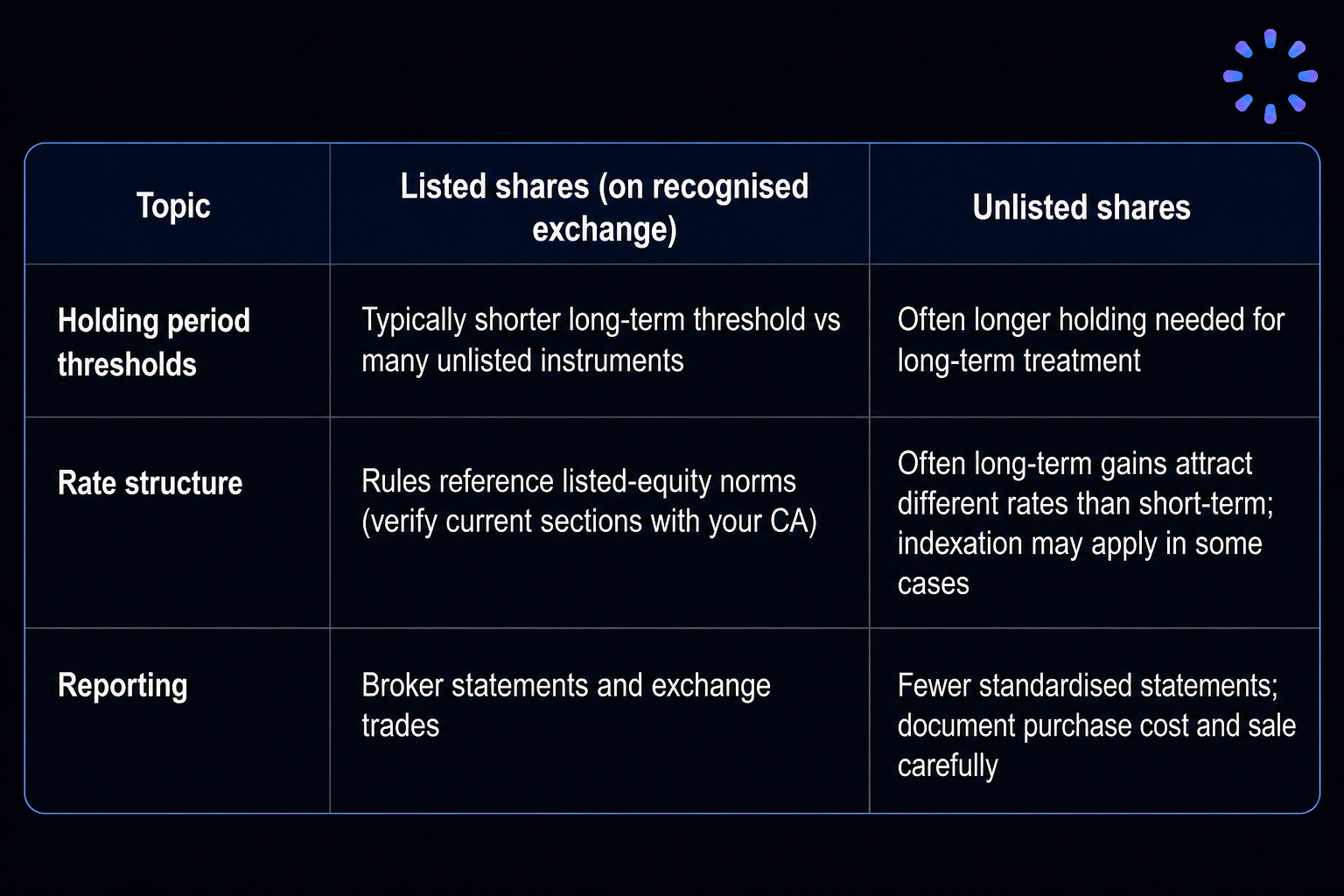
Exact rates, surcharges, and cess depend on residential status, holding period, and year of sale. Always reconcile with Annual Information Statement data.
Drawbacks and Risks to Model Early
Illiquidity: Options are not cash. Value may stay on paper for years.
Concentration: Your salary, career, and net worth can depend on one issuer.
Volatility: FMV can fall after you pay exercise costs and taxes.
Complexity: Leaver clauses, exercise windows, and secondary sale restrictions confuse people during stressful exits.
Governance gap: Option holders are not the same as large institutional investors; information rights vary.
Cash calls: Exercise may require cash upfront plus tax, before any sale proceeds.
If private-market investing is part of your diversification plan, use regulated platforms and read risk disclosures. Precize Care can help with account questions on the platform.
Conclusion
ESOPs can turn employment into meaningful ownership, but they are not a substitute for cash compensation or guaranteed wealth. The winners tend to be people who read the grant, understand vesting and exercise, budget tax, and avoid counting paper gains before a real liquidity path exists.
If your goal is to diversify beyond your employer’s equity and explore curated private-market opportunities, Precize offers a pathway to private equity and private credit products for investors who meet eligibility norms. Reserve access on the site if you want to explore what fits your profile. For more educational guides on investing and private markets, see the Precize blog. Stay updated with unlisted companies via our Precize Community.
Disclaimer: This article is for informational purposes only and is not tax, legal, or investment advice. ESOP rules, tax sections, and notifications change; confirm details with a qualified chartered accountant and your employer’s plan documents. Precize is not a stock exchange and is not advising you on your employer’s ESOP. Investments in private markets carry risks including illiquidity and loss of capital; read all documents carefully.