
When managing a partnership firm, understanding how partners’ capital is maintained is important. There are two common ways to record capital in a partnership: Fixed Capital Account and Fluctuating Capital Account. The difference lies in how changes in capital are recorded over time.
In this blog, we will discuss the differences between fixed and fluctuating capital accounts in detail. We will first explain what a fixed capital account is, followed by its advantages and disadvantages.
Then, we will cover what a fluctuating capital account is, along with its advantages and disadvantages. After that, we will highlight the differences between these two, making it easier for you to understand how each method works.
Let’s get started!
What is a Fixed Capital Account?
A fixed capital account is a capital account in a partnership where the initial capital contribution remains unchanged unless there is a permanent addition or withdrawal. All other transactions like drawings, interest, salary, and profit share are recorded separately in a current account, ensuring that the capital balance remains stable.
Now that you know what a fixed capital account is, let’s look at its advantages.
Advantages of a Fixed Capital Account

Opting for a fixed capital account provides a structured and stable financial approach for businesses. Here are its advantages:
Stable Capital Structure: The capital contributed by partners remains unchanged, allowing for better financial planning without frequent adjustments.
Clear Financial Records: All capital-related transactions are kept separate from personal withdrawals and interest, ensuring a well-organized accounting system.
Simplified Accounting: Since the capital balance does not change, maintaining records becomes easier, reducing accounting complexities.
Long-Term Stability: A fixed capital account supports steady business operations by preventing frequent fluctuations in capital.
Transparency in Partnerships: It ensures clarity in each partner’s contribution, minimizing conflicts and promoting trust among partners.
Now that you know the benefits, it’s equally important to understand the potential downsides of a fixed capital account.
Disadvantages of a Fixed Capital Account
While a fixed capital account provides stability, it also has some disadvantages if your business follows this. Here are a few important ones:
Limited Flexibility: Adjustments to the capital balance are restricted, making it difficult for partners to withdraw or add capital as needed.
Additional Accounting Effort: Since withdrawals and additional contributions are recorded separately, maintaining multiple accounts increases bookkeeping complexity.
Restricted Financial Overview: Separating personal and business transactions may make it harder to understand each partner’s financial position in the firm.
Not Ideal for Growing Businesses: Businesses that require frequent capital adjustments may find this structure too rigid for their evolving financial needs.
Time-Consuming Process: Any modifications to the capital account require formal approval and documentation, making changes slower compared to a fluctuating capital account.
With fixed capital accounts covered, it’s time to understand fluctuating capital accounts.
What is a Fluctuating Capital Account?
A fluctuating capital account is a type of capital account in a partnership where the capital balance changes based on transactions like profit share, interest on capital, drawings, and salary. All adjustments are recorded directly in the capital account, causing it to increase or decrease over time.
With the meaning of fluctuating capital accounts covered, let’s now look at the advantages of a fixed capital account.
Advantages of Fluctuating Capital Account
A fluctuating capital account offers several benefits, especially in partnerships where capital contributions and withdrawals change over time. Here are some advantages:
Simple Accounting: All transactions, including profit share, drawings, and interest, are recorded in a single account, reducing the need for separate records.
Real-Time Capital Balance: The capital balance updates automatically with every transaction, providing an accurate financial position for each partner.
Easy to Maintain: Since no separate current account is required, bookkeeping becomes straightforward, making it suitable for small and medium-sized businesses.
Flexible for Business Needs: Partners can withdraw or introduce capital as needed without requiring additional approvals or separate documentation.
Transparent Financial Records: As all partner-related transactions are recorded in one place, it ensures clarity in contributions, withdrawals, and profit distribution.
Before choosing this method, it’s important to understand the disadvantages that come with a fluctuating capital account.
Disadvantages of a Fluctuating Capital Account
While a fluctuating capital account offers flexibility, it also comes with certain disadvantages that can impact financial management. Here are some disadvantages of fluctuating capital account:
Unstable Capital Balance: The capital amount keeps changing due to transactions like profit share, drawings, and interest, making it difficult to maintain consistency.
Risk of Negative Balance: If a partner’s withdrawals or losses exceed their contributions and profits, the account may show a negative balance, affecting the firm’s financial standing.
Challenges in Financial Analysis: Frequent fluctuations make tracking long-term financial trends harder or assess a partner’s overall contribution and performance.
Lack of Segregation: Since all adjustments are recorded in one account, you may find it challenging to separate capital contributions from daily business transactions
Time-Consuming Adjustments: At the end of each financial year, you have to record many adjustments for profits, salaries, interest, and commissions in the capital account. This can be time-consuming and may lead to errors.
Now, let’s put fixed and fluctuating capital accounts side by side and see what sets them apart.
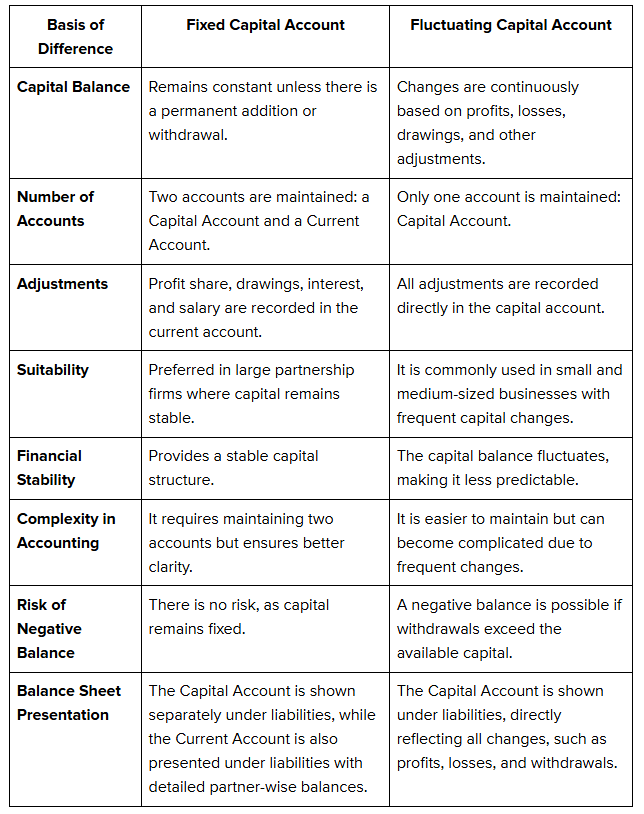
Differences Between Fixed Capital and Fluctuating Capital Accounts
Fixed and fluctuating capital accounts follow different accounting approaches in a partnership. The table below highlights their differences based on various factors.
Conclusion
Now that you understand the difference between fixed capital and fluctuating capital, it’s clear that each method has its own purpose. A fixed capital account ensures stability by keeping the capital unchanged, while a fluctuating capital account allows flexibility with continuous adjustments.
The right choice depends on your business needs, whether you prefer a structured financial approach or one that adapts to changing circumstances.
But if you want to explore investment opportunities, Precize is an alternative investment platform in India that offers access to private equity and private credit opportunities. With detailed research reports and comprehensive analyses, it helps investors make informed financial choices.
Reserve your access to Precize today and explore ways to diversify your portfolio!
Disclaimer
The information provided in this blog is for educational purposes only and should not be considered financial or accounting advice. Readers are encouraged to consult with a qualified financial expert or accountant before making any business decisions.