Eligibility Criteria After the Changes
If you want to claim the Income Tax Rebate under Section 87A for FY 2025-26 (AY 2026-27), here are the key conditions explained clearly:
Resident Status: You must be a resident individual of India. Non-Resident Indians (NRIs) cannot claim this rebate.
Before Cess Calculation: The rebate is applied to the total tax payable before adding the health and education cess.
Senior Citizen Eligibility: Residents aged 60 to 80 years can also claim the rebate, but individuals above 80 years (super senior citizens) are not eligible.
Automatic Application: The rebate is automatically adjusted when you file your ITR if you meet the required conditions.
Now that you know who qualifies, let’s walk through the process of claiming the rebate on your Income Tax Return.
5 Steps to Claim the Rebate
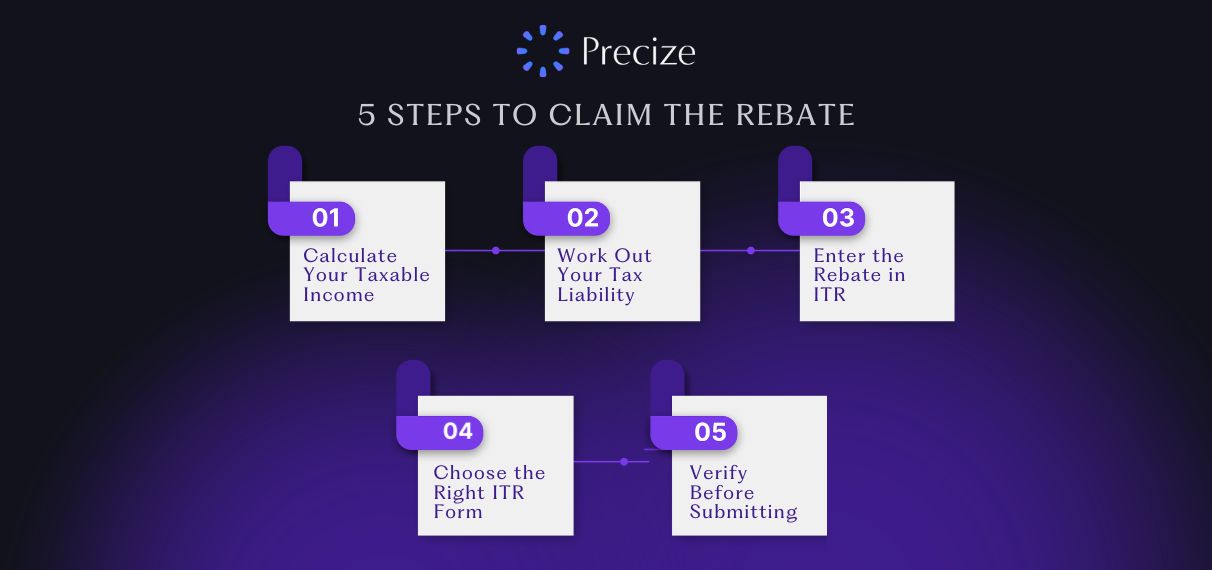
If you want to claim the Section 87A rebate for FY 2025-26, here are the 5 steps to follow:
Step 1: Calculate Your Taxable Income
Start by working out your taxable income under your chosen tax regime.
In the old regime, it included deductions like Section 80C, 80D, etc.
In the new regime, most deductions are not available, so income is calculated mainly after the standard deduction.
Step 2: Work Out Your Tax Liability
Apply the correct income tax slab rates to your taxable income. This will give you the gross tax payable before the rebate.
Step 3: Enter the Rebate in ITR
While filing your Income Tax Return (ITR), go to the Tax Computation section.
In the online portal or tax software, the rebate under Section 87A is usually auto-calculated.
If you are filling the form manually, you need to enter the eligible rebate amount yourself (up to ₹60,000 under the new regime or ₹12,500 under the old regime).
Step 4: Choose the Right ITR Form
Use ITR-1 if your income is from salary, pension, or one house property and you don’t have capital gains or carry-forward losses.
Use ITR-2 if you have capital gains or more complex income sources.
Step 5: Verify Before Submitting
Carefully check your tax summary to make sure the rebate has been deducted.
After learning the practical steps, it helps to be aware of typical misconceptions that could influence your rebate eligibility or expectations.
Common Misconceptions about Section 87A
When it comes to the 87A rebate, several misunderstandings often confuse taxpayers. Here are some of the most common ones explained:
Rebate Works on Tax, Not Income: Some confuse deductions or exemptions with a rebate. Section 87A directly reduces your final tax payable, not your taxable income.
Surcharge Not Applicable Within Limit: If your income is within the rebate limit, the surcharge is not added to your tax calculation.
Applied Automatically: You don’t need to apply separately. The rebate is usually adjusted automatically when you file your ITR if you meet the conditions.
Based on Taxable Income: Eligibility is checked after deductions are considered. It is your taxable income, not gross income, that decides if you can claim the rebate.
Conclusion
Section 87A continues to play an important role in giving tax relief to middle-class taxpayers in India. With the recent changes, you need to be careful about which income qualifies for the rebate, especially under the new tax regime, where it no longer applies to income taxed at special rates like long-term capital gains.
For most resident individuals, the rebate is still a valuable way to reduce tax liability, but it is important to declare income correctly and check how the rebate is applied in your ITR.
At the same time, building financial security also means looking beyond just tax rebates. Platforms like Precize make this easier by facilitating investments in private companies, where you can buy and sell unlisted and pre-IPO shares. It also opens access to unique global trade finance opportunities, helping you create a diversified portfolio with alternative fixed-income investments.
Unlock new growth opportunities, reserve your access and strengthen your portfolio today!
FAQs
Can the rebate be claimed on all types of income?
No. The rebate is available only on income taxed under the normal slab rates. From FY 2024-25 onward, it does not apply to income taxed at special rates such as LTCG under Section 112A. In some rulings, STCG under the new regime has been considered eligible, but this depends on case-specific interpretations.
How is the rebate calculated?
The rebate is the lower of the actual tax payable (before cess) or the maximum rebate limit allowed under your chosen tax regime.
Has anything changed recently in Section 87A?
Yes. Starting FY 2024-25, the rebate is no longer available on income taxed at special rates under the new regime. Income tax return (ITR) utilities now apply this rule automatically while calculating the rebate. In the old regime, however, the rebate still applies to total income, including income taxed at special rates.
Who can claim this rebate?
The rebate is only for resident individual taxpayers whose taxable income is within the specified limits of either the old or new regime. Non-resident individuals (NRIs) and other entities like HUFs are not eligible.
Is the rebate applied automatically in the ITR?
In most cases, the rebate is applied automatically when you file your ITR using online utilities. But if your income includes special rate components under the new regime, you should double-check, because the rebate applies only to slab-based income.
What should you keep in mind while filing taxes?
Always declare your income correctly and make sure the rebate under Section 87A is applied only to eligible income. Also, keep an eye on updates in the ITR utilities or official government clarifications so that your filing process remains smooth.
Disclaimer
The information provided in this blog is for educational purposes only and should not be considered as financial, investment, or tax advice. Tax laws are subject to change, and the applicability of the Section 87A rebate may vary based on individual income, chosen tax regime, and filing status. Readers are advised to consult a qualified tax professional or financial advisor for guidance specific to their personal situation.