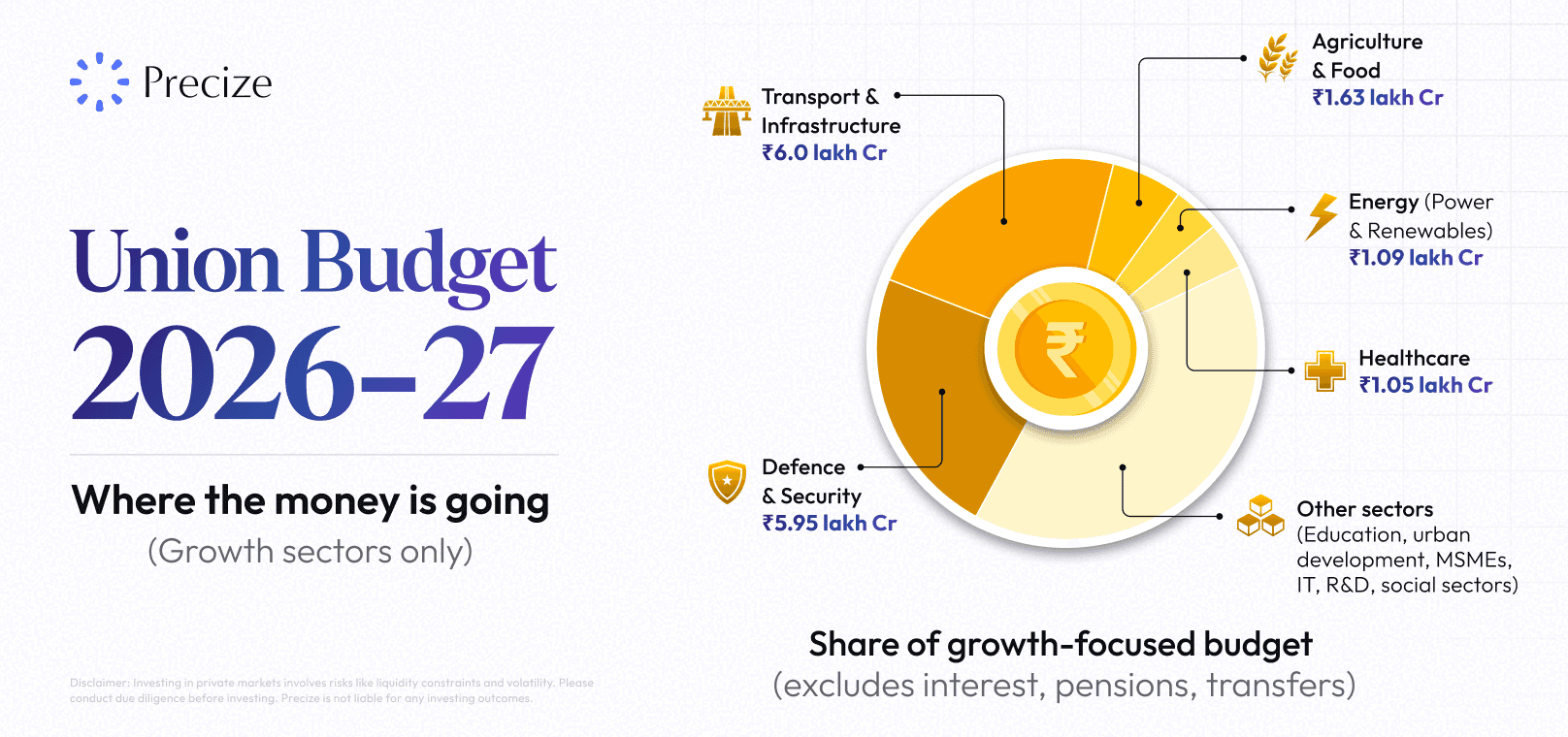
Union Budget 2026 - 27 is not just about line items. It is a directional signal of where great demand will be created over the next few years. When spending concentrates in a few sectors, it typically sets off a chain reaction: policy support, new tenders, vendor contracts, capacity additions, and, finally, greater revenue visibility for companies operating in those value chains.
This blog maps the big sectors in Budget 2026 - 27 and connects them to a few notable unlisted names that sit close to those sectors.
Why sector outlays matter more than announcements
Budget allocations matter because they are one of the few “top-down” indicators that can translate into real orders. But the impact is rarely immediate. In most cases, spending shows up in phases:
Intent and policy framing (rules, schemes, approvals)
Project pipeline creation (tenders, empanelment, contracting)
Execution cycle (procurement, commissioning, delivery)
Earnings visibility (repeat orders, operating leverage, scale)
So instead of only asking “which sector got a higher allocation?”, a better question is: which sectors are likely to see repeatable project flow and multi-year execution?
Sector snapshot: where the money is going
Defence and security -
Defence spending is increasingly geared toward Indian-made equipment, systems, and capabilities. This tends to benefit vendors that can meet quality, compliance, and delivery timelines, because defence procurement is high-trust and sticky once relationships mature.
Unlisted names tracked in this sector:
Goodluck Defence & Aerospace
Goa Shipyard
RRP S4E Innovation
Transport and infrastructure -
Infrastructure outlays usually have the clearest on-ground translation: EPC contracts, transmission build-outs, industrial servicing, project management, and component supply. This sector also creates second-order demand (materials, logistics, industrial services).
Unlisted names tracked in this sector:
Sterlite Grid 5 / Sterlite Electric
Delta Galaxy Engineering Services
Camac Commercial Company
Energy (power and renewables) -
Power, grid stability, and renewables continue to sit at the centre of India’s long-duration capex story. This sector is not only about generation. It includes evacuation, transmission, components, and industrial decarbonisation.
Unlisted names tracked in this sector:
Electrosteel Castings
Vikram Solar
Studds Accessories
Agriculture and food -
Agriculture allocations matter when they push the ecosystem beyond subsidies into productivity and value addition. Over time, this can expand demand for agri-inputs, trading infrastructure, and market linkage platforms.
Unlisted names tracked in this sector:
Indian Potash
NCDEX
Mohan Meakin
Healthcare -
Healthcare spending tends to spill into two places: delivery capacity (hospitals, diagnostics) and research-led infrastructure (trials, data, specialised services). This sector also benefits companies positioned around scale and compliance.
Unlisted names tracked in this sector:
Lakeshore Hospital & Research Centre
Veeda Clinical Research
API Holdings (PharmEasy)
The enabling layer: missions and funds that can shape the private market
Alongside sector allocations, Budget 2026 also emphasises “ecosystem building” through targeted missions and funding programs. These often create opportunity pockets that do not show up immediately in headline GDP narratives.
A few notable focus areas include:
SME Growth Fund (Rs. 10,000 crore) aimed at growth capital for tech-enabled SMEs and scaleups
Self-Reliant India (SRI) Fund boost (Rs. 2,000 crore) to sustain risk capital access for early-stage and micro startups
Biopharma Shakti (Rs. 10,000 crore) to support biotech, biosimilars, and AI-led drug discovery startups
Rare Earth corridors in four states to unlock advanced materials and clean-tech opportunities
Semiconductor Mission 2.0 for chips, equipment, and full-stack Indian IP
Rs. 40,000 crore for electronic components to strengthen hardware, IoT, and EV ecosystems
Rs. 20,000 crore for carbon capture and a High-Tech Tool Rooms Network to strengthen advanced manufacturing capacity
If you track private markets, these “enabling layers” matter because they often create:
Vendor ecosystems (component suppliers, specialised manufacturers)
Compliance and research infrastructure (clinical research, biotech tools)
Deeptech commercialisation pathways (semiconductors, advanced materials)
How to read this list without over-interpreting it
A budget is a direction setter, not a guaranteed earnings statement. The practical way to use these sectors is to treat them as probability signals:
Sectors with multi-year project cycles can create more repeatable order flow
Ecosystem missions can pull forward capacity building in specific supply chains
Execution still depends on tendering speed, regulatory clarity, and implementation quality
Conclusion
Budget 2026 - 27 strengthens five broad demand lanes: defence, infrastructure, energy, agriculture, and healthcare. Alongside that, the budget’s ecosystem push around SMEs, semiconductors, electronic components, biotech, rare earths, and carbon capture points to where new supply chains may deepen in India over the next few years.