
Investing in shares can be a lucrative way to build wealth, but it's necessary to understand the capital gain tax on shares in India when you sell your investments for a profit.
Capital gains tax is charged on the profits made from selling shares, and how much you pay depends on how long you've held the shares. In India, these taxes are split into short-term capital gains (STCG) and long-term capital gains (LTCG), each subject to different rules.
In this blog, we’ll break down the basics of capital gains tax, the key differences between short-term and long-term capital gains tax, and see how to calculate your tax liabilities.
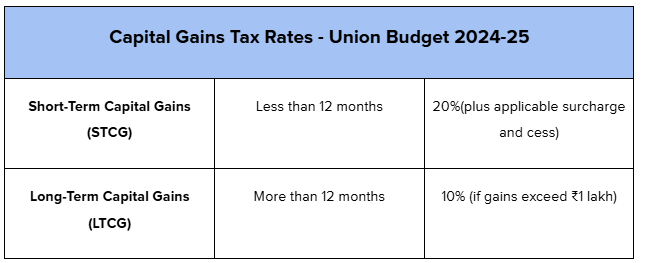
Capital Gains Tax Rates - Union Budget 2024-25
TL;DR
STCG (shares held less than 12 months) taxed at 20% plus surcharge and cess.
LTCG (shares held more than 12 months) taxed at 10% on gains exceeding ₹1 lakh; gains below ₹1 lakh are exempt.
Indexation benefit applies for shares held over 36 months to reduce taxable LTCG.
Dividends are taxed separately according to income slabs; up to ₹10 lakh is tax-free for residents.
Tax planning tips: stagger sales, maximize exemptions, invest in tax-efficient funds, and review portfolio regularly.
What is Capital Gains Tax?
Capital gains tax is the tax levied on the profit made from selling an asset, such as shares. When you sell shares for more than what you paid for them, the profit is subject to capital gain tax on shares in India.
This tax is calculated based on the difference between the selling price and the purchase price of the shares.
However, not all capital gains are taxed the same way. The tax rate depends on how long you hold the shares before selling them. In India, capital gains are classified into two categories:
Short-Term Capital Gains (STCG): Profits from shares held for less than 12 months.
Long-Term Capital Gains (LTCG): Profits from shares held for more than 12 months.
The tax rates for STCG and LTCG differ, and understanding these distinctions goes a long way toward effective tax planning.
Short-Term Capital Gains (STCG) on Shares
When you sell shares that you've held for less than 12 months, the profit you make is classified as Short-Term Capital Gains (STCG). The key takeaway here is that STCG is taxed at a higher rate because of the shorter holding period.
In India, the tax rate on STCG for listed shares is 20% (plus applicable surcharge and cess), but there are a few important things to keep in mind:
Flat Tax Rate: The 20% tax rate is fixed, regardless of your income level or tax bracket. This makes STCG more predictable than other forms of income that may be taxed at varying rates based on your earnings.
Securities Transaction Tax (STT): For the STCG tax to apply at the 20% rate, the transaction must be subject to Securities Transaction Tax (STT), which is automatically deducted by the stock exchange when you sell the shares.
How to Calculate Short-Term Capital Gains (STCG)

This relatively high tax rate for short-term sales encourages investors to consider their holding period carefully, especially for those looking to minimize taxes.
Long-Term Capital Gains (LTCG) on Shares
When you hold shares for more than 12 months before selling them, any profit you make is considered Long-Term Capital Gains (LTCG). The key benefit of LTCG is that it's taxed at a more favorable rate than short-term gains, making it an attractive option for long-term investors.
In India, the tax rate on LTCG from the sale of listed shares is 10%(plus applicable surcharge and cess), but only if the gains exceed ₹1 lakh in a financial year.
Exemption Limit: If your total LTCG exceeds ₹1 lakh, you’ll be taxed at the 10% rate on the amount above this threshold, without the benefit of indexation. However, if your gains are below ₹1 lakh, they are completely exempt from tax.
Indexation Benefit: For shares held for more than 36 months, you can use indexation to adjust the purchase price, which helps reduce the taxable capital gain by accounting for inflation. This means you pay less tax on the same gain.
How to Calculate Long-Term Capital Gains (LTCG)
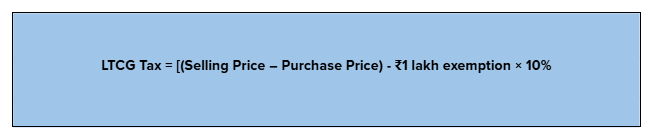
This favorable tax treatment on long-term investments encourages holding shares for an extended period. Understanding the rules around LTCG allows you to make informed decisions on when to sell shares and how to optimize your tax liabilities.
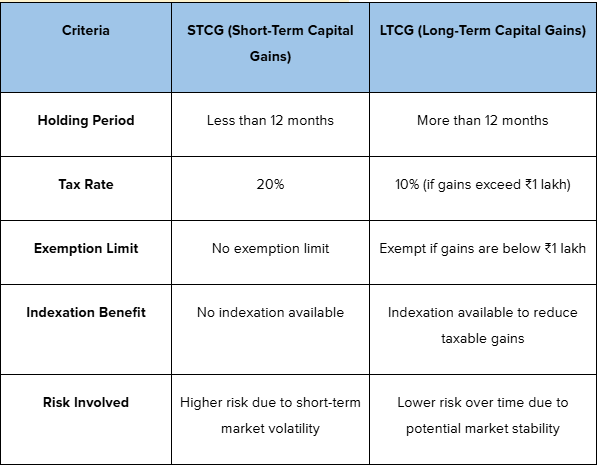
Key Differences Between STCG and LTCG
Should You Pay Tax on Dividends?
While capital gain tax on shares in India applies to the profit made from selling shares, it's important to note that dividends are taxed separately in India and do not fall under the capital gains tax category.
Dividends received from Indian companies are subject to Income Tax and must be reported in your income tax returns.
Tax Rate on Dividends: Dividend income is taxed according to your individual income tax slab.
For resident individuals, dividend income of up to ₹10 lakh is tax-free. The amount exceeding ₹10 lakh is taxable at 10%.
For non-resident individuals or foreign companies receiving dividends, the tax rate is typically 20% on the total dividend income (this rate may vary depending on the tax treaty with the respective country).
With the right strategy, such as optimizing your dividend income or planning your overall income, you can minimize the tax impact and boost the returns on your investments.
Tax Planning Tips for Investors

Here are some advanced and actionable tips specifically designed to help you manage capital gains tax efficiently:
Sell to Maximize Exemptions: If your LTCG is nearing ₹1 lakh for the year, consider holding onto your shares until the following financial year. This way, you can benefit from another ₹1 lakh exemption limit.
Capital Gains in Staggered Sales: Instead of selling a large number of shares at once, consider selling in smaller batches. This can help manage your total taxable gain across multiple years and prevent crossing the ₹1 lakh LTCG exemption limit in a single year.
Invest in Tax-Advantaged Assets: Explore Exchange-Traded Funds (ETFs) or Index Funds that qualify for favorable tax treatment. These instruments often offer a more tax-efficient structure compared to actively traded shares.
Review Your Asset Allocation: Reassess your portfolio regularly to determine which assets should be sold for capital gains and which should be held for a longer duration to qualify for LTCG benefits.
Following these strategies can effectively manage your capital gains tax and maximize your investment returns. Careful planning and staying informed will help you make the most out of your investments while minimizing tax liabilities.
Exploring Gains from Unlisted Shares
The market for unlisted shares has experienced substantial growth, with monthly trading volumes rising significantly from $50–60 million in 2023 to $300 million in 2024.
This sixfold increase in trading activity highlights the growing interest in private market investments, particularly in unlisted shares. This remarkable growth in both trading volumes and valuations reflects the increasing appeal of unlisted shares as a viable investment class.
Platforms like Precize are well-positioned to take advantage of this trend, offering investors access to a broader range of opportunities in these high-growth markets.
Diversify Your Portfolio Using Precize

Precize is an alternative investment platform that facilitates the buying and selling of unlisted (pre-IPO) shares in India. It offers investors access to private market opportunities, enabling transactions in unlisted shares and global trade finance investments.
How Does This Work?
Precise offers a simplified three-step process for investing in unlisted companies:
Select & Research: Choose the company of interest and conduct thorough research.
Place an Order: Add funds and place your investment order.
Receive Shares: Shares are deposited directly into your depository account.
Key Features of Precize
Access to Unlisted Shares: Research and invest in unlisted shares at competitive prices, simplifying the process of buying and selling these shares online.
Global Trade Finance Investments: Beyond equity shares, Precize offers opportunities in global trade finance, allowing investors to participate in transactions with potential stable returns over short periods.
Analytics and Research Reports: Investors have access to detailed analyses, including balance sheets, cash flow statements, income statements, and industry comparisons, aiding informed investment decisions.
As of the latest updates, long-term capital gains on the sale of pre-IPO shares held for more than 24 months have been reduced from 20% to 12.5%, making such investments more attractive.
If you're looking to diversify your portfolio or invest in high-growth unlisted stocks before they go public, Precize is the best way to move forward!
Explore more investment opportunities in unlisted shares and global trade finance. Reserve Access to start today.