The taxation of capital gains has undergone several changes over the last few years, with significant updates made in the Union Budgets of 2018, 2024, and 2025. These changes have impacted the way long-term capital gains (LTCG) and short-term capital gains (STCG) are taxed, particularly in the case of listed and unlisted assets. As Budget 2025 has not introduced any new changes to the tax rates or holding periods for determining LTCG and STCG, the rules from Budget 2024 continue to apply for the financial year 2025-26 (Assessment Year 2026-27).
Here’s a simplified breakdown of the latest tax rates and holding periods for various assets under the existing framework: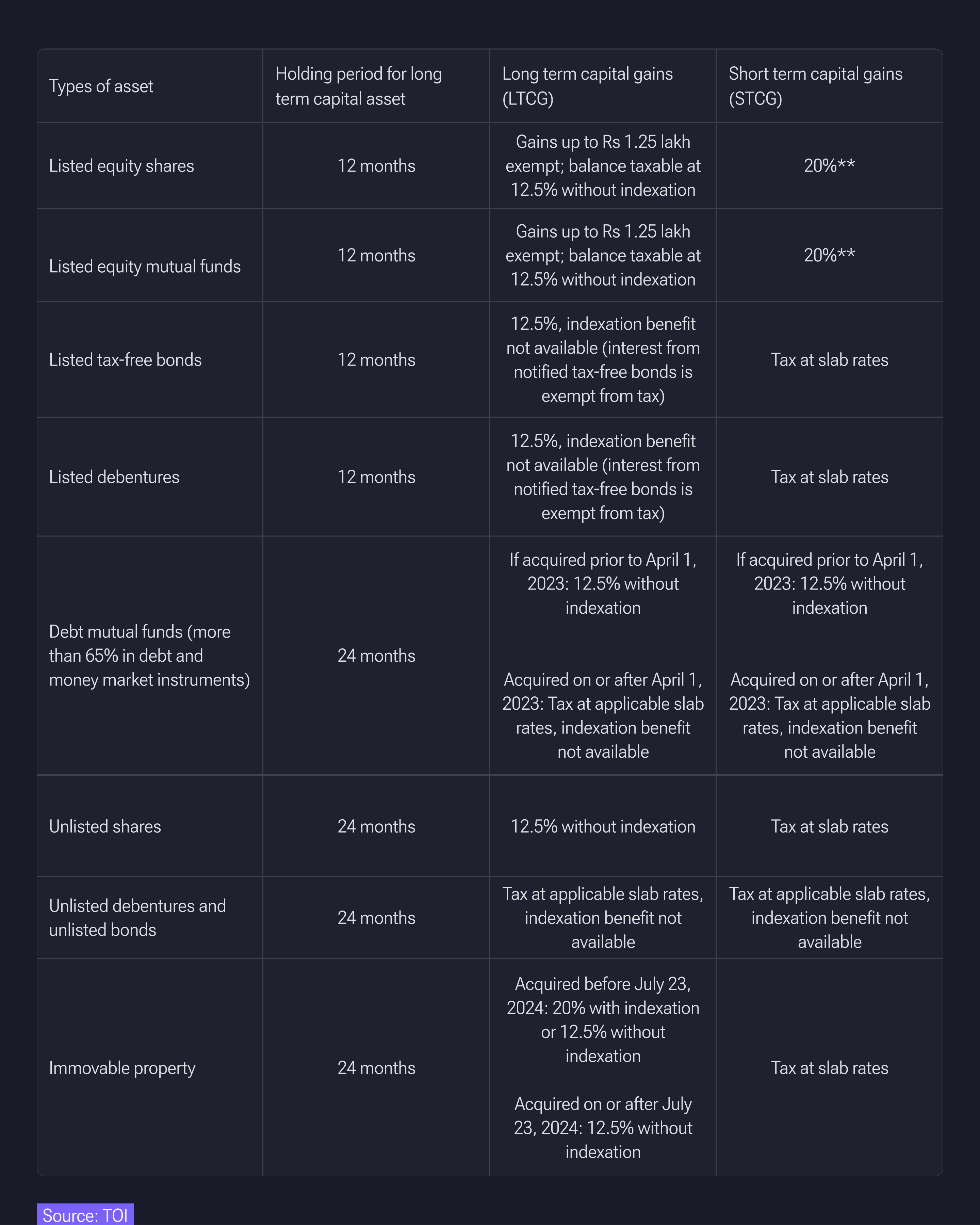
Key Changes in Budget 2025
One of the notable updates in Budget 2025 is the removal of the Section 87A tax rebate on capital gains. This means that the rebate is not available on any capital gains income from equities, whether short-term or long-term. The tax rebate was previously available for certain types of income under the old regime, but with the latest budget proposals, it will no longer apply to capital gains taxed at special rates (such as STCG and LTCG from equities).
According to tax expert Rahul Garg, “The slab benefit has significantly increased under the new tax regime, but the bar on rebate benefits under section 87A for special-rate income such as capital gains and speculative income from lotteries still remains.”
Understanding Tax Rates and Special Provisions
STCG: Short-term capital gains from equity transactions (subject to Section 111A) are taxed at 15%, provided that the Securities Transaction Tax (STT) is paid on both the purchase and sale of shares.
LTCG: Long-term capital gains exceeding ₹1 lakh from the sale of equity shares are taxed at 10% without the benefit of indexation, provided that the STT is paid.
For those involved in other assets such as immovable property, unlisted shares, or debt funds, the holding period and tax treatment may differ. While listed equity and mutual funds are subject to more straightforward taxation with significant exemptions, other assets like unlisted shares or immovable property can involve more complex tax implications, especially regarding indexation and the applicable slab rates for STCG.
Conclusion
The key takeaway from Budget 2025 is that the taxation of capital gains for the coming financial year will remain consistent with the previous budget. This means the holding periods and tax rates for LTCG and STCG for different asset classes, including listed and unlisted shares, mutual funds, debt funds, tax-free bonds, and immovable property, will continue under the same structure. Investors should be aware of the updated rules, particularly around the Section 87A rebate, which no longer applies to capital gains, and the changes that have impacted debt funds acquired after April 2023.
By understanding these tax implications and making informed investment decisions, individuals can optimize their returns while staying compliant with the latest regulations.