
What does CIAL FY26 passenger growth mean?
CIAL FY26 numbers describe throughput, not a profit-and-loss statement by themselves. Still, they answer a practical question: did Kochi airport keep climbing after prior years of strong recovery?
Press summaries indicate four consecutive years above the 10 million passenger mark (using international units as a cross-check on the crore milestone). A low single-digit growth rate in a noisy global environment usually points to stable base demand rather than a one-off festival bump.
If you want the wider policy picture on runways, routes, and capacity, the Ministry of Civil Aviation, Government of India publishes sector updates that help situate any single airport’s trend against national targets. For official video briefings, use the ministry’s video gallery.
Cochin International Airport passenger traffic (FY26)
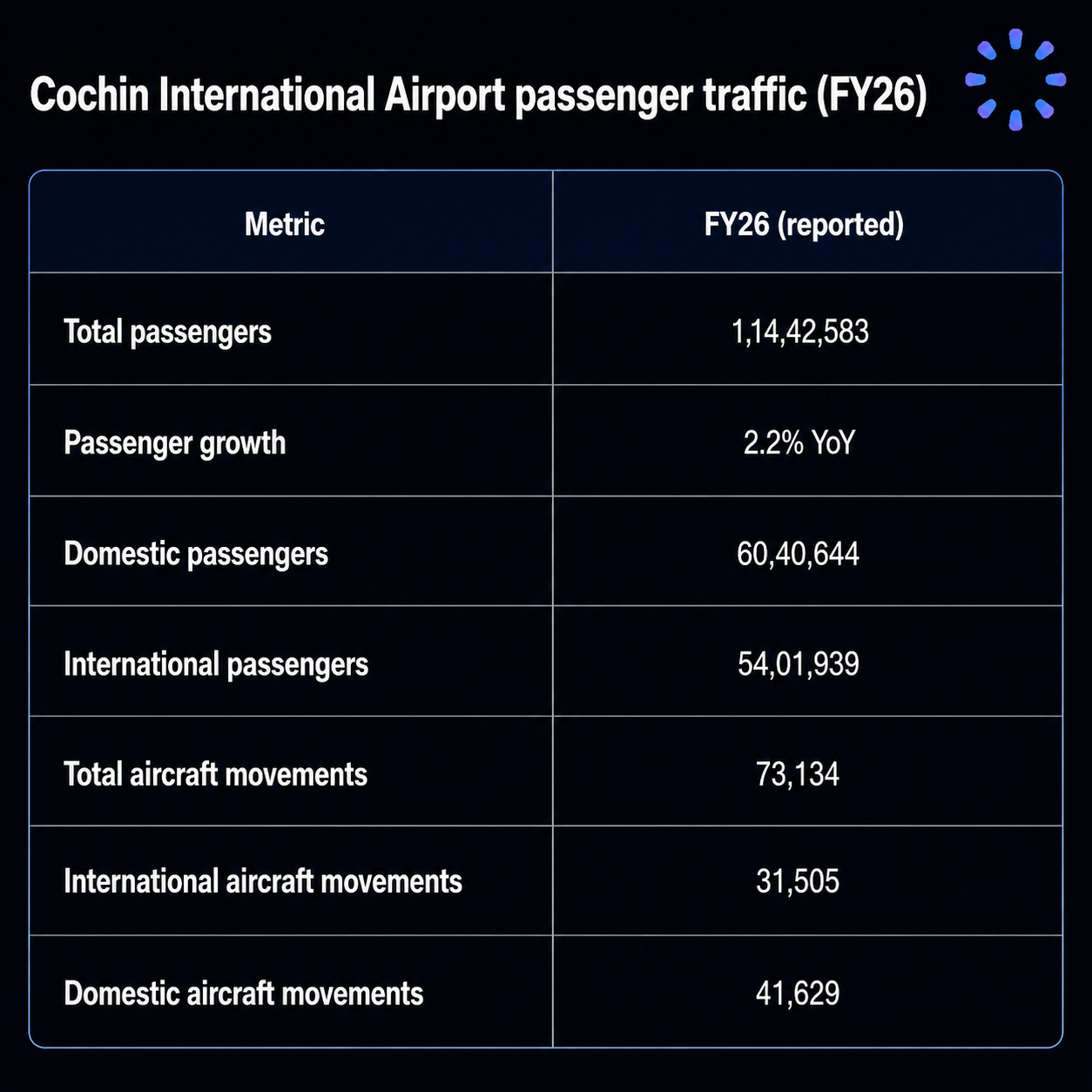
Source note: Aggregated from business press quoting CIAL. For audit-grade work, reconcile to official CIAL communications on CIAL and any statutory filings applicable to the entity you analyse.
Why growth still mattered despite headwinds
Demand held up when supply and geopolitics wobbled
Several forces could have flattened traffic: airline network changes, Middle East geopolitical tension affecting Gulf connectivity, international schedule disruptions, and cost inflation across aviation inputs.
That Cochin International Airport passenger traffic still grew, even modestly, supports three working ideas investors often test against data:
Kerala’s outbound and return travel tied to work abroad is recurring, not optional, for large cohorts of households.
Inbound tourism and inter-city business within India continue to add domestic seats.
A balanced domestic and international mix can smooth shocks when one region or carrier cuts frequencies.
Kochi as Kerala’s aviation hub
Traffic concentration and network depth
Kochi has been described in reporting as carrying a dominant share of Kerala’s passenger throughput compared with other state airports. That concentration matters for retail, hospitality, ground transport, and cargo planning, because a hub’s peak months set staffing and inventory cycles far beyond the terminal fence.
For South India connectivity, Kochi also competes as a regional international gateway. When international movements stay high relative to domestic, it signals widebody and narrowbody banks that feed transfer itineraries, not only point-to-point Kerala demand.
Infrastructure, processing tech, and the “CIAL 2.0” narrative
CIAL leadership has publicly tied growth to modernised infrastructure, faster passenger processing, and technology-led operations. The CIAL 2.0 framing is essentially a capacity and experience upgrade path: the same runway minutes become more productive if dwell times fall and baggage and security flows stabilise.
Across India, passenger growth is pressing every AAI and PPP airport to justify capex with measurable service levels. That is why serious infrastructure analysis pairs passenger charts with capex schedules, regulatory charges, and aeronautical versus non-aeronautical revenue mix wherever disclosed.
Cargo: The parallel story investors should not ignore
CIAL also reported strong cargo growth in FY26, with volumes above 72,000 metric tonnes and roughly 10% year-on-year expansion in press summaries. International cargo reportedly accounted for nearly three-fourths of the total, which aligns with export lanes for pharmaceuticals, perishables, and industrial shipments, plus e-commerce air feeder demand.
If your research stack spans logistics and consumer, cargo share is a cross-check on passenger glamour metrics. Busy bellies and freighters often track SME export intensity, not only tourist seasons.
How CIAL fits in the India airports map
Metro airports such as Delhi, Mumbai, and Bengaluru lead absolute passenger tables. CIAL remains a useful non-metro benchmark because it combines high international share, tourism, and NRI-linked travel in one catchment.
That combination helps explain why Kerala’s aviation growth shows up in Kochi first: deeper international banks and statewide road and rail spokes convert O and D traffic into repeatable monthly volumes.
What this means if you invest in India’s private markets
Separate “travel buzz” from “investible exposure”
Airport headlines are easy to read as a single equity story. In practice, your due diligence path depends on the exact instrument:
Listed airport operators and conglomerates with aviation assets move on regulatory tariffs, capex cycles, aero revenue, and macro rates.
Unlisted or pre-IPO exposure, when available, still requires the same discipline: who owns the economic interest, what are liquidity terms, and what filings exist?
If you are exploring unlisted shares and want a structured starting point, the Precize Screener helps you discover companies with available research context. For broader explainers on how private-market access works in India, browse the Precize blog and use the FAQs if process questions come up.
Institutional teams evaluating larger tickets can route questions through the Precize institutions portal.
Bottom line
Cochin International Airport Limited continues to illustrate how a non-metro Indian gateway can combine international depth, domestic scale, and cargo growth in one footprint. CIAL FY26 adds another year of evidence that Kerala’s aviation cluster is less a short post-pandemic spike and more a steady market, even when the world around aviation looks uneven.
If you are mapping sector trends to your own portfolio decisions, treat this as a macro and logistics signal worth pairing with filings, tariffs, and company-level data, not a standalone thesis.
Next steps on Precize: if you want help with onboarding or orders, use Precize Care. If you want to share Precize with people who follow India airport infrastructure and related sectors, see the Precize referral program.
Disclaimer: This content is for informational purposes only and does not constitute investment advice. Investing in unlisted shares involves risks including illiquidity and potential loss of capital. Consult a qualified financial advisor before making investment decisions. Precize is not a stock exchange and is not regulated by SEBI. Past performance does not guarantee future results. This article is not a recommendation to buy or sell any security related to CIAL or any other issuer. Do your own research before investing.