Valuation and issue size: How large is the Zepto IPO?
Published figures cluster around a $1.2 billion order of magnitude for the overall raise; Indian media frequently translate that into roughly ₹8,000 crore to ₹12,000 crore, sometimes higher when offer-for-sale components are included. Valuation implied by the issue will only lock when price band and share count are set.
Until then, avoid anchoring to private-market rumors alone. The listing process will surface peer comparisons (including Blinkit parent Zomato's quick-commerce disclosure where relevant and Swiggy's platform economics) and force transparency on share-based compensation, related-party deals, and funding history.
The numbers investors keep circling: FY25 growth vs FY25 losses
Why 129% revenue growth and a 177% loss widening land in the same sentence
Based on FY25 figures widely summarized in business press, Zepto's total income reportedly grew about 129% year-on-year, while net loss increased about 177% compared with FY24. FY24 coverage had often highlighted revenue more than doubling and loss metrics improving as a share of revenue versus FY23, so FY25 is where the bull-bear debate sharpens: scale is up, but absolute losses have climbed again in the summaries investors read today.
That is the honest question a financial analyst would pose on page one: Is this the temporary cost of winning share in a land-grab phase, or a signal that quick commerce still buys growth with heavy subsidies and capex? The answer lives in contribution margins by city cluster, cadence of store rollout, and whether repeat rates justify fixed cost per dark store.
What public investors will scrutinise beyond GOV
Contribution margin per order after variable costs (delivery, payments, promos).
Orders per dark store per day and revenue per store, not only national totals.
Retention and frequency, because users can hop to Blinkit or Swiggy Instamart for deals.
Cash burn and path to profit, including working capital and inventory churn.
Corporate governance items that filings spell out: promoter structure, related parties, ESOP load.
Bull case vs Bear case: "Should I invest in the Zepto IPO?"
This section is not advice. It frames how subscribers often think through subscription decisions.
Bull case themes
Category habit formation in top metros: Convenience delivery is becoming a recurring spend, not a novelty.
Operational leverage if order density rises faster than fixed cost per dark store.
Balance sheet optionality from a primary raise that extends runway to outlast weaker peers.
Brand and execution reputation: If Zepto is seen as a top-two operator, public listing liquidity can reward scale leaders.
Bear case themes
Loss expansion alongside revenue growth raises questions about pricing power and promo dependence.
Peer pressure from Swiggy Instamart and Blinkit can compress margins during promotional cycles.
Regulatory and local operating risk (zoning, FDI angles where relevant, gig-worker rules) can shift costs.
Listed-market discipline: volatility and quarterly comparisons punish unclear paths to profit.
Many investors will hold both lists at once. Your task is to match them to your horizon, liquidity needs, and tolerance for new-age listing volatility.
DRHP watch-list: What to read before you subscribe
When the Zepto DRHP hits SEBI filings, prioritize:
Risk factors specific to quick commerce, inventory spoilage, and discount reliance.
Use of proceeds split between fresh issue and offer for sale (OFS); OFS cash goes to selling shareholders, not the company's balance sheet.
Related-party transactions and founder or investor stakes post listing.
Financial statements and notes: revenue recognition, promotional accounting, lease commitments for dark stores.
Share-based payment expense and dilution path from ESOPs.
Industry and competition sections mentioning Blinkit, Swiggy Instamart, and other platforms.
Corporate history items such as domicile moves or restructuring that affect how domestic investors view the story.
If you track pre-IPO exposure elsewhere, compare those disclosures with this filing line by line rather than relying on secondary summaries alone.
Zepto IPO vs Unlisted Exposure: What changes after listing
Some readers discover Zepto through unlisted shares chatter first, then meet the same company again as a Zepto IPO candidate. The comparison points are simple but easy to blur.
Unlisted positions sit in private-market plumbing: negotiated prices, uneven liquidity, and disclosures that depend on what sellers and platforms publish. Listed shares trade on the exchange with continuous price discovery, broader participation, and recurring filings once Zepto is public.
That does not make one path “better.” It makes the risks different. Pre-IPO holders often care about capital gains timelines, lock-ins, and whether they can exit before volatility spikes. IPO subscribers care about price band fairness, post-listing drift, and whether FY25-style losses look acceptable against growth when the whole market can react in a session.
If you use Precize to study unlisted companies, treat the Zepto IPO DRHP as the canonical upgrade to second-hand summaries: use it to sanity-check what you already believe about scale, burn, and governance. When the issue opens, align ticket size with liquidity needs and keep dry powder for staggered buying if your strategy allows it.
Sector lens: beyond Zepto
If Zepto demonstrates improving unit economics with credible disclosure, confidence in quick commerce as a long-term category can rise. If profit visibility stays distant, the stock may still trade on momentum while long-only investors stay cautious. Either outcome feeds back into startup valuations and how retail reads India startup IPO 2026 headlines.
For more context on filings and sector mechanics, see Precize's companion piece Zepto IPO 2026: DRHP filing, financials, outlook.
Risks to keep visible even after SEBI clearance
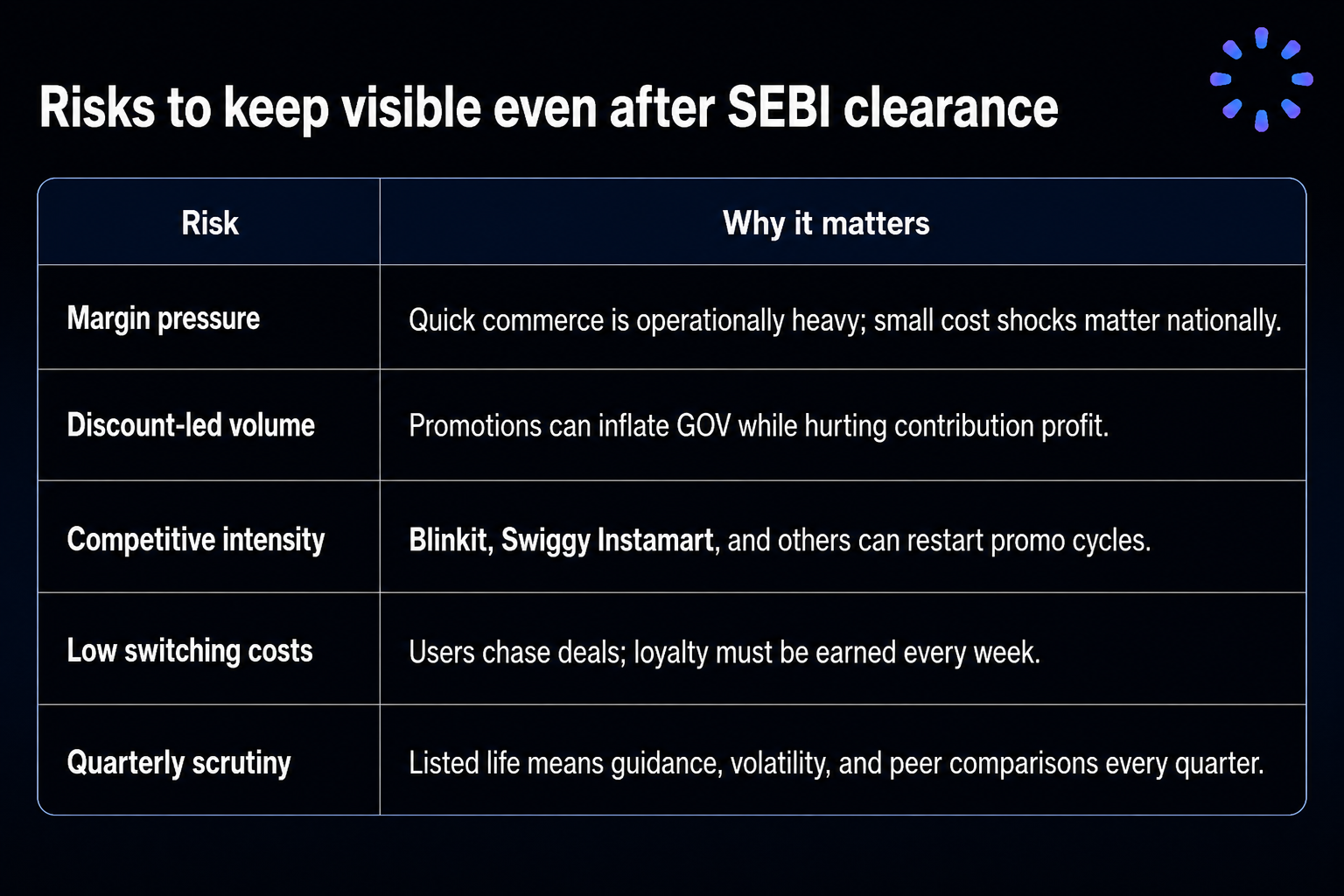
Framing Zepto as retail infrastructure plus logistics, not only a startup narrative, matches how serious shareholders build models.
Bottom Line
SEBI approval is a process milestone for the Zepto IPO, not a fairness opinion on price. The investment debate should center on whether FY25-style growth can eventually convert into controlled losses and transparent contribution margin progress at the city-cluster level. Until the DRHP and price band land, the disciplined move is to separate regulatory clearance from investment merit, then judge the filing on its own terms.
For more on how we think about private and pre-IPO research, browse the Precize blog. General platform questions are covered in our FAQs. To stay updated on unlisted companies, join Precize Community.
Disclaimer: This article is for informational purposes only and is not investment, legal, or tax advice. IPO and unlisted investing involve risk of loss and illiquidity. Numbers and dates are summarised from public commentary and draft filings and may change; always read the latest prospectus, SEBI filings, and exchange notices. Precize is not a stock exchange and is not a substitute for professional advice.