For investors, the key question is not just "when will Zepto list?" It is whether Zepto can turn its 10-minute delivery model, dark-store network, and high order frequency into a business with durable margins.
This article is for information only. It is not a recommendation to buy or sell Zepto shares, apply for an IPO, or invest in any unlisted shares.
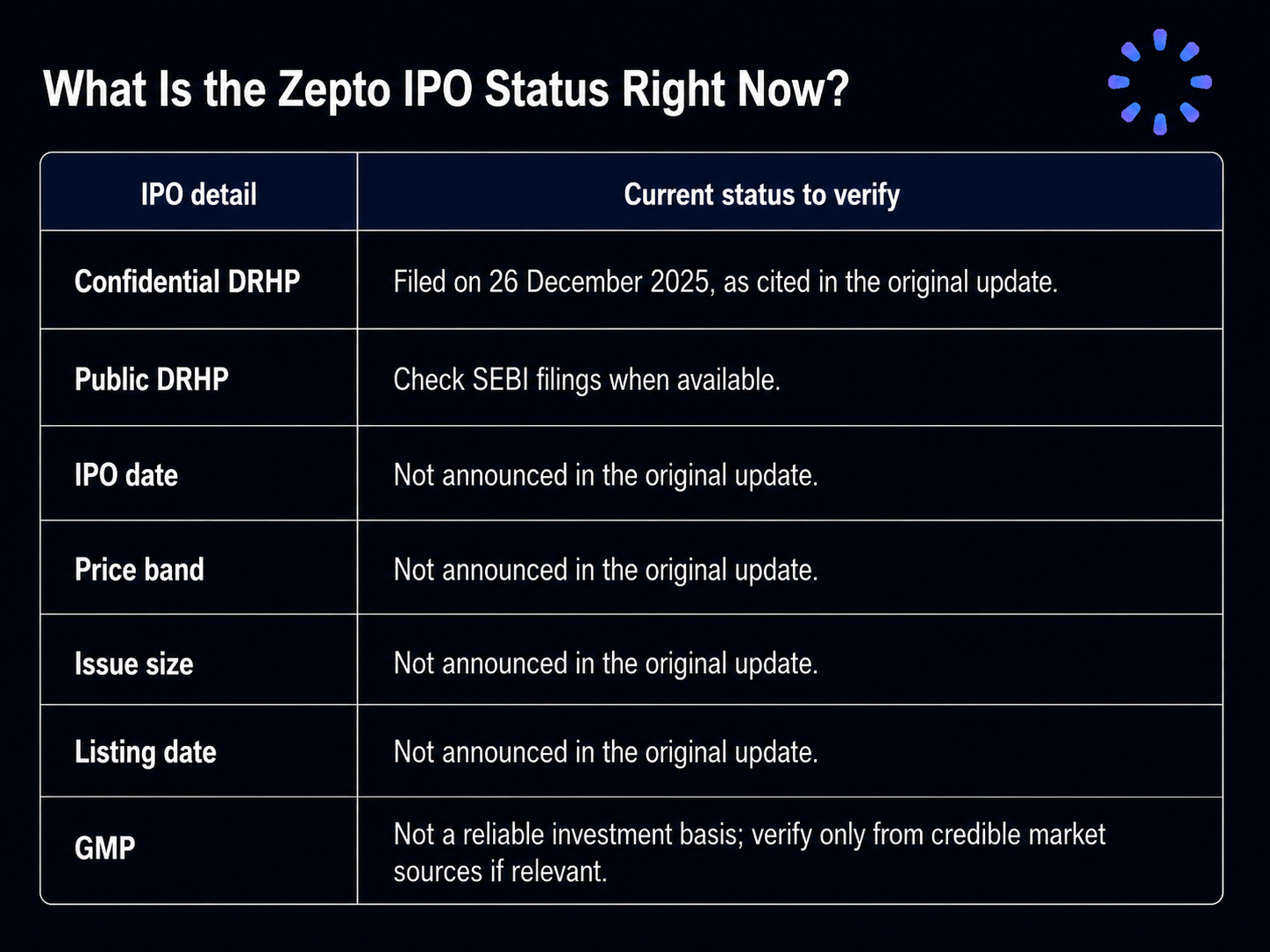
What Is the Zepto IPO Status Right Now?
Zepto is in the IPO preparation stage. The company filed a confidential Zepto DRHP with SEBI on 26 December 2025, according to the original filing update.
A confidential DRHP allows a company to begin regulatory review without immediately publishing the full offer document for public review. This also means the full DRHP may not be available to retail investors at the confidential filing stage. The public version, price band, issue size, use of proceeds, and full risk factors become more important as the IPO moves closer to launch.
As of this rewrite on 25 May 2026, readers should treat any media update on approval, timing, or issue size as provisional until it is matched against the latest SEBI-hosted documents and the company's final IPO prospectus.
About Zepto
Zepto is an Indian quick commerce company known for delivering daily essentials in roughly 10 minutes through a hyperlocal fulfilment network.
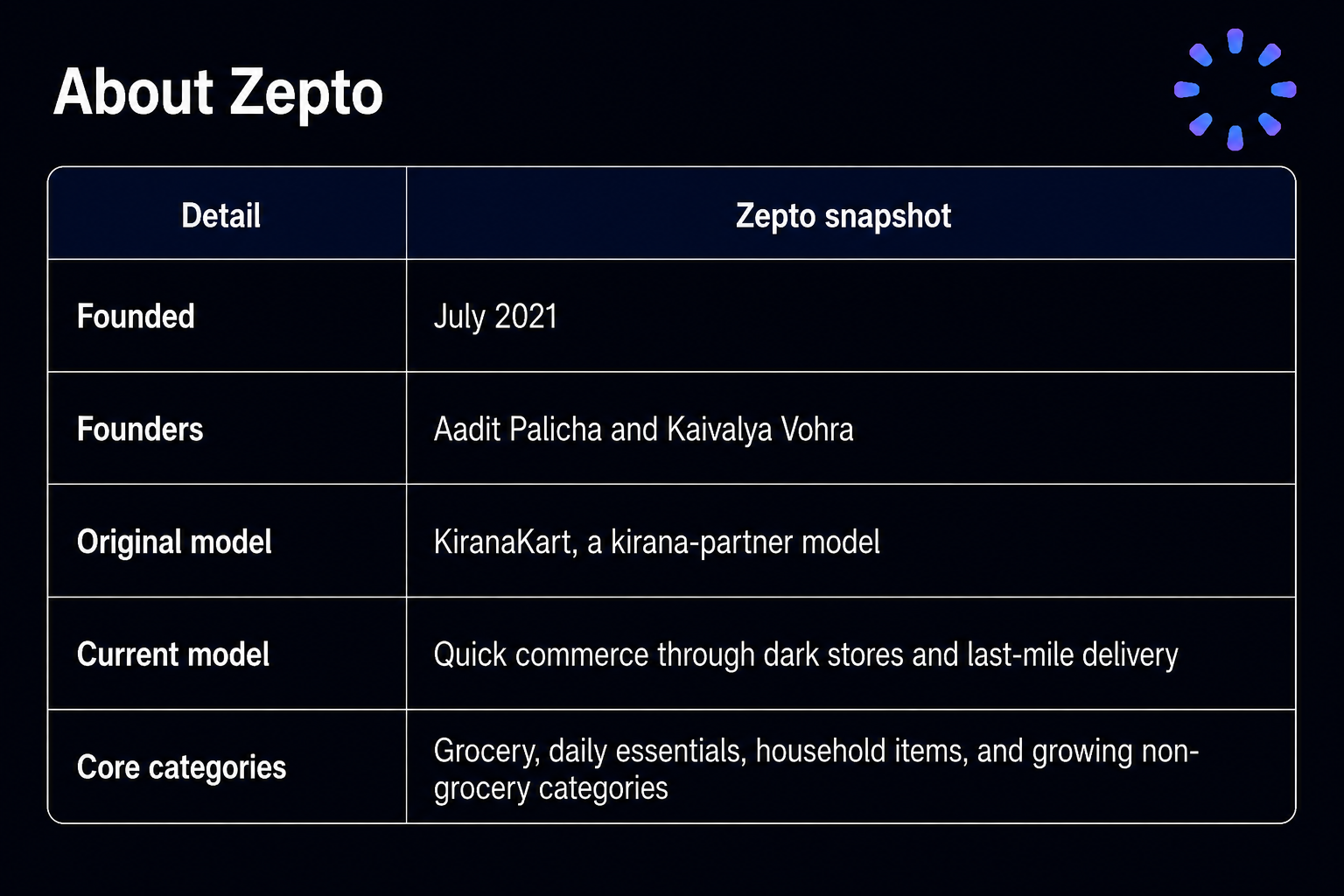
Zepto's pitch is built around speed, availability, and repeat use. Instead of operating like a traditional e-commerce marketplace with longer delivery timelines, the company places inventory close to customers and fulfils orders from neighbourhood dark stores.
That model can create strong customer habits. It also creates cost pressure because inventory, leases, delivery partners, discounts, and technology all sit close to every order.
Why Quick Commerce Is Scaling Fast in India
India is structurally attractive for quick commerce because many high-income urban customers live in dense neighbourhoods. Short delivery radii can improve delivery efficiency, while frequent purchases create more chances to build repeat behaviour.
The original article flagged three important market signals:
Quick commerce now drives a large share of e-grocery orders and is approaching a meaningful share of total e-retail spending in India.
Market estimates point to sharp growth, from around USD 5 billion in 2024 to a projected USD 27-50 billion by 2028, depending on the source and definition used.
Non-grocery categories are becoming more important, with general merchandise, electronics, mobiles, apparel, and other categories contributing an estimated 15-20% of gross merchandise value (GMV).
Source note: Market-size and category-mix figures are retained from the original brief. Add the final third-party source citation before publishing.
The market opportunity is real. However, a large addressable market does not automatically mean strong shareholder returns. Quick commerce companies still need to prove that convenience can be priced well enough to cover delivery, inventory, and expansion costs.
Zepto Business Model: How the Company Makes Money
Zepto uses a vertically integrated model that combines technology, inventory planning, dark-store operations, and last-mile delivery. The business is not only about delivery fees. It has several possible revenue and margin levers.
Key revenue streams called out in the original brief include:
B2B sale and trading of consumer goods, where Zepto earns from product sales and distribution.
Logistics and fulfilment services, covering store-to-door execution and delivery operations.
Platform, intellectual property, and technology support, where the company can monetise its operating stack.
Advertising income, where brands pay for visibility inside the Zepto app.
The most important margin question is how these streams mix over time. Grocery delivery alone can be thin-margin. Advertising, private labels, and higher-value non-grocery categories can improve economics if Zepto grows them without hurting customer trust.
For investors comparing quick commerce names with other private companies, the Precize screener can help organise company-level research before making any investment decision.
Zepto Financials: FY24 Highlights
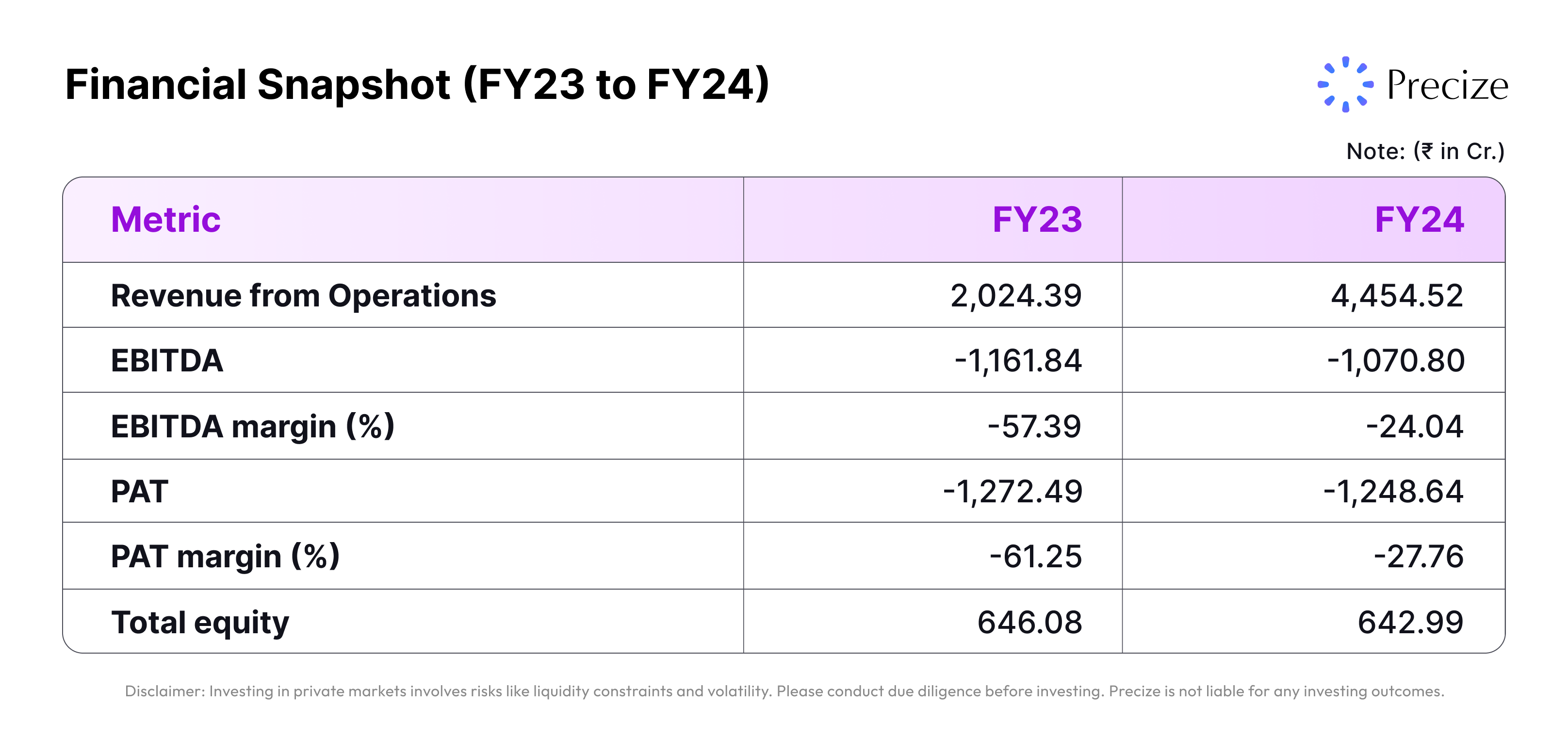
The growth headline is impressive. Revenue from operations rose by roughly 120% year-on-year from FY23 to FY24.
The loss number matters just as much. A loss-making company can still be attractive if the IPO price reflects risk and if unit economics are moving in the right direction. But if losses widen without visible margin progress, listed-market investors may become less patient after listing.
Key Corporate Actions to Track
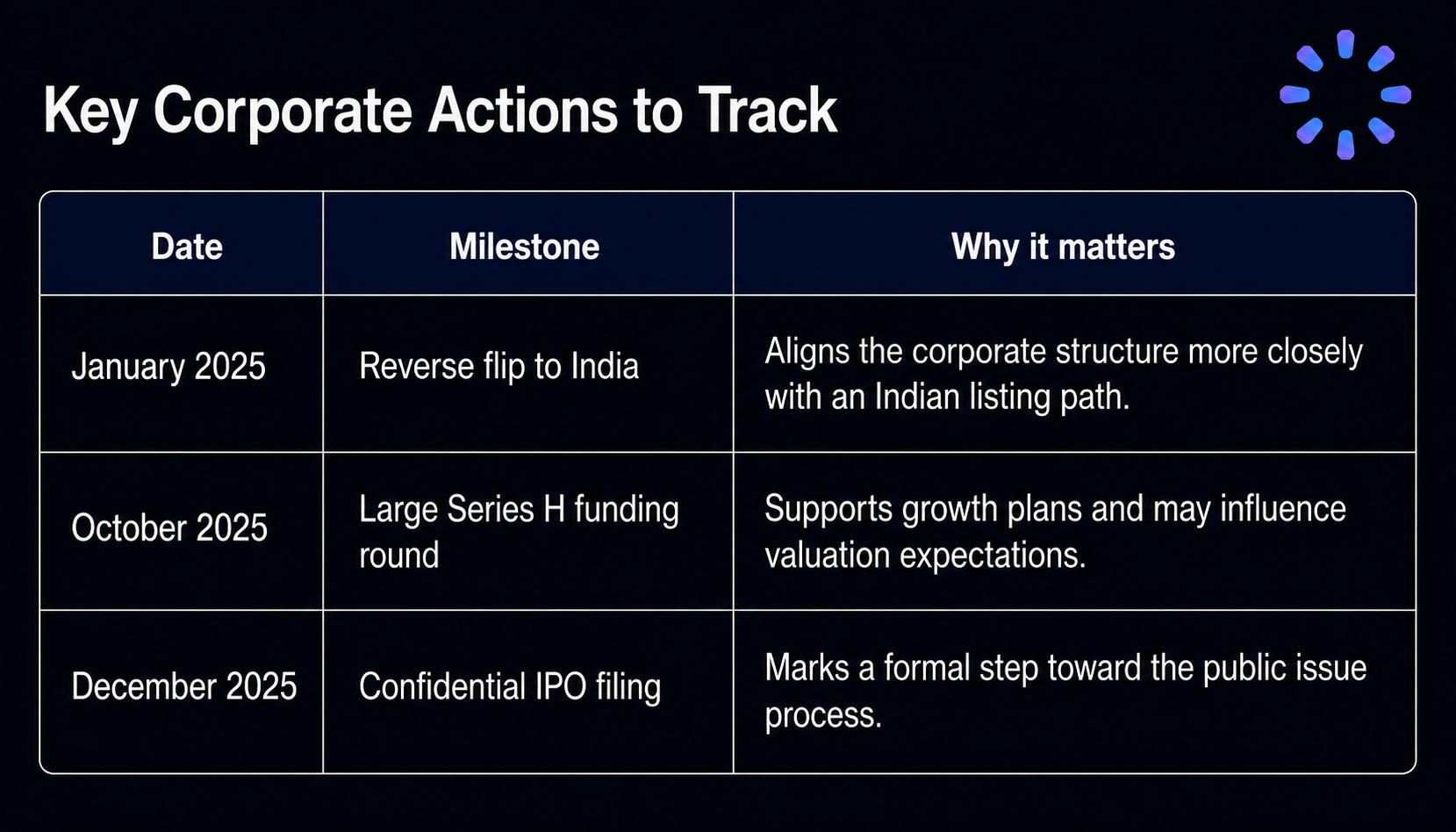
Before the IPO opens, investors should check how these actions are described in the DRHP. The filing should explain shareholding, related-party transactions, capital structure, use of proceeds, and any restructuring relevant to public shareholders.
What to Watch as the Zepto IPO Approaches
1. Revenue Growth Versus Margin Improvement
Zepto has already shown scale. The harder task is improving margins while still growing in a competitive category.
Investors should watch whether losses reduce as a percentage of revenue, whether contribution margin improves, and whether mature city clusters perform better than newer ones.
2. Fulfilment Cost Discipline
Delivery and handling costs are central to quick commerce. A 10-minute promise is valuable only if the company can execute it without permanently subsidising every order.
Look for disclosures on delivery cost per order, dark-store utilisation, order batching, lease costs, and the mix between owned and partner-led operations.
3. Non-Grocery and Advertising as Margin Levers
Non-grocery categories and in-app advertising can improve unit economics. Brands may pay for visibility, and higher-value categories may lift order value.
The risk is that expanding too far beyond daily essentials can complicate inventory planning. The DRHP should help investors see whether the category mix supports margins or simply adds operational complexity.
4. Competition From Blinkit, Swiggy Instamart, and Others
Zepto operates in a crowded market. Blinkit, Swiggy Instamart, Flipkart Minutes, and other fast delivery options can influence pricing, discounts, customer acquisition costs, and delivery expectations.
Low switching costs make this category tough. Customers can move between apps quickly if one platform has better prices, faster delivery, or a wider product range.
5. Regulation and Worker-Related Costs
Quick commerce depends on dark stores, delivery partners, and local operating permissions. Changes in labour rules, zoning norms, safety requirements, or compliance costs can affect margins.
This is why the risk factors section of the DRHP matters. Investors should read it carefully rather than relying only on headline growth numbers.
How to Read the Zepto DRHP Before Investing
When the public DRHP or final prospectus is available, do not stop at the summary pages. Focus on the sections that explain the business quality.
Read these areas first:
Risk factors: Look for risks linked to competition, losses, regulation, delivery partners, leases, and customer retention.
Use of proceeds: Check how much money goes into the company versus selling shareholders through an offer for sale.
Financial statements: Compare revenue, losses, cash burn, working capital, and finance costs across years.
Revenue recognition: Understand how product sales, platform income, logistics, and advertising revenue are recorded.
Related-party transactions: Check whether any group entities, founders, or investors have material transactions with the company.
Shareholding and dilution: Review promoter stakes, investor exits, ESOPs, and post-issue ownership.
Peer comparison: Compare Zepto's growth and margins with relevant listed or IPO-stage consumer internet companies.
If you are new to private-market investing, the common investor questions page explains unlisted shares, demat transfers, and investor process.
Can You Buy Zepto Unlisted Shares Before the IPO?
Availability of Zepto unlisted shares can change based on supply, seller interest, company restrictions, and platform-level checks. If shares are available on a trusted private market platform, the process is usually digital.
Here is the general flow:
Create your account: Sign up on a platform such as Precize and complete email or mobile verification.
Complete your profile: Add PAN, bank account details, and demat account information for compliance and settlement.
Review the opportunity: Study the company, price, available lot size, risks, and transfer timeline.
Place your order: Choose the number of shares or lots, fund the order, and confirm the purchase.
Receive shares in your demat account: After approval and settlement, shares are transferred to your CDSL or NSDL demat account.
Unlisted shares carry liquidity risk. You may not be able to sell quickly, prices can vary by platform and seller, and information may be more limited than listed companies. Always do your own research before investing.
For account, demat, or settlement-related questions, investors can contact Precize Care. Support teams can help with process questions, but they cannot provide personalised investment advice.
Zepto IPO 2026 Outlook
Zepto's IPO story has three parts: a fast-growing market, a company that has scaled quickly, and a profitability question that still needs clear answers.
The bull case is straightforward. Quick commerce is becoming a real urban habit, Zepto is one of the category's best-known brands, and advertising plus non-grocery expansion could improve margins over time.
The bear case is also clear. The model is expensive to run, competition is intense, and growth funded by discounts can look strong until public-market investors ask for proof of operating leverage.
That makes the DRHP central. Investors should not judge the Zepto IPO 2026 only by brand recall or market excitement. They should judge it by the filing: revenue quality, losses, cash burn, unit economics, governance, and valuation.
To track more private-market and IPO updates, browse the Precize blog or explore available opportunities through the Precize investment platform.
Frequently Asked Questions
What is the Zepto IPO 2026?
The Zepto IPO 2026 refers to Zepto's expected public listing process after its confidential DRHP filing with SEBI on 26 December 2025. The final IPO details, including price band and issue size, should be verified from SEBI filings and the final prospectus.
What is a confidential DRHP?
A confidential DRHP is a draft IPO document filed privately with the regulator during an early review stage. It lets the company start the process before all details are published for public investors.
Has Zepto filed its DRHP?
Yes, the original update states that Zepto filed a confidential DRHP with SEBI on 26 December 2025. Investors should still verify the latest public DRHP or final prospectus on SEBI before making decisions.
What is the Zepto IPO date?
The Zepto IPO date was not announced in the original update. The date will become clearer only after the public filing, price band, bidding dates, and listing timeline are formally released.
What is the Zepto IPO price band?
The Zepto IPO price band was not announced in the original update. Investors should wait for the official price band and compare it with Zepto's growth, losses, peer valuations, and risk factors.
What were Zepto's FY24 financials?
The original article cited FY24 revenue from operations of ₹4,454.52 crore and FY24 profit after tax of ₹(1,248.64) crore. Investors should verify these figures against the public DRHP or final prospectus before using them for decisions.
Why is Zepto important in quick commerce?
Zepto is important because it is one of India's most visible quick commerce companies and helped popularise the 10-minute delivery model. Its IPO could become a benchmark for how public markets value quick commerce economics.
What should investors check before applying for the Zepto IPO?
Investors should check the DRHP, risk factors, revenue growth, losses, cash burn, fulfilment costs, valuation, use of proceeds, and competitive position. They should also consider their own risk tolerance and liquidity needs.
Is this a recommendation to invest in Zepto?
No. This article is informational and does not recommend buying, selling, or applying for Zepto shares. Investors should consult a qualified financial advisor before making any investment decision.
Disclaimer: This article is for informational purposes only and should not be considered investment advice. Investing in unlisted shares or IPOs carries risks including illiquidity, volatility, and potential loss of capital. Please consult with a qualified financial advisor before making investment decisions. Precize is not a stock exchange and is not authorized by any capital markets regulator.