Deemed Prospectus: Meaning, Importance and Examples

Understand deemed prospectus and its legal role in share offerings. Ensure transparency and investor protection with intermediary accountability. Click for details!
10 min read
deemed prospectus

When a company issues shares or declares its capital, not every document it releases is what it seems at first glance. Some carry legal importance even without being officially called a prospectus; this is where a deemed prospectus comes in. Understanding it helps you navigate corporate rules with clarity and avoid common mistakes. 

In this blog, you’ll get a clear view of what a deemed prospectus is, its key features, and how it differs from a regular prospectus. We’ll go through practical examples, explain why it matters, point out common pitfalls, and outline the legal conditions and consequences linked to it.

Keep exploring!

Key Takeaways

  • A deemed prospectus is treated by law as a regular prospectus, even if issued indirectly through intermediaries.

  • It ensures full disclosure of the company’s financials, risks, and share details, protecting stakeholders.

  • Key examples include Offer for Sale (OFS) documents, Qualified Institutional Placements (QIP), shelf prospectuses, and secondary share offerings.

  • Legal accountability applies to companies, intermediaries, directors, and promoters, with civil and criminal consequences for misstatements.

What is a Prospectus?

A prospectus is an official document that you can refer to when you want to understand a company’s securities in detail. It provides all the essential information about the company, including its financial position, business operations, objectives, capital structure, directors, and potential risks. 

By going through a prospectus, you can get a clear picture of the company and make sense of its offerings. In India, this document ensures transparency and helps you understand the key aspects of a company before engaging with its shares.

With the basics of a prospectus clear, let’s move on to the deemed prospectus, which carries similar legal weight even when issued differently.

What is a Deemed Prospectus?

A deemed prospectus is a document that, by law, is treated as a prospectus even if it is not formally issued as one. This usually happens when a company offers shares or securities to the public without officially publishing a prospectus, but the law considers the offer equivalent to a formal prospectus. 

  • In India, the concept ensures that companies cannot bypass disclosure requirements, providing the same level of transparency and legal accountability as a regular prospectus. 

  • A deemed prospectus protects stakeholders by making companies answerable for the information shared during the issuance of shares, even if no formal prospectus is circulated.

Having covered what a deemed prospectus is, let’s now focus on the features that make it unique and legally accountable.

Key Features of a Deemed Prospectus

When you look at a deemed prospectus, it’s important to understand the main features that make it different from other company documents and how it protects transparency and accountability.

  1. Legal Equivalence to a Prospectus

You should know that a deemed prospectus is considered the same as a regular prospectus under the law, which means it must meet similar disclosure and compliance requirements.

  1. Issued Through an Intermediary

This happens when a company doesn’t issue shares directly but does so through intermediaries like brokers or merchant bankers, who then make the shares available to the public.

  1. Full Disclosure Requirement

The document must clearly present all essential information about the company, including its financial status, business plans, risks, and details of the shares being offered, ensuring transparency.

  1. Liability on the Company and Intermediary

Both the company and the intermediary are responsible for any false statements or missing information in the deemed prospectus, so accountability is maintained.

  1. Protects the Public and Ensures Transparency

Even if the shares are offered indirectly, a deemed prospectus makes sure the public receives accurate and complete information, preventing companies from skipping disclosure rules.

  1. Applies Within a Specific Time Frame

For a document to qualify as a deemed prospectus, the intermediary must offer the shares to the public within six months of receiving them from the company.

  1. Subject to Regulatory Oversight

All transactions involving a deemed prospectus are monitored by regulators like SEBI, which ensures the rules are followed and transparency is maintained.

  1. Prevents Legal Loopholes

This concept closes gaps that companies might try to exploit by offering shares indirectly instead of issuing a formal prospectus.

  1. Promotes Accountability

By holding both the company and the intermediary responsible, a deemed prospectus encourages honesty and discourages misleading disclosures.

With the key features in mind, let’s explore how a deemed prospectus differs from a regular prospectus and what that means in practice.

Difference Between Regular Prospectus vs Deemed Prospectus

When you compare a regular prospectus with a deemed prospectus, it helps to understand how each works, who issues it, and the level of legal responsibility involved. The table below highlights the key differences:
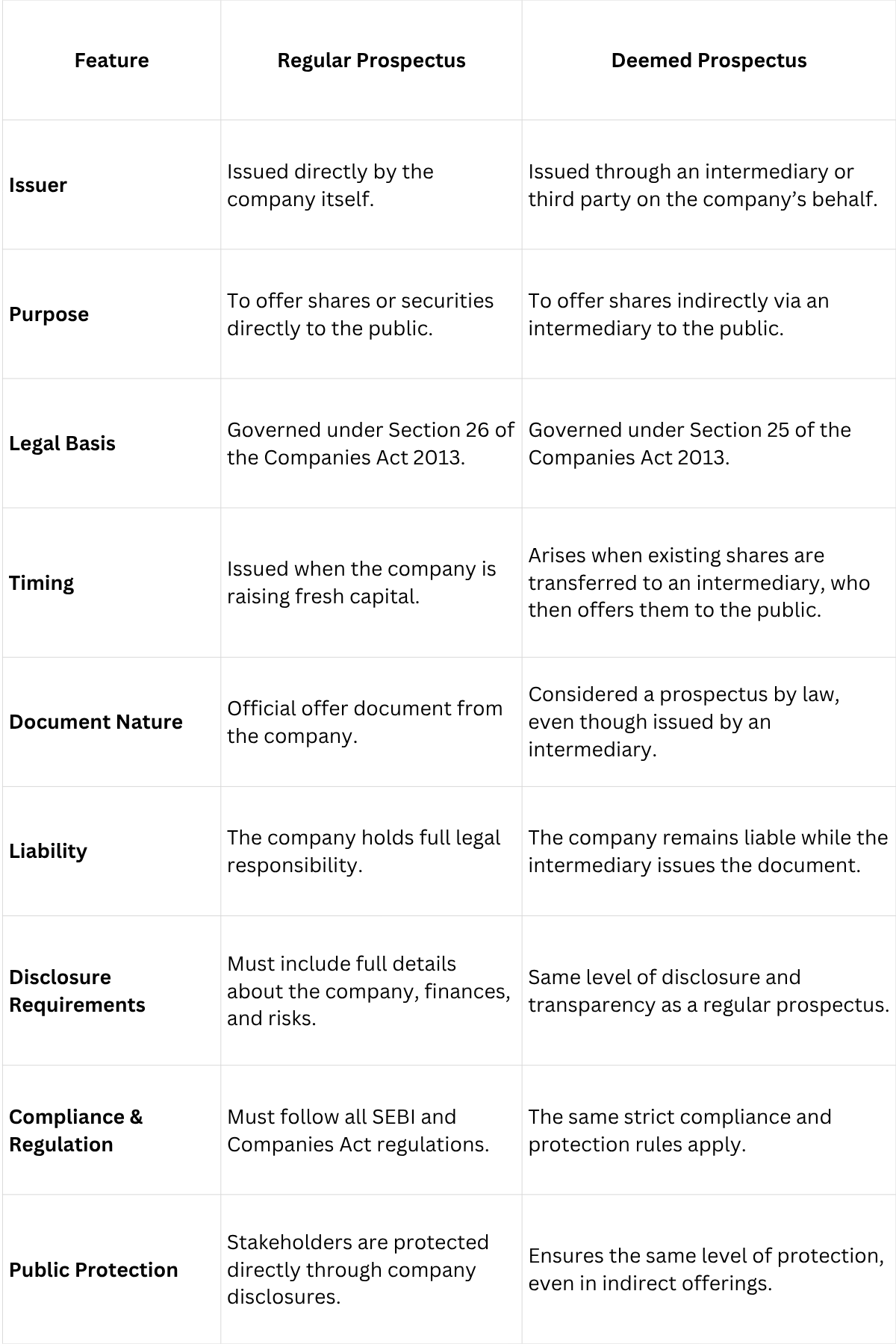
The distinctions are important, but seeing examples will help you understand how a deemed prospectus operates in real situations.

Examples of  Deemed Prospectus

When you look at how deemed prospectuses work in practice, it helps to see real examples of the documents that are treated as such by law.

  1. Offer for Sale (OFS) Document

When a company allocates shares to a broker or merchant bank, which then offers them to the public, the document used is considered a deemed prospectus. Even though it comes from the intermediary, it must include all important disclosures just like a regular prospectus.

  1. Qualified Institutional Placement (QIP) Document

If a company issues shares privately to qualified institutional buyers, the placement document is treated as a deemed prospectus to maintain transparency and proper disclosure.

  1. Shelf Prospectus and Information Memorandum

Sometimes, public sector companies or banks issue securities in multiple tranches using these documents. While not standard prospectuses, they are legally treated as deemed prospectuses.

  1. Secondary Offerings by Existing Shareholders

When existing shareholders sell their shares to the public through an intermediary, the sale document qualifies as a deemed prospectus, ensuring the same level of information and legal accountability.

Examples show how deemed prospectuses are applied in real scenarios, but even small errors in these documents can lead to serious problems, so knowing the pitfalls is essential.


Common Pitfalls of  Deemed Prospectus & How to Avoid Them

When you deal with a deemed prospectus, avoiding common mistakes is essential to maintain accuracy, transparency, and compliance with the law. Here are the main pitfalls to watch out for:

  1. Incomplete or Inaccurate Information

Always ensure that all key facts about the company, its financials, and the offer are accurate and complete. Providing partial or incorrect information can lead to legal issues and reduce trust.

  1. Misrepresentation of Financial Data

Present financial information truthfully using audited statements. Avoid overstating past performance or projecting unrealistic future results, as this can create legal complications.

  1. Unverified Legal Rights and Assets

Make sure that all claims regarding ownership of assets or business rights are verified and backed by proper documentation. This prevents disputes and protects your credibility.

  1. Insufficient Disclosure of Risks

Clearly disclose all significant risks related to the company and the securities. Downplaying or omitting risks can mislead readers and lead to penalties.

  1. Unclear Explanation of Use of Funds

Explain exactly how the proceeds from the offer will be used. Vague or misleading statements can confuse and attract regulatory scrutiny.

  1. Accountability with Intermediaries

When intermediaries are involved, clearly define the roles and responsibilities of all parties. Transparency ensures that liability for incorrect information is understood and properly managed.

Now that you know the frequent errors to watch for, let’s explore the legal responsibilities and potential consequences tied to issuing a deemed prospectus.

Legal Conditions and Consequences of a Deemed Prospectus

When handling a deemed prospectus, you should be aware of the laws and obligations that ensure transparency and accountability.

  1. Definition Under Law

A deemed prospectus is legally treated as a prospectus even if it is not issued directly by the company but through an intermediary offering the company’s securities to the public.

  • It must comply with all disclosure norms under Section 25 of the Companies Act, 2013, just like a regular prospectus.

  1. Disclosure Requirements

You must ensure the document contains all important information about the securities, the company’s financial status, risks involved, and other necessary details. 

  • This ensures transparency and safeguards the public.

  1. Offer to the Public

A deemed prospectus acts as an invitation to the public to apply for or purchase securities. The offer should be open to anyone, though actual allotment depends on the terms of subscription.

  1. Legal Accountability

Everyone involved, the company, intermediaries, directors, promoters, and experts, is responsible for the accuracy and truthfulness of the information in the document. Any misstatement can lead to serious legal consequences.

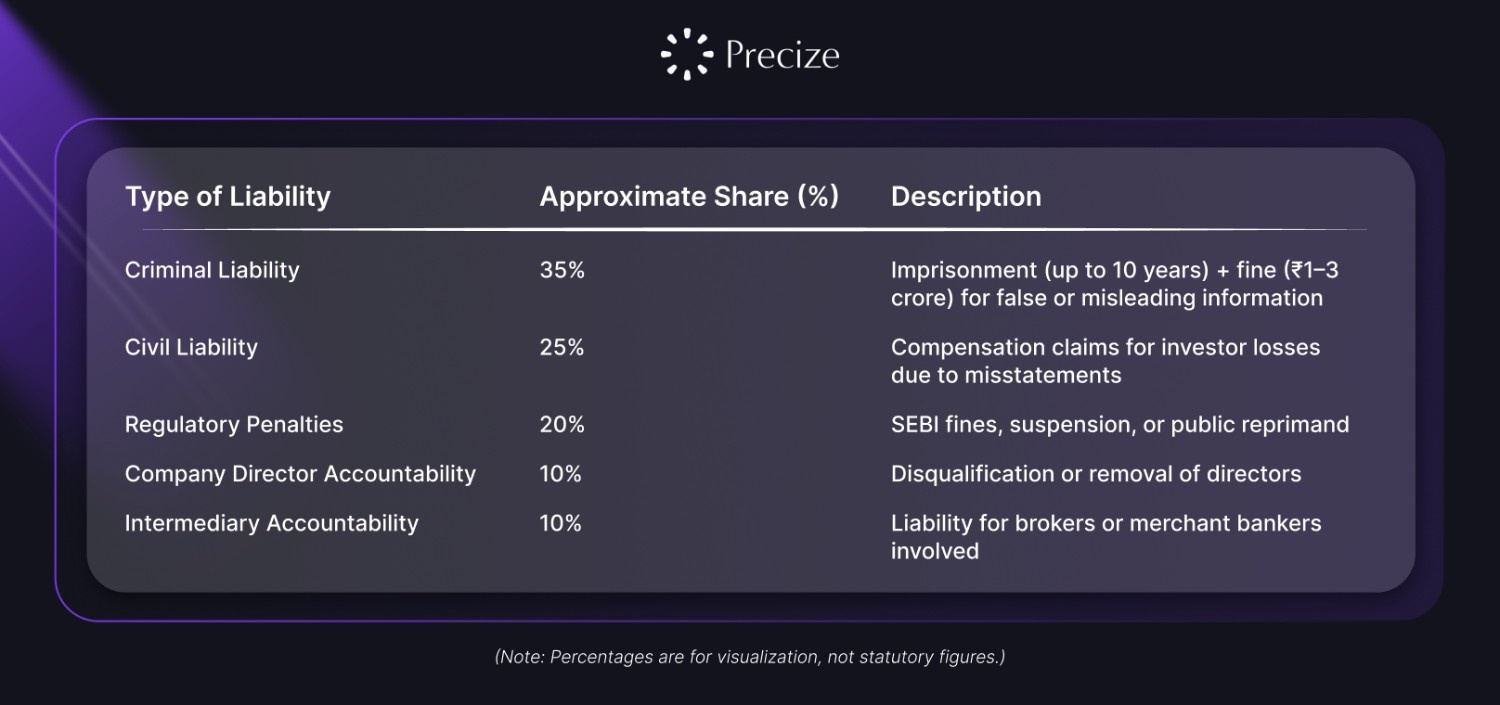
  1. Criminal Liability for Misstatements

If false or misleading information is included, the authorised persons can face criminal prosecution. 

  • Punishments may include imprisonment for up to 10 years and fines ranging from ₹1 lakh to ₹3 crore, depending on the severity and intent.

  1. Civil Liability and Compensation

Those who suffer losses due to false statements in the deemed prospectus can file civil claims for compensation against the company and other responsible parties.

  1. Validity Period

A deemed prospectus is only valid if issued within 90 days of filing or delivering it to the Registrar of Companies. Issuing it after this period makes it invalid and subject to penalties.

  1. Regulatory Oversight

Regulators like SEBI treat a deemed prospectus with the same scrutiny as a formal prospectus to ensure complete disclosure and protection in securities market transactions.

Conclusion

A deemed prospectus is more than just a legal requirement; it ensures that companies provide clear, accurate, and complete information whenever shares are offered, whether directly or through intermediaries. Knowing its key features, examples, and legal responsibilities helps you understand how transparency and accountability are maintained in the process.

Platforms like Precize make this process even more practical by giving you access to leading private companies, opportunities to trade unlisted and pre-IPO shares, and unique global finance opportunities. These features allow you to explore different investment opportunities confidently.

Take the next step towards a diversified portfolio by reserving your access with Precize today!

FAQs

  1. Can a deemed prospectus be issued without SEBI approval?

Yes, a deemed prospectus can be issued without prior SEBI approval, but it still must comply with all disclosure requirements under the Companies Act, 2013. Even if SEBI approval is not required, the company and intermediaries remain legally responsible for the accuracy of information.

  1. How does a deemed prospectus differ from a Red Herring Prospectus?

A Red Herring Prospectus is issued to the public before the final price of securities is determined, while a deemed prospectus is treated as a prospectus by law even if it is issued indirectly through an intermediary. Both ensure transparency, but the context and method of issuance are different.

  1. Who can be held liable for misstatements in a deemed prospectus?

Liability extends to the company, its directors, promoters, intermediaries, and experts involved in preparing or authorizing the document. Any false or misleading statement can lead to civil or criminal consequences under the Companies Act, 2013.

  1. Is a deemed prospectus valid if issued after six months of share allocation to an intermediary?

No, a deemed prospectus must be issued within six months of the shares being allocated to the intermediary. Issuing it after this period may render the document invalid and expose the company and intermediaries to legal penalties.

  1. Can a deemed prospectus be used for secondary share offerings?

Yes, when existing shareholders sell their shares to the public via an intermediary, the offer document qualifies as a deemed prospectus. This ensures that even indirect offerings meet disclosure standards and provide legal protection for stakeholders.

Disclaimer 

The content in this blog is meant to provide a general understanding of deemed prospectuses and related concepts. It is intended for educational purposes only & should not be considered as legal, financial, or professional advice. Every situation can be unique, and laws or regulations may change over time. Readers & encouraged to consult qualified professionals, such as legal advisors or regulatory experts, and refer to official guidelines under the Companies Act, 2013, and SEBI regulations before taking any decisions or actions related to company securities. The blog aims to simplify complex topics and provide clarity, but it cannot replace personalized professional guidance.

Precize
Precize
Content Strategy and Research Analyst

Stay in the Loop

Join our newsletter for exclusive access to thoughtfully curated content and we promise, no spam

The next generation of asset classes in India

Resources

Our Office

Office No. 1219, The Summit Business Park, Andheri Kurla Road, Andheri East, Mumbai, Maharashtra - 400093

Find us on Google

support@precize.in

+91 7738336457

All trademarks and logos or registered trademarks and logos found on this Site or mentioned herein belong to their respective owners and are solely used for informational and educational purposes.

The material presented in this advertisement is for informational purposes only and should not be construed as investment advice or investment availability. It is not a recommendation of, or an offer to sell or solicitation of an offer to buy, any particular unlisted share, security, strategy, or investment product. Investing in the private market and securities involves risks, including the potential loss of money, and past performance does not guarantee future results. Market trends, data interpretations, graph projections are provided for informational and illustrative purposes and may not reflect actual future performance. Nothing on this website should be construed as personalized investment advice or should not be treated as legal, financial, or any other form of advice. Precize is not liable for financial or any other form of loss incurred by the user or any affiliated party based on information provided herein.

Precize is neither a stock exchange nor does it intend to get recognized as a stock exchange under the Securities Contracts Regulation Act, 1956. Precize is not authorized by the capital markets regulator to solicit investments. The securities traded on these platforms are not traded on any regulated exchange.

The website will be updated regularly.

Copyright © 2026 - Precize - All Rights Reserved

Deemed Prospectus: Meaning, Importance and Examples