A demat account is a digital account that stores your shares and securities safely in electronic form. If you invest in stocks, ETFs, bonds, or unlisted shares in India, this account is mandatory.
What Is a Demat Account and Why It Matters
A demat account (short for dematerialized account) is where your securities are stored digitally through either CDSL (Central Depository Services Limited) or NSDL (National Securities Depository Limited), commonly referenced as CDSL and NSDL.
Instead of paper certificates, your holdings are recorded electronically against an ISIN (International Securities Identification Number), which is a unique code for each security.
Why this matters:
You get safer ownership records.
Settlements are faster and more transparent.
Corporate benefits like bonus shares and splits are credited automatically.
Buying and selling becomes operationally simpler.
India's investor base is also growing rapidly. As reported by The Economic Times, demat accounts in India crossed 20 crore in 2025, showing broader retail participation in markets.
Source: Economic Times report on demat account growth
Demat Account vs Trading Account
Many first-time investors search demat vs trading account and still confuse these two accounts. They work together, but they are not the same.
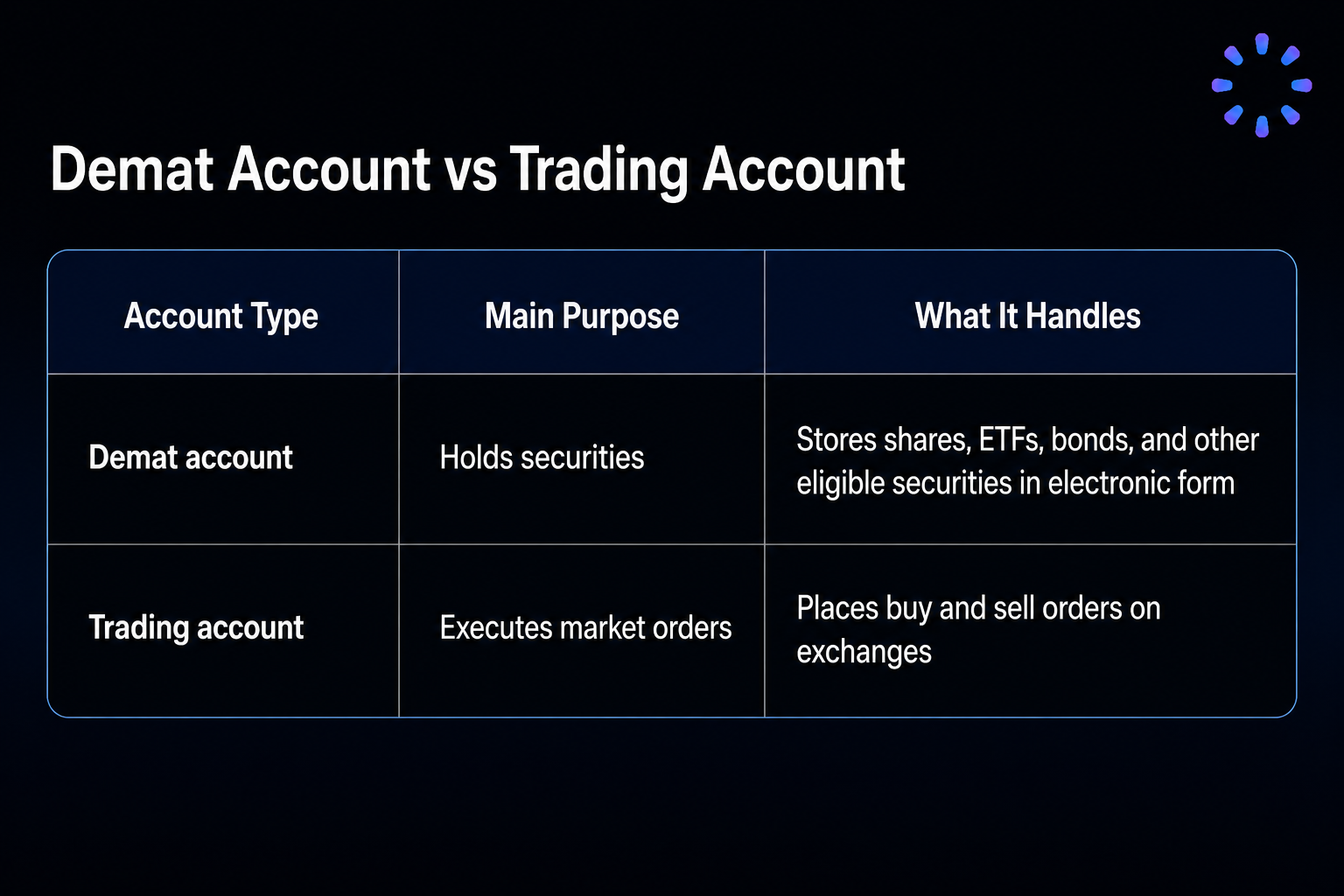
Simple flow:
You place a buy or sell order through your trading account.
On execution and settlement, securities move in or out of your demat account.
Money moves through your linked bank account and broker ledger.
If you are new, read our step-by-step guide: How to buy unlisted shares.
Demat Account Features and Benefits: What Your Account Actually Does
When people search for demat account features and benefits, they usually focus only on "holding shares." In reality, a good demat account offers much more.
1) Electronic Holding Across Instruments
You can hold multiple security types in one place, including equities, ETFs, sovereign gold bonds, listed debt, and certain unlisted shares, subject to eligibility.
This makes your account easier to track and reconcile at tax time.
2) Automatic Corporate Action Processing
If you hold securities on the record date, actions such as bonus shares, splits, and rights entitlements are processed through depository rails.
You do not need manual paperwork in most routine cases.
3) Sell Authorization Controls (eDIS or POA)
When you sell shares, your holdings are debited from demat only after authorization:
eDIS: one-time or session-based approval using TPIN/OTP.
POA: standing authority that allows debit without per-order confirmation.
Most retail investors prefer eDIS for tighter control.
4) Pledge and Re-pledge Facility
You can pledge eligible holdings as collateral for margin or loan purposes instead of selling long-term investments immediately.
This is useful when you need liquidity but do not want to exit quality holdings.
5) Off-market Transfer and Nomination
Demat accounts support off-market transfers (such as family transfers), nominee setup, and transmission processes for legal heirs.
These are practical features many investors need only occasionally, but they are critical when required.
Demat Account Benefits After You Understand the Features
The strongest demat account benefits are operational clarity, security, and flexibility. Together with the features above, they explain why demat account features and benefits matter together: features are what the system can do; benefits are what you gain day to day.
Better Safety and Ownership Clarity
Digital records reduce risks linked to physical certificates, such as loss, damage, or forged transfer paperwork.
Faster Settlement Experience
India has moved to a faster settlement cycle in cash equities. This improves cash and holdings visibility for active investors.
Reference: SEBI circulars and market regulations
Easier Portfolio Tracking
Your consolidated statement helps you track holdings, debits, credits, and corporate actions systematically.
Cleaner Tax and Audit Trail
Contract notes plus depository statements make return filing and gain calculation easier than fragmented manual records.
Useful for Long-term and Tactical Investors
Whether you are building long-term wealth or managing tactical positions, demat infrastructure supports both through holding, pledging, and transfer features.
Types of Demat Accounts: Regular vs BSDA
Most investors open a regular demat account through a broker or bank DP. If your holdings stay below depository-defined thresholds and you meet eligibility rules, you may qualify for a Basic Services Demat Account (BSDA) with lower or waived annual maintenance in many cases.
BSDA is meant for small holders who want essential services without paying full AMC every year. Limits and eligibility rules can change, so treat the tariff sheet as the source of truth when you open or renew.
Why this matters for demat account features and benefits:
If you qualify for BSDA, your total cost of ownership drops, which improves net returns on small portfolios.
If you grow holdings beyond BSDA limits, your DP may migrate you to regular pricing automatically.
Ask your DP clearly: "Am I eligible for BSDA today, and what triggers an upgrade to regular demat charges?"
Consolidated Account Statement, DP ID, and Client ID
Your demat relationship has identifiers you will see on forms, IPO applications, and transfer requests:
DP ID + Client ID: Together these identify your account at the depository. Formats differ slightly between CDSL and NSDL, but the purpose is the same: precise routing of securities and messages.
Beneficiary Owner ID (BO ID): Often used interchangeably in everyday language with your demat account number at the depository level.
You should also know the Consolidated Account Statement (CAS). CAS helps you view demat holdings across DP relationships in one place for a reporting period, which supports reconciliation when you use multiple accounts or switch brokers.
Practical habit: once a quarter, export CAS and match it with your broker ledger and bank payout entries. Small mismatches are easier to fix early.
Demat Account Charges: What You Actually Pay
Many investors underestimate costs because charges are split across line items. Always review the tariff sheet before opening.
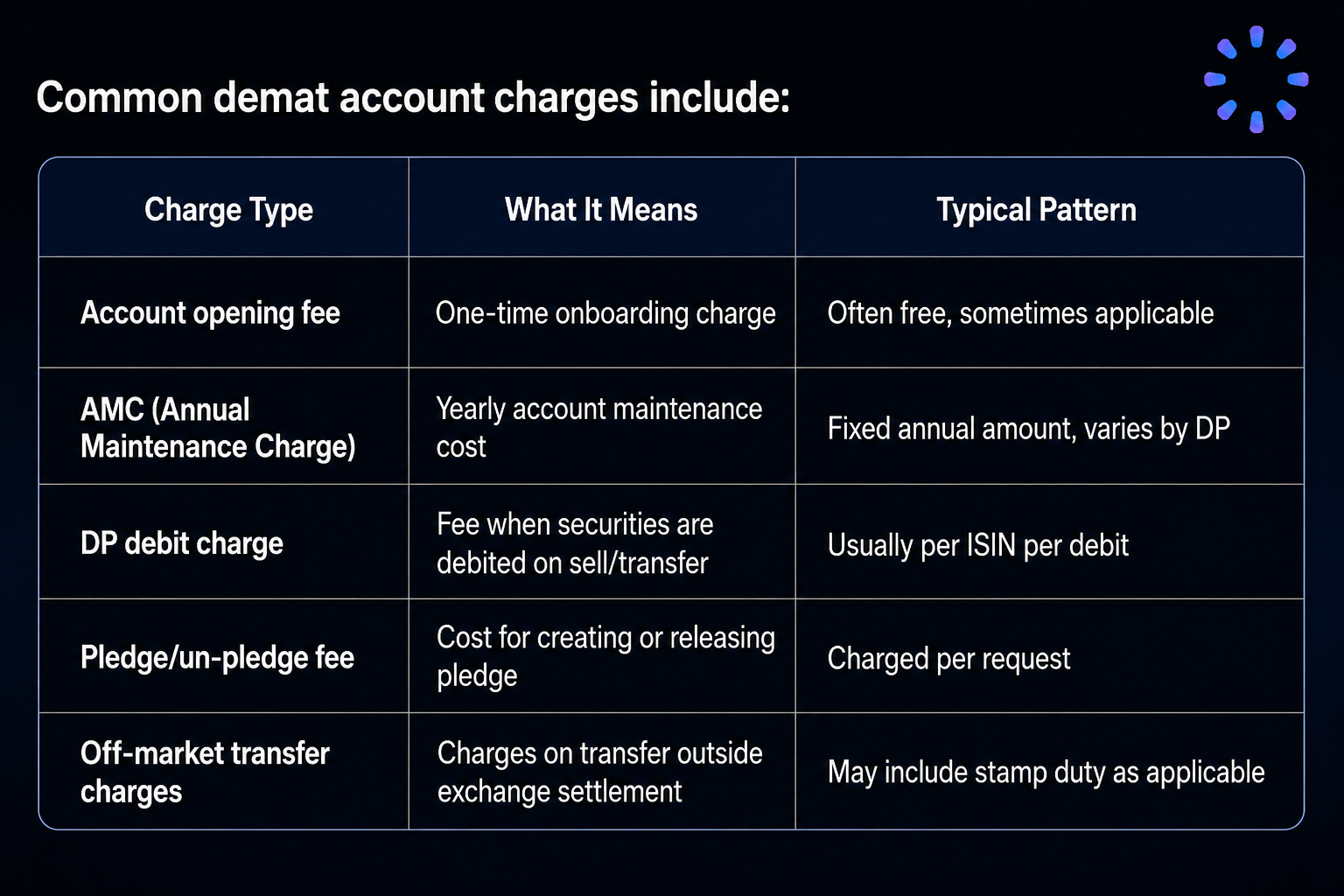
Practical tip: A small fixed debit charge can look tiny, but for low-ticket exits it may materially increase effective cost percentage.
How to Open a Demat Account in India (Step-by-Step)
If you are searching how to open a demat account in India, this is the practical sequence.
Choose your DP carefully. Compare platform quality, service response, and total cost structure.
Complete KYC. Keep PAN, Aadhaar, bank proof, and photo ready.
Link accounts. Connect your bank and trading account.
Add nominee details. Do this at the beginning rather than later.
Set transaction controls. Activate eDIS/TPIN and security alerts.
Verify statements monthly. Reconcile CAS and broker back-office data.
You can also review common account setup questions here: Precize FAQs.
Safety Checklist for Demat Account Holders
Even a well-set account needs discipline. Use this checklist:
Never share TPIN, OTP, or account credentials.
Keep SMS and email debit alerts enabled.
Check depository statements every month.
Freeze inactive holdings or accounts when not in use.
Update email, mobile number, and nominee details promptly.
Keep signed and digital records of major transfers.
For official investor education and safety references, use depository websites:
Using a Demat Account for Unlisted and Pre-IPO Investing
A demat account is also relevant for investors exploring private market opportunities before listing, where eligible securities can be credited in demat after required processes are completed.
If you are evaluating this segment:
Start with research quality, not hype.
Understand liquidity and holding-period risk.
Track allotment, ISIN updates, and action history clearly.
Keep records for tax and compliance from day one.
To evaluate opportunities, use the Precize Screener. If you need support on process or documentation, reach out to Precize Care. You can also browse more market explainers on the Precize blog.
Common Mistakes to Avoid
Investors often make avoidable errors after account opening:
Choosing only on "zero brokerage" and ignoring full demat account charges (AMC, debit fees, pledge fees, and transfer charges).
Not checking statements and alerts regularly.
Skipping nominee setup.
Using blanket authorizations without understanding risk.
Ignoring pledge and transfer fee structures.
Delaying issue reporting during corporate action mismatches.
A demat account is simple to use, but only if your controls and review habits are strong.
Conclusion
The most important thing to remember is this: a demat account is not just a compliance requirement. It is your core ownership and control layer for investing in securities in India.
When you understand the real demat account features and benefits, you can reduce operational risk, control costs better, and manage investments with more confidence.
If you are ready to go beyond basics and evaluate private market opportunities with structured research, explore companies on Precize.
Sources
Disclaimer: This content is for informational purposes only and does not constitute investment advice. Investing in unlisted shares involves risks including illiquidity and potential loss of capital. Consult a qualified financial advisor before making investment decisions. Precize is not a stock exchange and is not regulated by SEBI.