
Owning a share in a company may sound simple, but the reality is that not all shares are the same, and knowing the difference can change how you understand the market. For anyone in India trying to make sense of the stock market, learning about the different types of shares is a crucial first step.
In this blog, you will learn what shares are, the main types of shares in India, the pros and cons of shares and how to choose the right kind of shares. This will help you see how shares are classified and why these distinctions hold significance.
Let’s explore!
Key Takeaways
Shares represent ownership in a company and give you certain rights, like voting and dividends.
The main types include equity shares, preference shares, DVR shares, bonus shares, and rights shares.
Each type differs in terms of voting power, dividend priority, and level of risk.
Knowing these differences helps you understand how companies raise capital and how shareholders benefit.
What Are Shares?
Shares are a way to own a part of a company. Holding shares makes you a partial owner, with your ownership determined by how many shares you have relative to the company’s total shares. Companies issue shares to raise funds for business operations, expansion, or new projects.
For you, owning a share means having certain rights, such as the right to receive a part of the company’s profits (in the form of dividends) and, in many cases, the right to vote on important company matters.
In India, shares are traded on stock exchanges like the NSE and BSE, making them one of the most common ways companies and individuals are connected in the financial system.
Once the meaning of shares is clear, it becomes easier to explore their main types and see how each one plays a unique role for investors.
Main Types of Shares in India
In India, shares are broadly divided into two main categories: Equity Shares and Preference Shares. Each comes with its own types, features, and advantages or disadvantages. Here is the explanation to help you understand them better.
1. Equity Shares
Equity shares, also called ordinary shares, make you a part-owner of the company. They give you voting rights in company matters and allow you to share in the profits through dividends. These shares are permanent and are commonly traded on stock exchanges in India.
Types of Equity Shares
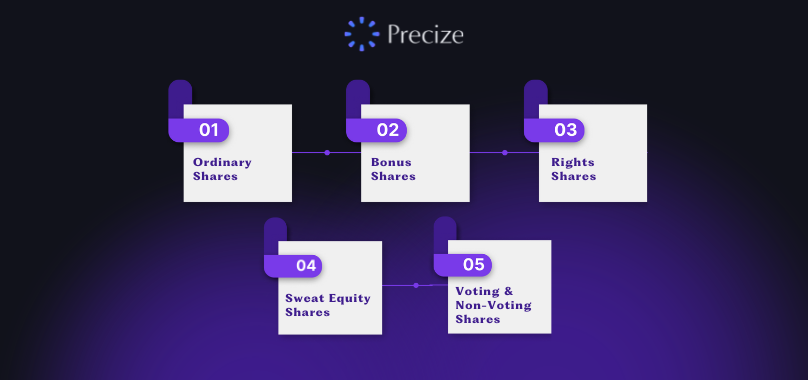
Ordinary Shares
These are the most common forms of equity. You get voting rights and a share in profits through dividends, though the dividend amount depends on how well the company performs.
Pros: Voting rights, ownership, potential for higher returns.
Cons: Dividends are not guaranteed, and you face more risk if the company struggles.
Bonus Shares
Companies may reward existing shareholders with additional shares at no cost, usually from their reserves or profits.
Pros: Free extra shares increase your overall holding.
Cons: Total value may not always increase since the share price often adjusts after a bonus issue.
Rights Shares
Rights shares are offered first to current shareholders at a lower price, giving them the opportunity to buy additional shares before anyone else.
Pros: Chance to buy shares at a lower price and maintain your ownership share.
Cons: Requires extra funds, and if you don’t subscribe, your stake in the company may get diluted.
Sweat Equity Shares
Given to employees or company directors as recognition for their contributions, skills, or innovative work.
Pros: Helps recognize and motivate employees.
Cons: Can dilute the value of existing shares when more are issued.
Voting and Non-Voting Shares
Most equity shares come with voting rights, but some companies issue shares without voting power. These may still carry dividend rights.
Pros: Flexibility for shareholders who prefer returns over decision-making.
Cons: Non-voting shareholders don’t have a say in company matters.
2. Preference Shares
Preference shares are different from equity shares because they usually don’t provide voting rights. Instead, they offer fixed dividends and priority in repayment if the company shuts down. They are less risky than equity shares but also limit growth potential.
Types of Preference Shares
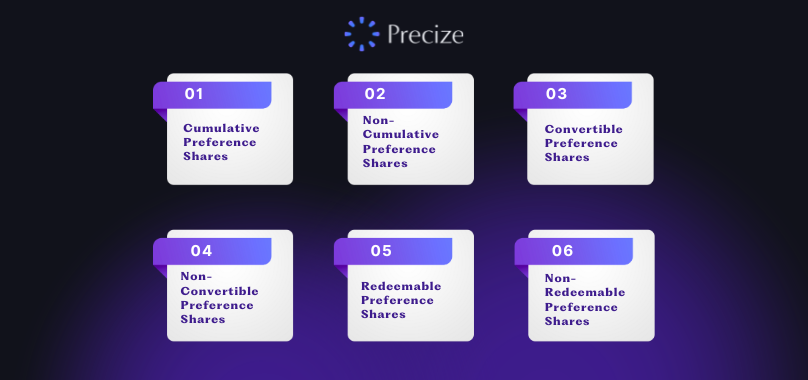
Cumulative Preference Shares
These shares allow any unpaid dividends to accumulate and be paid in future years before equity shareholders receive theirs.
Pros: You are assured of eventually receiving any missed dividends.
Cons: Payments may be delayed if the company faces financial difficulties.
Non-Cumulative Preference Shares
With these shares, if a dividend is skipped in a particular year, it is not carried forward.
Pros: Dividends still take priority over equity shareholders.
Cons: Any unpaid dividends for that year are lost permanently.
Convertible Preference Shares
These shares can be changed into equity shares after a specific time or when certain conditions are met.
Pros: Offers flexibility to convert into equity and potentially benefit from growth.
Cons: Limited rights until conversion, and conversion terms may not always be advantageous.
Non-Convertible Preference Shares
These shares remain as preference shares throughout their lifetime and cannot be converted into equity.
Pros: Provide fixed dividend payments and priority in payouts.
Cons: No opportunity to gain from potential equity share appreciation.
Redeemable Preference Shares
These are issued with the condition that the company will buy them back after a certain time.
Pros: Clear timeline for repayment and dividend priority.
Cons: Ownership ends once redeemed, and rights are limited.
Non-Redeemable Preference Shares
Non-redeemable preference shares cannot be bought back by the company during its lifetime and remain until the company is wound up.
Pros: Continuous entitlement to dividends.
Cons: Rarely issued today, with no defined exit timeline.
Knowing the kinds of shares helps, but exploring their pros and cons will tell you how they actually impact investors and companies.
Pros and Cons of Shares
When you own shares in a company, you enjoy certain advantages but also face some challenges. Understanding both sides helps you see what comes along with holding different types of shares.
Pros of Shares
Here are some of the main advantages of owning shares:
Ownership in a Company
By holding shares, you become a part-owner of the company. This gives you a stake in its growth and overall success.
Chance for Profit
If the company performs well, the value of your shares can go up. You may benefit by selling them at a higher price.
Dividend Income
Some shares provide dividends, which are payments made out of the company’s profits. These can serve as an additional income.
Voting Rights
Equity shares generally allow you to vote on important matters, such as selecting directors or making key decisions.
Liquidity
Shares listed on stock exchanges like NSE or BSE can be quickly bought or sold, making it easy to turn them into cash when required.
Variety of Options
There are different types of shares to meet different needs. Equity shares may offer growth, preference shares provide fixed dividends, and non-voting shares allow earnings without involvement in management decisions.
Cons of Shares
The following are some common limitations of shares:
Market Risk
Share prices can move up or down due to changes in the market, which directly affect the value of your holding.
Dividends Are Not Certain
Companies are not required to pay dividends every year. If profits are low, dividends can be reduced, delayed, or skipped.
Last Priority in Liquidation
If a company shuts down, equity shareholders are paid only after debts and preference shareholders are settled.
No Fixed Returns on Equity Shares
Unlike deposits or bonds, equity shares do not provide fixed returns. What you earn depends entirely on how the company performs.
Limited Power for Small Shareholders
If you hold only a small number of shares, your voting rights and influence in decisions are very limited.
Restrictions on Preference Shares
Preference shares may give you fixed dividends, but they usually don’t provide voting rights, so you don’t have a say in the company’s decisions.
Every investment option has two sides, and shares are no different. After looking at the pros and cons, it’s time to see how you can make the right choice.
How to Choose the Right Type of Share
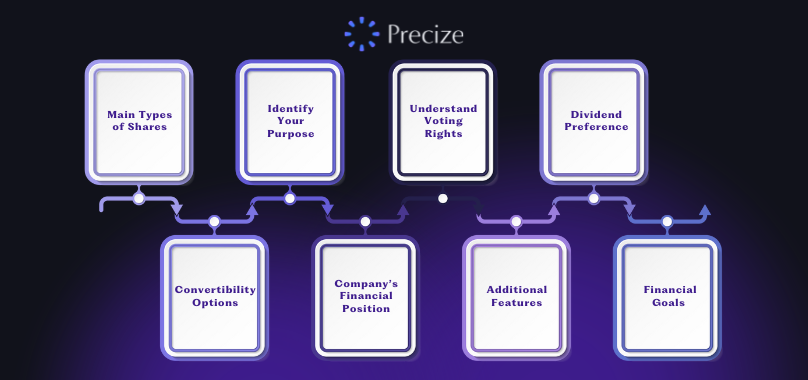
Choosing the right type of share comes down to knowing what each one offers and which matches your purpose. Here are the steps to make the decision easier:
Step 1: Know the Main Types of Shares
Start by understanding the two broad categories: Equity (or Ordinary) Shares and Preference Shares.
Equity shares give ownership and voting rights in the company, while preference shares provide priority in dividend payments but usually don’t carry voting rights.
Step 2: Identify Your Purpose
Think about what you expect from holding shares.
Do you want to participate in company decisions, or would you prefer regular dividends?
Equity shares give voting power, whereas preference shares are focused on steady payouts.
Step 3: Understand Voting Rights
If having a say in company decisions is important, equity shares with voting rights are the option to consider.
Some equity shares may not have voting rights, so it’s worth checking.
Preference shares generally don’t allow voting, except under specific conditions.
Step 4: Look at Dividend Preference
Preference shareholders are paid dividends before equity shareholders. If regular dividend income matters to you, preference shares may suit that need.
Equity shareholders receive dividends only after preference shareholders, and only if the company declares them.
Step 5: Check Convertibility Options
Certain preference shares can be converted into equity shares after a specified period, giving shareholders the option to gain ownership rights later.
This feature is useful if you want the possibility of ownership benefits in the future.
Non-convertible preference shares, on the other hand, remain fixed.
Step 6: Review the Company’s Financial Position
Look at how the company is performing. Preference shares work best when the company maintains steady profits, while equity shares may offer higher returns if the company grows, but with more risk.
Step 7: Explore Additional Features
Companies may issue special categories like bonus shares (extra shares given to existing shareholders), rights shares (offered at a discount to existing shareholders), or shares with differential voting rights.
These features can change the benefits you receive, so it helps to know about them.
Step 8: Match with Your Financial Goals
The final step is to compare the type of share with your own goals and comfort with risk.
Equity shares suit those who want growth and involvement, while preference shares are better for those who prefer a more stable income and less participation in decision-making.
Conclusion
It’s important to understand the different types of shares, as each comes with its own features, benefits, and risks. Whether it's equity shares, preference shares, or shares with different voting rights, each type plays a unique role in how companies raise capital and how shareholders are involved in ownership. Having this clarity helps you see how companies structure their capital and how rights and returns may vary across shareholders.
If you’re interested in looking beyond traditional shares, platforms like Precize make that journey easier. Precize is an alternative investment platform in India that opens access to private equity and private credit opportunities.
With a minimum investment of only ₹10,000, it opens the door for more people to participate, while focusing on security and offering research-based insights to help you make informed decisions.
Reserve your access today to strengthen your portfolio and unlock new growth opportunities.